Short Communication - (2025) Volume 11, Issue 6
Received: 01-Dec-2025, Manuscript No. jssc-26-188336;
Editor assigned: 03-Dec-2025, Pre QC No. P-188336;
Reviewed: 17-Dec-2025, QC No. Q-188336;
Revised: 22-Dec-2025, Manuscript No. R-188336;
Published:
29-Dec-2025
, DOI: 10.37421/2472-0437.2025.11.334
Citation: Abdullah, Ahmad. ”Advances in Steel Bridge Engineering:
Performance and Durability.” J Steel Struct Constr 11 (2025):334.
Copyright: © 2025 Abdullah A. This is an open-access article distributed under the terms of the Creative Commons Attribution License, which permits unrestricted use,
distribution and reproduction in any medium, provided the original author and source are credited.
The structural integrity and long-term performance of bridge infrastructure are paramount for national connectivity and economic prosperity. Steel, with its high strength-to-weight ratio and durability, has long been a preferred material in bridge construction. However, ensuring the safety and resilience of steel bridges requires a deep understanding of their behavior under various challenging conditions. This review synthesizes recent research advancements aimed at optimizing steel bridge design and maintenance.
The performance evaluation of steel structural components in bridges is a critical area of study, with recent investigations focusing on advanced analysis techniques and material behavior under diverse load scenarios. These studies highlight the indispensable role of accurate modeling in predicting and enhancing seismic and fatigue resistance, ultimately contributing to the development of safer and more robust bridge infrastructure through innovative connection designs. [1] Significant attention has been devoted to the seismic behavior of steel bridge piers, with research exploring the efficacy of various bracing systems. Through sophisticated finite element analysis and rigorous experimental validation, optimal configurations for dissipating seismic energy and minimizing plastic deformation are being identified, offering practical guidance for the design of earthquake-resistant steel bridge piers. [2] Fatigue assessment of steel bridge decks subjected to the relentless stress of traffic loading remains a key concern. Researchers are employing probabilistic approaches to forecast fatigue life, meticulously considering the inherent uncertainties in material properties, stress ranges, and loading spectra. This work is paving the way for improved guidelines on inspection and maintenance to guarantee the long-term serviceability of steel bridges. [3] The buckling behavior of slender steel compression members in bridges is another area of active research. Current design codes are being critically evaluated, and proposed modifications aim to more accurately account for second-order effects and residual stresses, thereby enhancing the safety and efficiency of long-span steel bridge designs. [4] In the realm of composite structures, the behavior of steel-concrete composite bridge girders under ultimate limit states is being meticulously examined. Non-linear finite element modeling is instrumental in understanding load-carrying capacity and failure mechanisms, providing crucial insights into the interaction between steel and concrete components for more optimized composite bridge designs. [5] The application of high-strength steel in bridge construction is gaining momentum, promising benefits such as reduced weight and increased span capabilities. Challenges related to weldability and ductility are being addressed through advanced welding techniques and material treatments, encouraging the broader adoption of high-strength steel in modern bridge engineering. [6] Ensuring the long-term durability of steel bridge elements, particularly in corrosive environments, is vital. Research is evaluating the performance of various protective coating systems and cathodic protection strategies, offering recommendations for material selection and maintenance practices to extend the service life of steel bridges under aggressive conditions. [7] Dynamic loads, including wind and traffic vibrations, significantly impact steel truss bridges. Advanced numerical simulation techniques are being employed to analyze the response of truss members and connections, fostering a better understanding of dynamic amplification effects and informing designs for more stable and comfortable truss bridges. [8] Innovative connection types for steel bridges, encompassing both bolted and welded designs with enhanced detailing, are being explored. Investigations into their structural performance, constructability, and cost-effectiveness aim to promote the use of efficient and reliable connection details in contemporary steel bridge projects. [9] Finally, the influence of material degradation due to environmental exposure on the structural reliability of steel bridges is being assessed. Probabilistic models are being developed to quantify the impact of corrosion and other degradation mechanisms on load-carrying capacity and service life, underscoring the necessity for robust monitoring and maintenance strategies. [10]The performance evaluation of steel structural components within bridges is a dynamic field, with contemporary research deeply invested in advanced analysis techniques and a nuanced understanding of material behavior under an array of load conditions. A significant emphasis is placed on the critical importance of precise modeling for ensuring robust seismic and fatigue resistance. This line of inquiry underscores the transformative potential of innovative connection designs in bolstering overall structural integrity and extending the durability of bridge infrastructure, thereby contributing to enhanced safety and resilience. [1]
Studies focusing on the seismic behavior of steel bridge piers are systematically examining the effectiveness of diverse bracing systems. These investigations leverage the power of finite element analysis, complemented by thorough experimental validation, to pinpoint optimal configurations. The primary goal is to maximize the dissipation of seismic energy and minimize plastic deformation, ultimately providing valuable practical guidance for the design of steel bridge piers capable of withstanding seismic events. [2] A substantial body of work is dedicated to the fatigue assessment of steel bridge decks, a crucial aspect given the constant stress from traffic loading. The research prominently features probabilistic approaches designed to forecast fatigue life, meticulously accounting for the inherent variabilities in material properties, the magnitude of stress ranges, and the characteristics of loading spectra. This rigorous analysis informs the development of enhanced guidelines for inspection and maintenance protocols aimed at preserving the long-term serviceability of steel bridges. [3] The complex phenomenon of buckling in slender steel compression members used in bridges is under intense scrutiny. Current design codes are being subjected to critical review, with researchers proposing modifications intended to more accurately integrate the effects of second-order actions and residual stresses. Such advancements are vital for improving both the safety margins and the design efficiency of long-span steel bridges. [4] Research into the behavior of steel-concrete composite bridge girders under ultimate limit states is a key area of investigation. Through the application of non-linear finite element modeling, the load-carrying capacities and characteristic failure mechanisms are being thoroughly explored. This in-depth analysis yields critical insights into the synergistic interaction between steel and concrete elements, facilitating the creation of more optimized and efficient composite bridge designs. [5] The utilization of high-strength steel in bridge construction is being actively promoted, with a focus on its capacity to reduce structural weight and enable longer span lengths. Ongoing research addresses the inherent challenges associated with weldability and ductility, proposing the development and implementation of advanced welding techniques and sophisticated material treatments. These solutions are poised to overcome existing limitations, thereby encouraging the wider adoption of high-strength steel in contemporary bridge engineering. [6] Ensuring the long-term durability of steel bridge elements, particularly when exposed to corrosive environmental conditions, is a critical concern. Investigations are focused on evaluating the efficacy of various protective coating systems and cathodic protection strategies. The findings from these studies provide essential recommendations for optimal material selection and the implementation of appropriate maintenance practices, all aimed at extending the operational service life of steel bridges in demanding environments. [7] Steel truss bridges are being subjected to rigorous analysis concerning their behavior under dynamic loads, specifically wind forces and traffic-induced vibrations. The application of advanced numerical simulation techniques is instrumental in dissecting the response patterns of truss members and their connections. This research endeavor seeks to deepen the understanding of dynamic amplification effects and furnish design insights that promote greater stability and enhanced user comfort in truss bridge structures. [8] Innovative connection typologies for steel bridge structures are being actively explored, including both advanced bolted and welded connection designs featuring refined detailing. These innovative solutions are subjected to rigorous evaluation of their structural performance, constructability, and overall cost-effectiveness through a combination of analytical methodologies and experimental investigations. The ultimate aim is to foster the adoption of more efficient and reliable connection details in the design of modern steel bridges. [9] Finally, the study assesses the profound influence of material degradation, stemming from environmental exposure, on the overall structural reliability of steel bridges. Probabilistic models are being incorporated to precisely quantify the impact of corrosive processes and other degradation mechanisms on the load-carrying capacity and anticipated service life of critical bridge components. This research strongly emphasizes the indispensable need for proactive and robust monitoring and maintenance strategies to ensure the continued safety and longevity of steel bridges. [10]This collection of research papers addresses critical aspects of steel bridge engineering, focusing on enhancing performance, safety, and durability. Key areas explored include advanced analysis techniques for structural components, seismic behavior of bridge piers, fatigue assessment of bridge decks, and buckling behavior of compression members. The research also covers the performance of steel-concrete composite girders, the application of high-strength steel, and strategies for improving long-term durability in corrosive environments. Furthermore, studies delve into the dynamic analysis of steel truss bridges and the development of innovative connection details. Finally, the impact of material degradation on structural reliability and the importance of robust monitoring systems are investigated, collectively contributing to safer and more resilient steel bridge infrastructure.
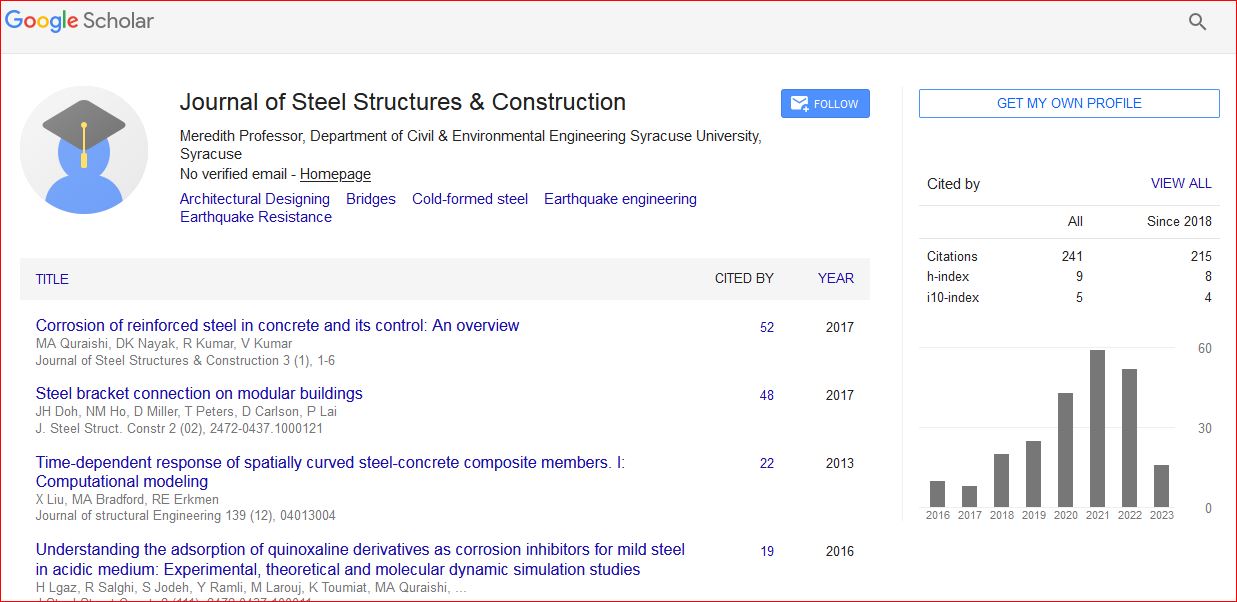
Journal of Steel Structures & Construction received 583 citations as per Google Scholar report