Brief Report - (2025) Volume 9, Issue 2
Received: 01-Apr-2025, Manuscript No. cmcr-25-177670;
Editor assigned: 03-Apr-2025, Pre QC No. P-177670;
Reviewed: 17-Apr-2025, QC No. Q-177670;
Revised: 22-Apr-2025, Manuscript No. R-177670;
Published:
29-Apr-2025
, DOI: 10.37421/2684-4915.2025.9.362
Citation: Strauss, Helena. ”Advances in Patient Care: Outcomes, Equity, Technology.” Clin Med Case Rep 09 (2025):362.
Copyright: © 2025 Strauss H. This is an open-access article distributed under the terms of the Creative Commons Attribution License, which permits unrestricted use, distribution and reproduction in any medium, provided the original author and source are credited.
Understanding clinical outcomes is paramount for advancing patient care and refining treatment strategies across a spectrum of diseases. For cancer patients who also contract COVID-19, a systematic review and meta-analysis dug into their specific clinical outcomes. This research revealed a higher risk of severe COVID-19 and increased mortality within this vulnerable group. This finding clearly highlights the critical need for tailored protective measures and precise treatment strategies to improve their chances [1].
Looking at real-world data, another study focused on heart failure patients with reduced ejection fraction receiving sacubitril/valsartan. It examined both their clinical outcomes and the utilization of healthcare resources. The compelling findings strongly supported the medication's effectiveness in enhancing patient outcomes, particularly when observed outside the highly controlled environment of clinical trials [2].
A multicenter study dedicated itself to shedding light on the clinical outcomes of critically ill patients infected with SARS-CoV-2 during the pandemic. This research provided crucial insights into managing COVID-19 in intensive care settings by highlighting the severe complications and alarmingly high mortality rates associated with the infection in this population [3].
In the specialized field of oncology, a systematic review and meta-analysis investigated clinical outcomes after liver transplantation for hepatocellular carcinoma that extended beyond the established Milan criteria. What this team found was significant: while patient outcomes naturally varied, carefully selected patients could still derive substantial benefit, suggesting a potential and crucial expansion of transplantation eligibility guidelines [4].
The initial stages of the COVID-19 pandemic also saw intense focus on therapeutic options. One systematic review and meta-analysis explored the clinical outcomes associated with remdesivir treatment for severe COVID-19. The cumulative evidence suggested that remdesivir played a vital role, demonstrating its capacity to shorten recovery time and improve the overall clinical status in hospitalized patients, thereby offering a crucial early therapeutic option [5].
The lingering effects of COVID-19 became a major public health concern. A study examining a large group of outpatients meticulously investigated persistent symptoms and overall clinical outcomes post-COVID-19. It revealed that a significant portion of individuals experienced long-term health issues, now widely recognized as Long COVID, underscoring the pressing need for ongoing support systems and a deeper understanding of this prolonged condition [6].
Beyond acute illnesses, chronic disease management is continuously evolving. A review and meta-analysis assessed the impact of digital health interventions on clinical outcomes in patients with Type 2 Diabetes. The evidence convincingly showed that these interventions could effectively improve glycemic control and other key health markers, thereby suggesting a powerful and transformative role for technology in the management of chronic diseases [7].
Addressing health equity is a persistent challenge in medicine. A systematic review and meta-analysis specifically uncovered racial and ethnic disparities in the clinical outcomes of heart failure patients. It starkly highlighted that certain demographic groups face demonstrably worse prognoses, emphatically underscoring the urgent necessity to address systemic inequities in both healthcare access and overall quality [8].
Mental health support has also seen significant innovation. Another systematic review and meta-analysis focused on digital interventions for mental health, demonstrating that these tools can dramatically improve clinical outcomes for individuals suffering from depression and anxiety. This represents a genuine game-changer, expanding access to effective mental health support, especially for those who typically face substantial barriers to traditional care models [9].
Finally, the frontier of personalized medicine is being advanced through pharmacogenomics. A systematic review and meta-analysis explored the clinical outcomes of pharmacogenomics-guided treatment for depression. The findings from this research suggested that carefully tailoring antidepressant therapy based on an individual's unique genetic profile can lead to more effective treatment responses and, ultimately, significantly improved patient outcomes [10].
This extensive body of research collectively contributes to a more nuanced understanding of disease progression, treatment efficacy, and the critical importance of equitable, personalized, and technologically-supported healthcare interventions. These studies provide foundational knowledge for clinicians and policymakers alike, guiding future research and clinical practice to enhance patient well-being worldwide.
The landscape of modern medicine is constantly evolving, with research continually providing deeper insights into disease mechanisms, treatment efficacy, and patient outcomes. Several recent studies collectively highlight significant advancements and persistent challenges across various health domains. For instance, the ongoing battle against COVID-19 revealed critical vulnerabilities and therapeutic pathways. A systematic review and meta-analysis underscored that cancer patients contracting COVID-19 face a higher risk of severe disease and mortality, calling for specialized care strategies [1]. Similarly, a multicenter study on critically ill SARS-CoV-2 patients detailed severe complications and high mortality rates, offering vital lessons for intensive care management during the pandemic [3]. On a more optimistic note, evidence suggested remdesivir could shorten recovery time and improve clinical status in severe COVID-19 cases, providing a crucial therapeutic option [5]. However, the long-term impact was also clear: a large outpatient cohort study identified persistent symptoms, commonly known as Long COVID, highlighting a significant need for ongoing patient support and further understanding of the disease's chronic effects [6].
Beyond infectious diseases, cardiovascular health remains a major area of focus. Real-world data supported the effectiveness of sacubitril/valsartan in improving clinical outcomes for heart failure patients with reduced ejection fraction, affirming its benefits outside of controlled trial environments [2]. This progress, however, is tempered by significant systemic issues. Another systematic review and meta-analysis exposed stark racial and ethnic disparities in heart failure outcomes, where certain groups experience worse prognoses. This finding critically underscores the urgent need to address deep-seated inequities in healthcare access and quality to ensure equitable outcomes for all patients [8].
In the realm of oncology, advancements in surgical interventions are also being explored. A systematic review and meta-analysis focusing on liver transplantation for hepatocellular carcinoma beyond the Milan criteria showed that while outcomes can vary, carefully selected patients could still benefit. This suggests a potential expansion of eligibility for life-saving transplantation procedures, offering hope to a broader group of patients [4].
The integration of technology into healthcare is another transformative theme emerging from this research. Digital health interventions are proving to be remarkably effective in managing chronic conditions. For patients with Type 2 Diabetes, a systematic review and meta-analysis demonstrated that these interventions significantly improve glycemic control and other health markers, suggesting a powerful and accessible tool for chronic disease management [7]. This trend extends to mental health, where digital interventions for depression and anxiety were found to substantially improve clinical outcomes. This represents a significant breakthrough, offering expanded access to effective mental health support, especially for individuals who might otherwise face barriers to traditional care [9].
Finally, the push towards personalized medicine is showing tangible benefits, particularly in mental health. A systematic review and meta-analysis on pharmacogenomics-guided treatment for depression illustrated that tailoring antidepressant therapy based on an individual's unique genetic profile can lead to better treatment responses and improved patient outcomes [10]. This kind of precision medicine holds immense promise for optimizing therapeutic approaches and minimizing trial-and-error in patient care. Taken together, these studies paint a comprehensive picture of current medical research, from addressing global pandemics and chronic diseases to leveraging digital tools and genetic insights for more personalized and equitable healthcare solutions.
This collection of studies highlights diverse clinical outcomes across various medical conditions, emphasizing both challenges and advancements in patient care. Research into COVID-19, for example, revealed heightened risks for cancer patients battling the virus, showing increased severity and mortality, thus underscoring the need for specialized protective and treatment strategies [1]. Critically ill patients with SARS-CoV-2 also faced significant complications and high mortality rates, providing essential data for intensive care management [3]. While remdesivir emerged as a vital therapeutic early in the pandemic, capable of shortening recovery for severe cases [5], the broader impact of COVID-19 was also noted through the prevalence of persistent symptoms, known as Long COVID, in a large outpatient cohort, calling for sustained support [6]. Beyond infectious diseases, advancements in cardiovascular care were examined. A real-world study affirmed the effectiveness of sacubitril/valsartan in enhancing outcomes for heart failure patients with reduced ejection fraction [2]. However, significant racial and ethnic disparities in heart failure outcomes were also identified, indicating an urgent need to address healthcare inequities that lead to worse prognoses in certain populations [8]. In oncology, liver transplantation for hepatocellular carcinoma beyond Milan criteria was found to potentially benefit carefully selected patients, suggesting expanded eligibility for this life-saving procedure [4]. The studies also underscore the growing role of technology in healthcare. Digital health interventions proved effective in improving glycemic control and other health markers for patients with Type 2 Diabetes [7]. Similarly, digital tools showed significant promise in improving clinical outcomes for depression and anxiety, which is a major step towards making mental health support more accessible [9]. Looking ahead, pharmacogenomics-guided treatment for depression demonstrated that tailoring antidepressant therapy to an individual's genetic profile can lead to better treatment responses and improved patient outcomes [10]. Collectively, these findings provide crucial insights for improving patient care, addressing health disparities, and leveraging innovative treatments and technologies.
None
None
Indexed at, Google Scholar, Crossref
Indexed at, Google Scholar, Crossref
Indexed at, Google Scholar, Crossref
Indexed at, Google Scholar, Crossref
Indexed at, Google Scholar, Crossref
Indexed at, Google Scholar, Crossref
Indexed at, Google Scholar, Crossref
Indexed at, Google Scholar, Crossref
Indexed at, Google Scholar, Crossref
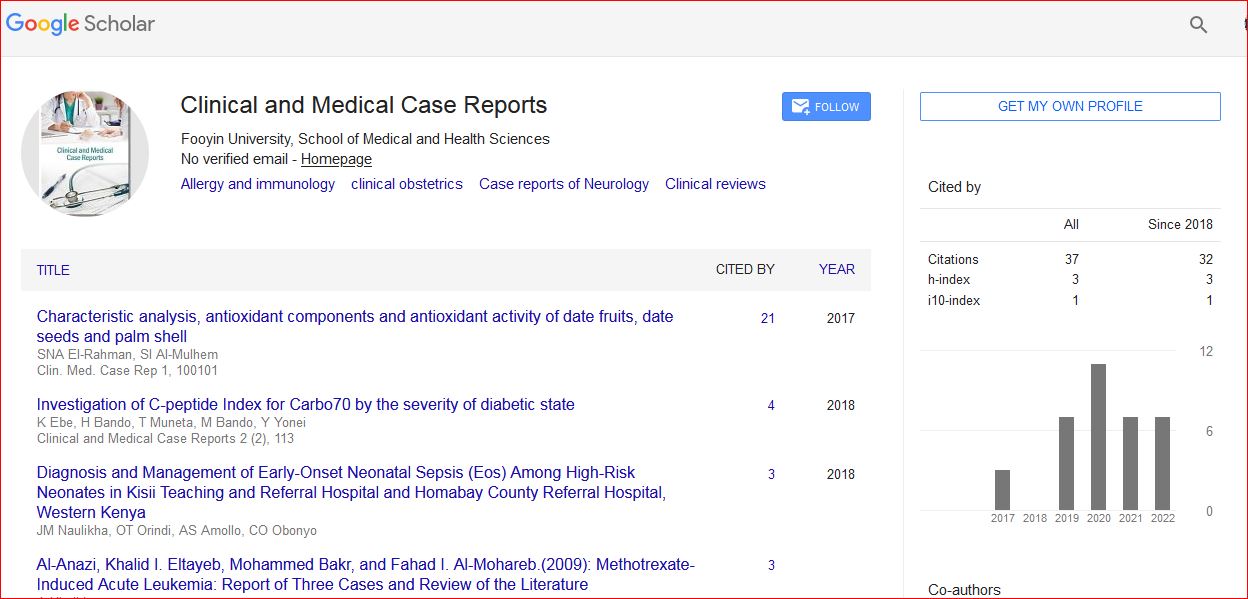
Clinical and Medical Case Reports received 53 citations as per Google Scholar report