Short Communication - (2025) Volume 9, Issue 5
Received: 03-Oct-2025, Manuscript No. jcao-26-187161;
Editor assigned: 06-Oct-2025, Pre QC No. P-187161;
Reviewed: 20-Oct-2025, QC No. Q-187161;
Revised: 24-Oct-2025, Manuscript No. R-187161;
Published:
30-Oct-2025
, DOI: 10.37421/2684-6004.2025.9.316
Citation: Oliveira, Sofia. ”Advances in Airway Management: Guidelines, Devices, and Training.” J Clin Anesthesiol 09 (2025):316.
Copyright: © 2025 Oliveira S. This is an open-access article distributed under the terms of the Creative Commons Attribution License, which permits unrestricted use, distribution and reproduction in any medium, provided the original author and source are credited.
Recent advancements in airway management techniques and devices are significantly impacting patient safety and procedural efficiency in anesthesia. This evolution is crucial for anesthesiologists navigating complex clinical scenarios and striving for optimal patient outcomes. The emphasis on updated guidelines for difficult airway management, incorporating tools like video laryngoscopy and supraglottic airway devices, reflects a proactive approach to patient care [1].
Optimization of ventilation strategies during general anesthesia, especially in the context of laparoscopic surgery, remains a key area of focus. Understanding the physiological effects of positive pressure ventilation and implementing evidence-based recommendations for ventilator parameters are essential for minimizing ventilator-induced lung injury (VILI) and enhancing gas exchange [2].
The efficacy and safety of novel supraglottic airway devices (SGADs) are continuously being investigated in comparison to traditional endotracheal intubation. Data on ease of insertion, seal pressures, and patient comfort provide valuable insights for clinical decision-making, guiding the selection of appropriate devices for routine anesthetic practice [3].
Video laryngoscopy has emerged as a prominent alternative to direct laryngoscopy for routine tracheal intubation. Systematic reviews and meta-analyses synthesizing evidence on intubation success rates, time to intubation, and airway trauma incidence offer a comprehensive understanding of its benefits and limitations [4].
Managing hypopharyngeal obstruction during spontaneous breathing anesthesia necessitates a thorough understanding of various airway adjuncts. Comparative studies assessing the effectiveness of oropharyngeal airways, nasopharyngeal airways, and newer devices inform the selection of the most appropriate adjunct for diverse patient populations and clinical situations [5].
The anticipated difficult airway presents unique challenges in the operating room, demanding systematic approaches and robust contingency plans. Pre-operative assessment, judicious use of airway devices, and emphasis on teamwork and communication are paramount for successful management [6].
In cases of severe respiratory failure refractory to conventional management, extracorporeal membrane oxygenation (ECMO) serves as a critical rescue therapy. Understanding its indications, contraindications, and basic principles is vital for its application in complex anesthetic scenarios where conventional methods prove insufficient [7].
Simulation-based training has demonstrated a significant impact on improving anesthesiologists' skills in managing difficult airways. Performance metrics before and after training highlight improvements in intubation success rates, reduced intervention times, and enhanced decision-making, advocating for its integration into curricula [8].
A fundamental understanding of the physiology of airway management and the impact of anesthetic agents on airway reflexes is foundational. Maintaining airway patency and adequate oxygenation throughout the perioperative period requires a deep appreciation of the neurophysiology governing airway control [9].
Specific patient populations, such as the obese, present unique airway management challenges. Clinical practice guidelines offer evidence-based recommendations for airway assessment, device selection, and positioning to optimize safety and mitigate risks like hypoxemia and difficult intubation [10].
Current research and clinical practice in anesthesia are increasingly focused on refining airway management techniques and devices to enhance patient safety and procedural efficiency. This includes the implementation of updated guidelines for managing difficult airways, the utilization of video laryngoscopy, and the application of various supraglottic airway devices across different clinical contexts. The importance of continuous training and simulation in mastering these advanced techniques is also highlighted [1].
Mechanical ventilation strategies are crucial for optimizing gas exchange and minimizing lung injury during general anesthesia, particularly in surgical procedures like laparoscopy. Anesthesiologists are advised to carefully consider the physiological effects of positive pressure ventilation and adhere to recommendations for setting ventilator parameters. Continuous monitoring of respiratory mechanics is also emphasized to ensure optimal ventilation [2].
The development and evaluation of new generation supraglottic airway devices (SGADs) aim to provide safe and effective alternatives to endotracheal intubation. Studies are assessing their ease of insertion, ability to maintain a seal, and potential for gastric insufflation, contributing to a better understanding of when these devices are most appropriate for routine use in anesthesia practice [3].
Systematic reviews and meta-analyses are instrumental in evaluating the comparative effectiveness of different intubation techniques. The evidence regarding video laryngoscopy versus direct laryngoscopy for routine tracheal intubation provides anesthesiologists with a comprehensive overview of success rates, procedure times, and the incidence of airway trauma associated with each method [4].
Airway adjuncts play a vital role in preventing hypopharyngeal obstruction, especially during spontaneous breathing anesthesia. Research comparing various adjuncts, including oropharyngeal and nasopharyngeal airways, as well as newer devices, helps clinicians select the most suitable option for maintaining airway patency and ensuring patient comfort in different situations [5].
Managing anticipated difficult airways in the operating room requires a structured and systematic approach. This involves thorough pre-operative assessment, strategic selection and use of various airway devices, and the establishment of clear contingency plans for situations where initial intubation attempts are unsuccessful. Effective teamwork and communication are critical components of this process [6].
Extracorporeal membrane oxygenation (ECMO) represents a life-saving rescue therapy for patients experiencing severe respiratory failure that does not respond to conventional airway management and mechanical ventilation. Its application as an adjunct in complex anesthetic cases, when standard interventions are inadequate, is an area of growing interest and research [7].
Simulation-based training is recognized as a highly effective method for enhancing anesthesiologists' proficiency in managing challenging airway scenarios. Studies have quantitatively demonstrated improvements in skills such as intubation success, reduction in time-to-intervention, and enhanced diagnostic and decision-making capabilities, underscoring its value in residency training [8].
The physiological underpinnings of airway management are intrinsically linked to the effects of anesthetic agents on airway reflexes. Maintaining airway patency and ensuring adequate oxygenation throughout the perioperative period necessitate a deep comprehension of the neurophysiological mechanisms that control the airway [9].
Airway management in obese patients poses specific challenges due to anatomical and physiological alterations. Clinical practice guidelines address these complexities by providing evidence-based recommendations for airway assessment, selection of appropriate devices, and optimal patient positioning to ensure safety and prevent adverse events such as hypoxemia and difficult intubation [10].
Recent literature highlights significant advancements in airway management for anesthesiologists. Key areas of focus include updated guidelines for difficult airways, the role of video laryngoscopy and supraglottic airway devices, and mechanical ventilation strategies to optimize patient outcomes and minimize lung injury. Comparative studies evaluate the efficacy of new airway devices and adjuncts, while systematic reviews assess intubation techniques. The management of anticipated difficult airways and specific patient populations like the obese is addressed with practical approaches and clinical guidelines. Simulation-based training is emphasized for skill enhancement, alongside a fundamental understanding of airway physiology and the impact of anesthesia. Extracorporeal membrane oxygenation (ECMO) is presented as a rescue therapy for severe respiratory failure.
None
None
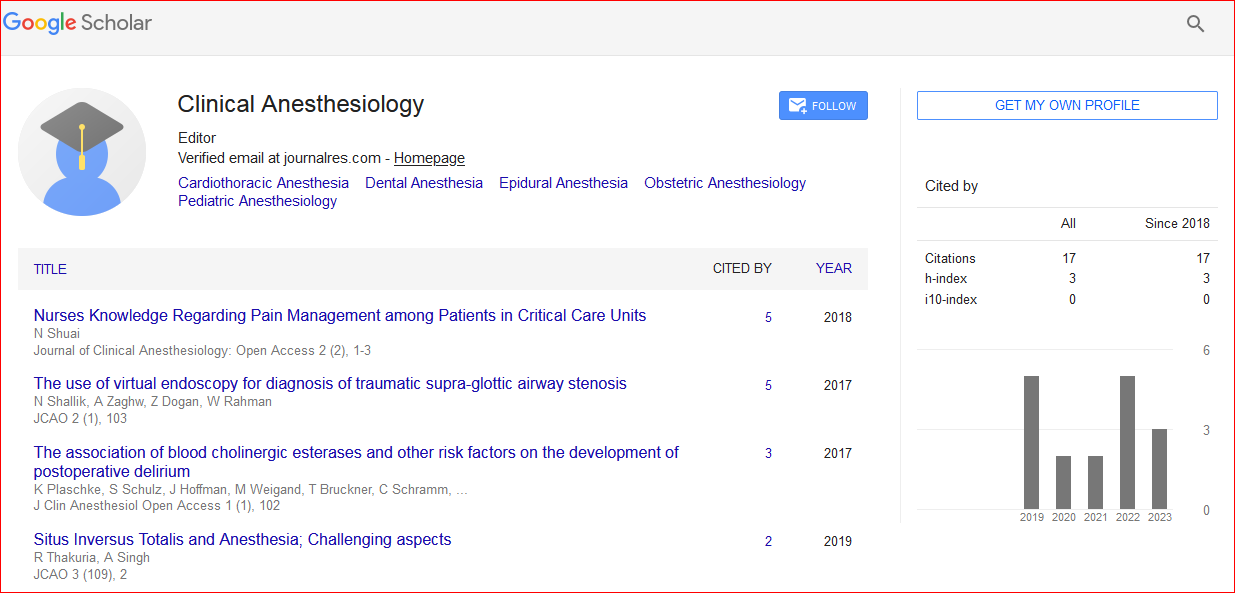
Journal of Clinical Anesthesiology: Open Access received 31 citations as per Google Scholar report