Perspective - (2025) Volume 11, Issue 3
Received: 01-Jun-2025, Manuscript No. jssc-26-188281;
Editor assigned: 03-Jun-2025, Pre QC No. P-188281;
Reviewed: 17-Jun-2025, QC No. Q-188281;
Revised: 23-Jun-2025, Manuscript No. R-188281;
Published:
30-Jun-2025
, DOI: 10.37421/2472-0437.2025.11.303
Citation: Dubois, Sophie. ”Advancements In Steel-Concrete
Composite Structures.” J Steel Struct Constr 11 (2025):303.
Copyright: © 2025 Dubois S. This is an open-access article distributed under the terms of the Creative Commons Attribution License, which permits unrestricted use,
distribution and reproduction in any medium, provided the original author and source are credited.
The field of structural engineering continually seeks to optimize the performance and efficiency of building materials and systems. Composite structures, which leverage the distinct advantages of different materials, have emerged as a cornerstone of modern construction. Among these, steel-concrete composite elements have garnered significant attention due to their synergistic properties. The investigation into the structural performance of composite steel-concrete beams under various loading conditions has revealed substantial advancements. These include enhancements in shear connection design and material utilization, which collectively lead to increased load-carrying capacity and reduced deflection [1].
The behavior of composite columns is another critical area of research. Specifically, the effectiveness of different reinforcement configurations and concrete infill types on their axial and bending capacities is being explored. Findings indicate that optimized detailing of rebar and the use of ultra-high-performance concrete can significantly boost the strength and ductility of these structural elements [2].
Furthermore, the fire performance of composite steel-concrete slabs is a crucial consideration for safety. Studies evaluating the influence of concrete cover thickness, steel reinforcement ratios, and fire protection systems provide key insights into achieving enhanced fire resistance through strategic design modifications, ensuring structural integrity and limiting temperature rise [3].
The durability of composite structures is also a major concern, particularly regarding fatigue behavior. Investigations into the fatigue behavior of composite beams with various shear connector types analyze crack initiation and propagation under cyclic loading, offering insights into the longevity and service life of these structures [4].
For large-scale infrastructure, the behavior of long-span composite bridges is of paramount importance. Research focusing on load distribution, vibration characteristics, and aerodynamic stability examines the benefits of composite materials for achieving lighter and more efficient bridge designs [5].
Connections represent critical nodes within any structural system, and the performance of composite beam-column connections under cyclic loading is actively studied. This research investigates the impact of different connection details on the ductility and energy dissipation capacity, confirming that well-designed composite connections contribute to overall seismic resilience [6].
In specific structural forms like box girders, understanding complex stress distributions is vital. The shear lag effect in steel-concrete composite box girders explores how stress distribution along the flange width affects overall structural behavior, providing refined insights for the design of large-span structures [7].
Innovation in shear connection technology is continuously improving the performance of composite elements. Experimental studies on the performance of composite slabs with novel shear connectors, such as headed studs and channel connectors, assess slip behavior and ultimate load-carrying capacity, leading to optimized connector utilization [8].
The long-term serviceability of composite structures is significantly influenced by time-dependent material behaviors. Analysis of long-term deflection in steel-concrete composite beams, considering creep and shrinkage in concrete and steel relaxation, employs advanced analytical models to predict and control deformations [9].
Finally, the application of advanced materials in composite structures is a driving force for enhanced performance, particularly in seismically active regions. The seismic performance of composite structures utilizing high-strength steel and concrete focuses on improved ductility and energy absorption capabilities, enabling more slender and efficient designs for extreme events [10].
Advancements in the structural performance of composite steel-concrete beams are characterized by improvements in shear connection design and material utilization, leading to enhanced load-carrying capacity and reduced deflection. The use of high-strength steel and concrete in combination further contributes to improved seismic resistance and overall structural efficiency, with practical design considerations and the impact of long-term effects like creep and shrinkage being thoroughly discussed [1].
The research into composite columns focuses on the impact of reinforcement configurations and concrete infill types on their axial and bending capacities. Optimized detailing of rebar and the incorporation of ultra-high-performance concrete have been shown to significantly enhance the strength and ductility of these elements, supported by experimental validation and numerical simulations for combined load scenarios [2].
The fire performance of composite steel-concrete slabs is examined through thermal analysis and structural response simulations under standard fire conditions. Key findings highlight that enhanced fire resistance can be achieved by modifying concrete cover thickness, steel reinforcement ratios, and employing specific fire protection systems, ensuring structural integrity and limiting temperature rise within critical components [3].
Investigating the fatigue behavior of composite beams involves analyzing crack initiation and propagation under cyclic loading with different shear connector types. The study proposes improved design guidelines aimed at mitigating fatigue-related failures, emphasizing the critical role of connector detailing and accurate load spectrum characterization for ensuring long-term structural reliability [4].
In the realm of long-span infrastructure, research on steel-concrete composite bridges concentrates on load distribution, vibration characteristics, and aerodynamic stability. The benefits of using composite materials for creating lighter and more efficient bridge designs are explored through numerical models that predict structural behavior under traffic and wind loads [5].
Composite beam-column connections, essential components in moment-resisting frames, are studied for their performance under cyclic loading. The research analyzes how various connection details influence ductility and energy dissipation, with experimental and finite element analyses confirming that effective connection design contributes significantly to the seismic resilience of the overall structure [6].
The phenomenon of shear lag in steel-concrete composite box girders is explored to understand its effect on stress distribution across the flange width and its implication for overall structural behavior. This research provides a refined understanding of shear lag for the design of box girders used in bridges and large-span roof structures, employing both analytical and numerical methods [7].
Studies on composite slabs with innovative shear connectors, such as headed studs and channel connectors, evaluate their performance under various loading conditions. The research assesses slip behavior at the interface and the ultimate load-carrying capacity, offering a comparative analysis of different connector types to optimize their use for robust composite action and improved structural performance [8].
Long-term deflection in steel-concrete composite beams is analyzed by considering time-dependent phenomena such as concrete creep and shrinkage, along with steel relaxation. Advanced analytical models are presented to accurately predict these effects, validated against experimental data, providing practical guidance for engineers to manage long-term deformations [9].
The application of high-strength steel and concrete in composite structures for seismic regions is investigated for their enhanced ductility and energy absorption capabilities. Detailed finite element analysis demonstrates the potential for creating more slender and efficient structural designs capable of withstanding extreme seismic events, promoting safer and more sustainable construction [10].
This compilation of research highlights advancements in steel-concrete composite structures. Studies cover the enhanced structural performance of composite beams through improved shear connections and materials, leading to greater load capacity and reduced deflection. Research also details the behavior of composite columns, emphasizing optimized reinforcement and high-performance concrete for improved strength and ductility. The fire resistance of composite slabs is investigated, with strategies for enhancing safety. Additionally, the durability of composite beams is addressed through fatigue behavior analysis, and the performance of long-span composite bridges is examined for load distribution and stability. The critical role of composite beam-column connections in seismic resilience is explored, alongside the shear lag effect in composite box girders and the performance of composite slabs with innovative shear connectors. Finally, the long-term deflection of composite beams considering creep and shrinkage is analyzed, and the benefits of high-strength materials for seismic performance in composite structures are demonstrated.
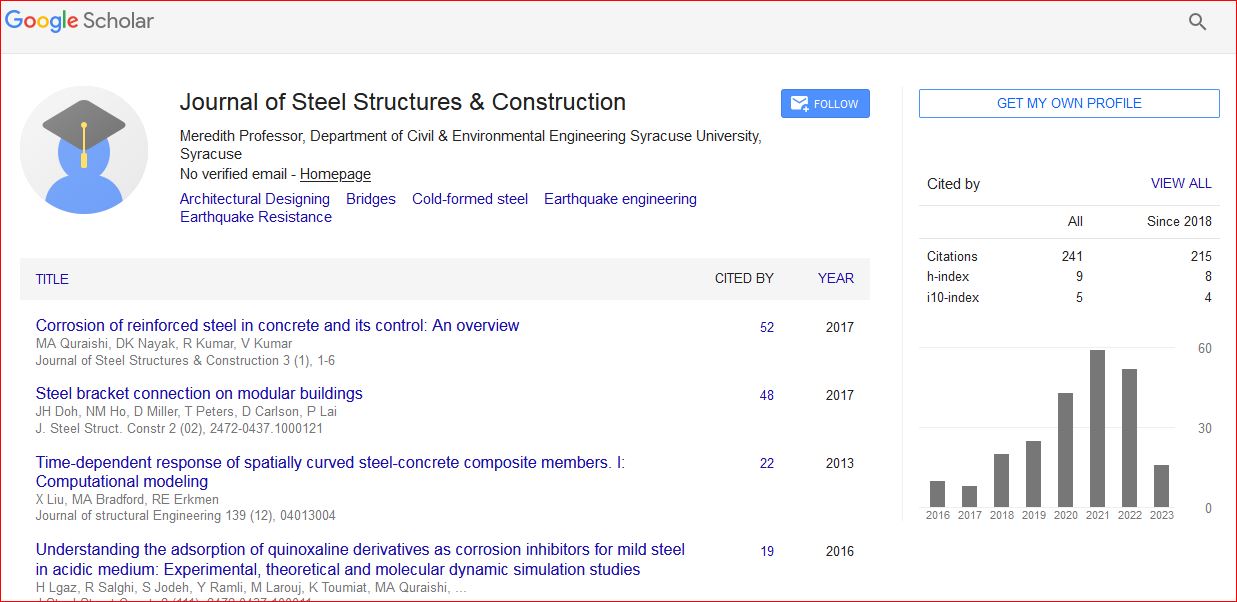
Journal of Steel Structures & Construction received 583 citations as per Google Scholar report