Brief Report - (2025) Volume 13, Issue 1
Received: 03-Feb-2025, Manuscript No. jpgeb-25-157465;
Editor assigned: 05-Feb-2025, Pre QC No. P-157465;
Reviewed: 19-Feb-2025, QC No. Q-157465;
Revised: 24-Feb-2025, Manuscript No. R-157465;
Published:
28-Feb-2025
, DOI: 10.37421/2329-9002.2025.13.352
Citation: Stein, Liora. ”Advancements in Phylogenomics: Methods and Application.” J Phylogenetics Evol Biol 13 (2025):352.
Copyright: © 2025 Stein L. This is an open-access article distributed under the terms of the Creative Commons Attribution License, which permits unrestricted use, distribution
and reproduction in any medium, provided the original author and source are credited.
This research introduces a straightforward empirical Bayes method for branch-site codon models. It's a significant step for detecting positive selection in specific lineages or sites across a phylogeny. The technique helps identify genes evolving under adaptive pressure, offering a more nuanced understanding of molecular evolution than traditional methods [1].
This paper tackles the challenging problem of accurately inferring species trees from genomic data, especially when gene trees conflict due to incomplete lineage sorting. It proposes new strategies for reranking, refining, and iteratively improving phylogenomic species tree estimates, demonstrating enhanced accuracy for large datasets. This is crucial for reconstructing the evolutionary history of closely related species [2].
IQ-TREE 2 introduces significant advancements in phylogenetic inference, offering new substitution models and highly efficient algorithms optimized for large-scale genomic datasets. This software update empowers researchers to perform more accurate and faster phylogenetic analyses, making it an indispensable tool for current phylogenomic studies [3].
This study delves into Bayesian inference of diversification rates, specifically addressing the common issue of incomplete taxon sampling in phylogenies. The methods presented here improve our ability to estimate how quickly new species arise and go extinct, even when our datasets are not perfectly comprehensive, which is critical for understanding macroevolutionary patterns [4].
This research utilizes target enrichment sequencing to resolve complex phylogenetic relationships and biogeographic patterns within the grape family (Vitaceae). The application of these modern phylogenomic techniques provides a high-resolution understanding of plant evolution and dispersal, highlighting the power of genomic data for resolving difficult taxonomic groups [5].
This paper critically examines the potential pitfalls in statistical phylogenomics, particularly how seemingly robust phylogenetic trees can sometimes lead to misleading conclusions. It emphasizes the importance of careful model selection and understanding underlying assumptions to avoid drawing incorrect evolutionary inferences from large genomic datasets [6].
This review offers a comprehensive look at how molecular phylogenetics has shaped our understanding of life's diversification. It discusses foundational concepts and recent advances, showing how phylogenetic trees are indispensable tools for exploring evolutionary processes across all levels of biological organization, from genes to entire ecosystems [7].
The Genome Taxonomy Database (GTDB) provides a standardized, phylogenetically consistent bacterial and archaeal taxonomy, significantly improving the classification of microbial life. This work is foundational for microbial ecology and metagenomics, ensuring that researchers worldwide can reliably identify and compare prokaryotic organisms based on their genomic relatedness [8].
This study explores the extensive molecular diversity and complex evolutionary dynamics of influenza A virus. Using phylogenetic approaches, the authors shed light on how this rapidly evolving pathogen adapts and spreads, which is essential for understanding epidemics and developing effective vaccines and antiviral strategies [9].
This research applies phylogenomic species delimitation to a challenging group of cryptic species, the Sceloporus torquatus lizards. It demonstrates how genomic data can effectively resolve taxonomic ambiguities where traditional morphological methods fall short, providing a robust framework for identifying distinct evolutionary lineages and refining species boundaries [10].
Modern evolutionary biology relies heavily on sophisticated phylogenetic methods to unravel life's intricate history. Recent work introduces a simple empirical Bayes method for branch-site codon models, marking a notable advancement in detecting positive selection within specific lineages or at particular sites across a phylogeny [1]. This technique is vital for pinpointing genes under adaptive pressure, providing a more refined view of molecular evolution than previous approaches. Furthermore, accurately inferring species trees from genomic data presents a persistent challenge, especially when gene trees show conflict due to incomplete lineage sorting. Researchers have developed new strategies involving reranking, refining, and iteratively improving phylogenomic species tree estimates, which have shown enhanced accuracy for large datasets and are critical for reconstructing the evolutionary history of closely related species [2].
Beyond theoretical and algorithmic innovations, software developments significantly enhance practical phylogenomic studies. IQ-TREE 2, for instance, offers new substitution models and highly efficient algorithms specifically optimized for large-scale genomic analyses. This powerful software empowers researchers with faster and more accurate tools for contemporary phylogenetic inference, becoming an indispensable component in the modern genomic era [3].
Understanding macroevolutionary patterns demands robust methods for estimating diversification rates. One critical area addresses the common problem of incomplete taxon sampling in phylogenies when inferring these rates. New Bayesian inference methods aim to improve our ability to estimate how quickly new species emerge and disappear, even when datasets are not entirely comprehensive, which is paramount for discerning broad evolutionary trends [4]. However, the path to accurate evolutionary inferences is not without its obstacles. A critical examination of statistical phylogenomics reveals potential pitfalls, where seemingly sound phylogenetic trees can sometimes lead to misleading conclusions. This highlights the crucial need for careful model selection and a thorough understanding of underlying assumptions to prevent incorrect evolutionary inferences from large genomic datasets [6]. Ultimately, a comprehensive review underscores how molecular phylogenetics fundamentally shapes our understanding of life's diversification, discussing foundational concepts and recent advances, and affirming that phylogenetic trees are indispensable for exploring evolutionary processes across all levels of biological organization [7].
Genomic data are transforming how we delineate species and classify life. Target enrichment sequencing has been successfully employed to resolve complex phylogenetic relationships and biogeographic patterns, as seen within the grape family (Vitaceae). Applying these modern phylogenomic techniques yields a high-resolution understanding of plant evolution and dispersal, demonstrating the power of genomic data in clarifying difficult taxonomic groups [5]. This extends to micro-organisms, where the Genome Taxonomy Database (GTDB) provides a standardized, phylogenetically consistent bacterial and archaeal taxonomy. This work is foundational for microbial ecology and metagenomics, ensuring that researchers can reliably identify and compare prokaryotic organisms based on their genomic relatedness globally [8]. Similarly, phylogenomic species delimitation has been applied to challenging groups of cryptic species, such as the Sceloporus torquatus lizards. This work illustrates how genomic data can effectively resolve taxonomic ambiguities where traditional morphological methods fall short, offering a robust framework for identifying distinct evolutionary lineages and refining species boundaries [10].
Beyond broad taxonomic classifications, phylogenetics offers deep insights into the dynamics of rapidly evolving organisms. For example, extensive molecular diversity and complex evolutionary dynamics are characteristic of the influenza A virus. Phylogenetic approaches in one study illuminate how this quickly evolving pathogen adapts and spreads, which is essential for understanding epidemics and developing effective vaccines and antiviral strategies [9]. Such studies exemplify the power of phylogenetic analysis to inform public health and disease management by tracking evolutionary changes in real-time. The collective insights from these varied research efforts emphasize that whether examining ancient diversification events, resolving modern taxonomic puzzles, or tracking pathogen evolution, advanced phylogenetic and phylogenomic methods remain at the forefront of biological discovery.
This compilation of recent research delves into the evolving landscape of molecular phylogenetics and phylogenomics, showcasing significant methodological advancements and diverse applications. One key area focuses on refining phylogenetic inference, introducing methods like an empirical Bayes approach for branch-site codon models to detect positive selection and new strategies for improving species tree estimates amidst gene tree conflict. The development of advanced software such as IQ-TREE 2 also underscores efforts to enhance the speed and accuracy of large-scale genomic analyses. Beyond methodological innovations, these studies tackle crucial challenges in evolutionary biology, including the Bayesian inference of diversification rates despite incomplete taxon sampling and a critical examination of statistical phylogenomics' pitfalls, advocating for judicious model selection to prevent misleading conclusions. The practical impact of these tools is evident in their application to resolving complex biological questions. Researchers have utilized phylogenomic techniques for high-resolution understanding of plant evolution within the grape family, for robust species delimitation in cryptic animal groups like Sceloporus lizards, and for standardizing microbial classification through the Genome Taxonomy Database (GTDB). The collection also includes a comprehensive review on molecular phylogenetics' role in understanding life's diversification and an exploration into the evolutionary dynamics of influenza A virus, illustrating how these powerful approaches are indispensable for unraveling complex evolutionary histories and informing public health strategies across a broad spectrum of life.
None
None
1. Ziheng Y, P. K, M. X. "A simple empirical Bayes method for branch-site codon models".Mol Biol Evol 37 (2020):3326-3337.
Indexed at, Google Scholar, Crossref
2. Erfan S, Siavash M, Xiyue J. "Reranking, refining, and iterating: Towards accurate phylogenomic species tree inference".Mol Biol Evol 36 (2019):2588-2601.
Indexed at, Google Scholar, Crossref
3. Bui QM, Heiko AS, Oliver C. "IQ-TREE 2: New models and efficient algorithms for phylogenetic inference in the genomic era".Mol Biol Evol 37 (2020):1530-1536.
Indexed at, Google Scholar, Crossref
4. Joëlle B, Marc AS, Sebastian H. "Bayesian inference of diversification rates in phylogenies with incomplete taxon sampling".Syst Biol 69 (2020):755-773.
Indexed at, Google Scholar, Crossref
5. Jun W, Chang-Qin X, Jia-Qi L. "Phylogenetic resolution and biogeography in the grape family (Vitaceae) using target enrichment sequencing".Syst Biol 70 (2021):446-464.
Indexed at, Google Scholar, Crossref
6. John G, Brian CO, Rute RdF. "The pitfalls of statistical phylogenomics: When good trees are bad".Mol Phylogenet Evol 143 (2020):106679.
Indexed at, Google Scholar, Crossref
7. Daniel LR, Joseph F, Mark TH. "Molecular phylogenetics and the diversification of life".Science 370 (2020):eaba6120.
Indexed at, Google Scholar, Crossref
8. Donovan HP, Christian R, Maria C. "GTDB: a reference taxonomy for all bacterial and archaeal genomes".Nat Biotechnol 38 (2020):755-763.
Indexed at, Google Scholar, Crossref
9. Philippe L, Oliver GP, Maciej B. "The molecular diversity and evolutionary dynamics of influenza A virus".PLoS Pathog 15 (2019):e1007555.
Indexed at, Google Scholar, Crossref
10. Adam DL, William MB, Frank TB. "Phylogenomic species delimitation in a complex of cryptic species: a case study from the Sceloporus torquatus group (Squamata: Phrynosomatidae)".Syst Biol 69 (2020):686-702.
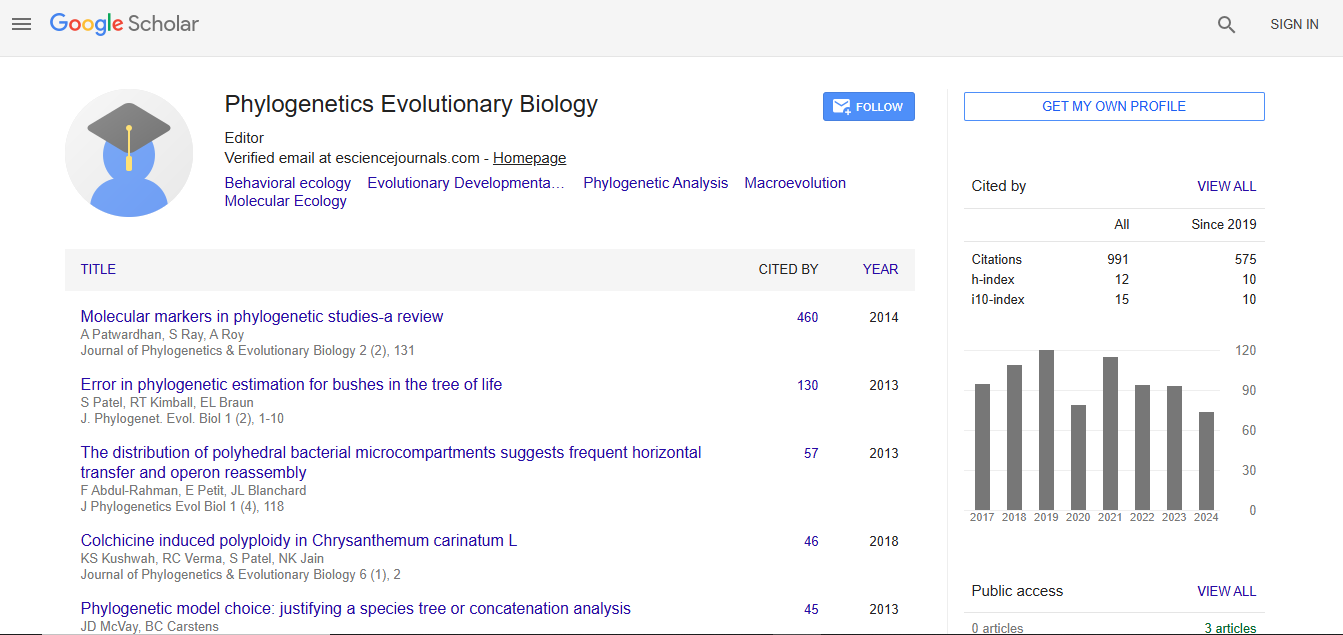
Journal of Phylogenetics & Evolutionary Biology received 911 citations as per Google Scholar report