Perspective - (2025) Volume 14, Issue 4
Received: 03-Aug-2025, Manuscript No. jsp-26-182265;
Editor assigned: 05-Aug-2025, Pre QC No. P-182265;
Reviewed: 19-Aug-2025, QC No. Q-182265;
Revised: 21-Aug-2025, Manuscript No. R-182265;
Published:
30-Aug-2025
, DOI: 10.37421/2165-7939.2025.14.734
Citation: Russo, Valentina. ”Advancements in Interventional Spine Pain Management.” J Spine 14 (2025):734.
Copyright: © 2025 Russo V. This is an open-access article distributed under the terms of the Creative Commons Attribution License, which permits unrestricted use, distribution and reproduction in any medium, provided the original author and source are credited.
The field of interventional spine pain management has witnessed remarkable progress, driven by the development and refinement of minimally invasive techniques. These advancements are fundamentally reshaping how chronic spine-related pain is addressed, offering targeted relief and improved patient outcomes. Percutaneous discectomy, radiofrequency ablation, and spinal cord stimulation are now cornerstone procedures, providing less invasive alternatives to traditional open surgery with shorter recovery times and fewer complications [1].
The application of regenerative medicine is also a significant area of recent exploration, with stem cells and platelet-rich plasma being investigated for conditions like disc degeneration and facet joint osteoarthritis. Ongoing research aims to optimize the clinical use of these biologic agents for chronic spine conditions [2].
Neuromodulation techniques, particularly spinal cord stimulation (SCS) and peripheral nerve stimulation (PNS), are crucial for managing intractable spine-related pain. Latest developments in SCS and PNS systems, including novel waveforms and implantable devices, offer personalized pain management strategies for patients refractory to conventional treatments, with a growing emphasis on precise patient selection and optimized programming protocols [3].
The integration of advanced imaging and navigation technologies is revolutionizing the precision and safety of interventional spine procedures. Intraoperative imaging modalities such as fluoroscopy and cone-beam CT, coupled with navigation systems, enhance accuracy in needle placement and reduce the risk of complications, thereby improving clinical outcomes in minimally invasive spine surgery [4].
Endoscopic techniques are increasingly employed for lumbar disc herniations and spinal stenosis, offering advantages such as smaller incisions, reduced tissue disruption, and faster recovery. Various endoscopic approaches, including transforaminal and interlaminar discectomy, demonstrate efficacy in managing specific spinal pathologies, marking a paradigm shift in minimally invasive treatment [5].
Radiofrequency ablation (RFA) continues to be a critical tool for managing facet joint pain and sacroiliac joint pain. Current evidence, technique variations, and refined patient selection criteria highlight RFA's effectiveness in providing long-term pain relief for specific types of axial back pain, underscoring its minimally invasive nature and favorable safety profile [6].
Minimally invasive lumbar decompression techniques have advanced significantly for spinal stenosis, encompassing procedures like percutaneous lumbar decompression (PLD) and minimally invasive lumbar fusion. These approaches are instrumental in alleviating neurogenic claudication and enhancing functional capacity in affected patients [7].
The burgeoning field of artificial intelligence (AI) and machine learning (ML) is poised to transform interventional spine pain management. AI/ML applications are emerging for patient selection, procedural planning, and outcome prediction, promising to personalize treatment strategies and boost the efficiency and effectiveness of spine interventions [8].
Percutaneous vertebral augmentation, including vertebroplasty and kyphoplasty, remains vital for treating vertebral compression fractures, particularly those associated with osteoporosis. Advances in indications, techniques, and complication management, alongside a focus on patient selection and post-intervention bone health, are crucial for optimal outcomes [9].
Finally, the management of post-surgical spine pain is increasingly addressed through advanced interventional techniques. Epidural injections, nerve blocks, and neuromodulation are employed to treat persistent pain after spine surgery, advocating for a multidisciplinary approach that integrates these procedures with physical therapy and psychological support [10].
The landscape of interventional spine pain management is characterized by a continuous evolution towards less invasive and more targeted therapeutic approaches. Pioneering advancements in minimally invasive techniques, such as percutaneous discectomy, radiofrequency ablation, and spinal cord stimulation, are providing effective solutions for a spectrum of spinal pain conditions, offering patients benefits like reduced recovery times and minimized surgical risks compared to traditional open procedures [1].
A significant frontier in spinal pain management is regenerative medicine, which explores the use of biologics like stem cells and platelet-rich plasma for conditions such as disc degeneration and facet joint osteoarthritis. Extensive research is dedicated to understanding and optimizing the application of these regenerative therapies in clinical practice to address chronic spine ailments [2].
Neuromodulation has emerged as a powerful strategy for managing refractory spine-related pain. Contemporary developments in spinal cord stimulation (SCS) and peripheral nerve stimulation (PNS) systems, including innovative waveforms and sophisticated implantable devices, enable highly personalized pain management. Emphasis is placed on refining patient selection criteria and programming protocols to maximize the efficacy of these interventions [3].
Precision in interventional spine procedures is being dramatically enhanced by the integration of advanced imaging and navigation technologies. Tools such as intraoperative fluoroscopy, cone-beam CT, and navigation systems are crucial for ensuring accurate needle placement and improving the safety profile of minimally invasive spine surgery, ultimately contributing to better patient outcomes [4].
Endoscopic spine surgery represents a significant paradigm shift, particularly for conditions like lumbar disc herniations and spinal stenosis. This technique utilizes smaller incisions and causes less tissue disruption, leading to quicker recovery periods. Various endoscopic approaches are discussed for their effectiveness in treating specific spinal pathologies, underscoring their minimally invasive nature [5].
Radiofrequency ablation (RFA) is a well-established and critically reviewed technique for axial spine pain, specifically targeting facet joint and sacroiliac joint pain. The current body of evidence, coupled with refined technique variations and precise patient selection guidelines, reinforces RFA's efficacy in delivering long-term pain relief with a favorable safety record for these conditions [6].
For spinal stenosis, minimally invasive lumbar decompression techniques have seen substantial progress. Procedures like percutaneous lumbar decompression (PLD) and minimally invasive lumbar fusion offer effective management strategies, aiming to alleviate neurogenic claudication and improve patients' overall functional capacity [7].
The integration of artificial intelligence (AI) and machine learning (ML) is an emerging and transformative development in interventional spine pain management. These technologies hold immense potential for enhancing patient selection, optimizing procedural planning, and predicting treatment outcomes, paving the way for more personalized and effective interventions [8].
Percutaneous vertebral augmentation, including vertebroplasty and kyphoplasty, remains a critical intervention for osteoporotic vertebral compression fractures. The focus is on optimizing indications, refining surgical techniques, and managing potential complications, with a significant emphasis on patient selection and strategies for post-intervention bone health improvement [9].
Finally, the management of persistent pain after spine surgery is being significantly improved by advanced interventional techniques. The use of epidural injections, nerve blocks, and neuromodulation, alongside a multidisciplinary approach that includes physical therapy and psychological support, forms a comprehensive strategy for addressing post-surgical spine pain [10].
This collection of articles explores the advancements in interventional spine pain management, focusing on minimally invasive techniques and emerging technologies. Key areas covered include percutaneous procedures, regenerative medicine, neuromodulation, advanced imaging, endoscopic surgery, radiofrequency ablation, lumbar decompression, artificial intelligence, vertebral augmentation, and post-surgical pain management. These approaches aim to provide targeted pain relief, reduce recovery times, and improve patient outcomes compared to traditional surgical methods. The content highlights the growing sophistication and efficacy of interventional strategies in addressing a wide range of spinal conditions.
None
None
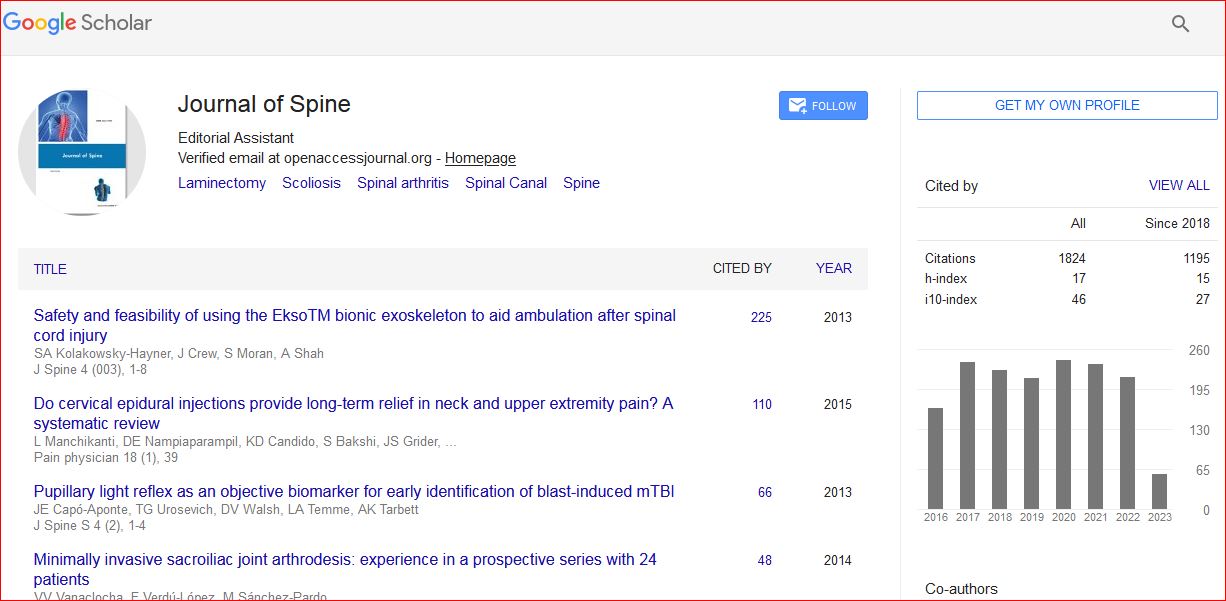
Journal of Spine received 2022 citations as per Google Scholar report