Opinion - (2025) Volume 15, Issue 6
Received: 31-Oct-2025, Manuscript No. jtese-26-184258;
Editor assigned: 03-Nov-2025, Pre QC No. P-184258;
Reviewed: 17-Nov-2025, QC No. Q-184258;
Revised: 21-Nov-2025, Manuscript No. R-184258;
Published:
28-Nov-2025
, DOI: 10.37421/2165-8064.2025.15.681
Citation: Popescu, Elena. ”Advancements in Fire-Retardant and Protective Textiles.” J Textile Sci Eng 15 (2025):681.
Copyright: © 2025 Popescu E. This is an open-access article distributed under the terms of the Creative Commons Attribution License, which permits unrestricted use, distribution and reproduction in any medium, provided the original author and source are credited.
The development of advanced textile materials with enhanced fire-retardant properties is a critical area of research, driven by the increasing demand for safety in various applications. This field leverages innovative chemical treatments and material science principles to imbue fabrics with inherent resistance to ignition and flame propagation. The exploration into novel finishing techniques and the strategic incorporation of advanced flame-retardant additives forms the bedrock of this research, aiming to surpass existing performance benchmarks [1].
Furthermore, a significant focus within this domain is the pursuit of sustainable solutions. This involves investigating eco-friendly flame retardants derived from renewable resources, which can achieve effective fire protection without compromising environmental integrity. The evaluation of bio-based phosphorus compounds for cotton textiles exemplifies this trend, seeking to provide sustainable alternatives for protective materials [2].
Beyond basic flame retardancy, the evolution of protective textiles encompasses the development of multi-functional materials. These advanced textiles integrate flame retardancy with other essential properties such as water repellency and antimicrobial activity. The application of sophisticated techniques like layered nanocoatings allows for a single finishing process to impart a comprehensive protective profile suitable for demanding environments [3].
Understanding the fundamental mechanisms of flame retardancy is crucial for designing next-generation materials. Research delves into the behavior of novel inorganic flame retardants within synthetic textile fibers, analyzing their thermal stability, char formation, and gas-phase inhibition effects. This mechanistic understanding provides pathways for optimizing material design for high performance and safety [4].
The physical characteristics of textiles also play a pivotal role in their fire-retardant performance. Studies are investigating how weaving structures and fabric densities interact with flame-retardant finishes. It has been observed that denser weaves and specific structural designs can significantly enhance overall fire resistance by promoting char formation and limiting oxygen availability [5].
Another key consideration in the practical application of flame-retardant textiles is the durability of these protective finishes. Rigorous assessment of finishes after multiple washing cycles is essential to quantify the retention of fire-retardant properties and fabric integrity. Developing durable finishes that maintain effectiveness throughout the textile's lifespan is paramount for long-term safety applications [6].
The application of specialized coatings, such as intumescent flame retardant coatings, offers another avenue for creating self-extinguishing textile materials. These coatings function by forming a protective char layer upon exposure to heat and flame, significantly reducing heat release and smoke production. This approach is vital for enhancing fire safety in a wide array of textile products [7].
The shift towards more environmentally benign flame retardant technologies is also evident in the exploration of halogen-free alternatives. Research into compounds like layered double hydroxides (LDHs) for polyester fabrics highlights their potential as sustainable substitutes for traditional halogenated flame retardants, often offering comparable or superior fire protection [8].
A more permanent approach to fire protection involves the development of intrinsically flame-retardant fibers. This is achieved by incorporating flame-retardant elements directly into the polymer backbone during polymerization. Such intrinsic treatments offer robust fire protection that is impervious to washing or abrasion, making them ideal for high-performance protective apparel [9].
Finally, the synergistic interaction of hybrid flame-retardant systems is a promising area of research. Combining different types of flame retardants, such as phosphorus-based compounds and nanoclays, can lead to enhanced fire performance compared to individual components. This approach paves the way for more efficient and effective fire-retardant textile solutions [10].
The advancement of fire-retardant and protective textile materials is a dynamic field characterized by innovation in chemical treatments and material engineering. Current research is focused on developing novel materials that exhibit superior performance in terms of ignitability, flame spread, and heat release, thereby enhancing safety in diverse applications. This involves exploring synergistic effects between different flame-retardant systems and assessing their impact on mechanical properties and durability, leading to significant improvements in overall safety characteristics [1].
In parallel with performance enhancements, there is a strong push towards sustainability within the textile industry. This involves the investigation and application of eco-friendly flame retardants, particularly those derived from renewable resources. The successful implementation of bio-based phosphorus compounds on cotton textiles demonstrates the feasibility of achieving good fire-retardant performance while preserving essential fabric properties like breathability and comfort, addressing a crucial need for environmentally conscious protective materials [2].
The evolution of protective textiles extends to their functional versatility. Research is actively pursuing the development of multi-functional materials that integrate flame retardancy with other desirable properties such as water repellency and antimicrobial activity. Innovative approaches like the application of layered nanocoatings allow for a singular finishing process to impart a comprehensive protection profile, making these textiles suitable for demanding applications like workwear and military gear [3].
Fundamental to the progress in this field is a deep understanding of the underlying flame retardancy mechanisms. Investigations into novel inorganic flame retardants, particularly their integration into synthetic textile fibers, provide crucial insights. By analyzing thermal stability, char formation, and gas-phase inhibition, researchers can better comprehend how these additives influence polymer decomposition and contribute to reduced flammability, guiding the design of future high-performance textiles [4].
The physical architecture of textile materials is recognized as a significant factor influencing their fire-retardant capabilities. Studies systematically examining the interaction between weaving structures, fabric densities, and flame-retardant finishes reveal that specific textile designs can inherently enhance fire resistance. This enhancement is often achieved through mechanisms such as improved char formation and restricted oxygen availability within the fabric structure [5].
The long-term efficacy of flame-retardant finishes is a paramount concern for practical usability. Research efforts are dedicated to assessing the durability of these finishes following repeated washing cycles. By employing various quantitative assessment methods, the retention of fire-retardant properties and fabric integrity over time is determined, underscoring the importance of developing finishes that provide sustained protection throughout a textile's service life [6].
Innovative application methods, such as the use of intumescent flame retardant coatings, are being explored to create self-extinguishing textile materials. These coatings operate by forming an expanded char barrier when exposed to heat and flame, effectively mitigating heat release and smoke production. This technology is instrumental in improving fire safety across a broad spectrum of textile products [7].
As environmental regulations become more stringent, the development of sustainable and halogen-free flame retardant solutions is gaining momentum. The study of layered double hydroxides (LDHs) as flame retardants for polyester fabrics exemplifies this trend. These materials are synthesized, characterized, and applied to evaluate their effectiveness as environmentally responsible alternatives to conventional halogenated compounds, often achieving comparable or superior fire protection [8].
For applications requiring the utmost in fire resistance, the development of intrinsically flame-retardant fibers is a key area of focus. By chemically modifying the polymer backbone during fiber synthesis, flame-retardant properties are permanently integrated. This intrinsic approach offers a robust solution that resists degradation from washing or abrasion, making it highly suitable for demanding protective apparel [9].
The optimization of flame-retardant systems often involves exploring synergistic effects. Hybrid systems, such as those combining phosphorus-based compounds with nanoclays, have demonstrated enhanced fire performance compared to their individual constituents. These hybrid systems are characterized for their ability to limit heat release and smoke generation, presenting a pathway toward more effective and efficient fire-retardant textile solutions [10].
This collection of research explores advancements in fire-retardant and protective textile materials. Studies focus on enhancing inherent flame resistance through innovative finishing techniques, incorporating advanced flame-retardant additives, and exploring synergistic effects between different systems. Sustainability is a key theme, with investigations into eco-friendly treatments like bio-based phosphorus compounds and halogen-free alternatives such as layered double hydroxides. The development of multi-functional textiles combining flame retardancy with other properties like water repellency and antimicrobial activity is also highlighted. Mechanistic understanding of flame retardancy, the influence of fabric structure, and the durability of finishes after washing are crucial aspects. Intrinsic flame retardancy through polymer modification and the effectiveness of intumescent coatings are also examined, all contributing to the creation of safer and more advanced textile materials.
None
None
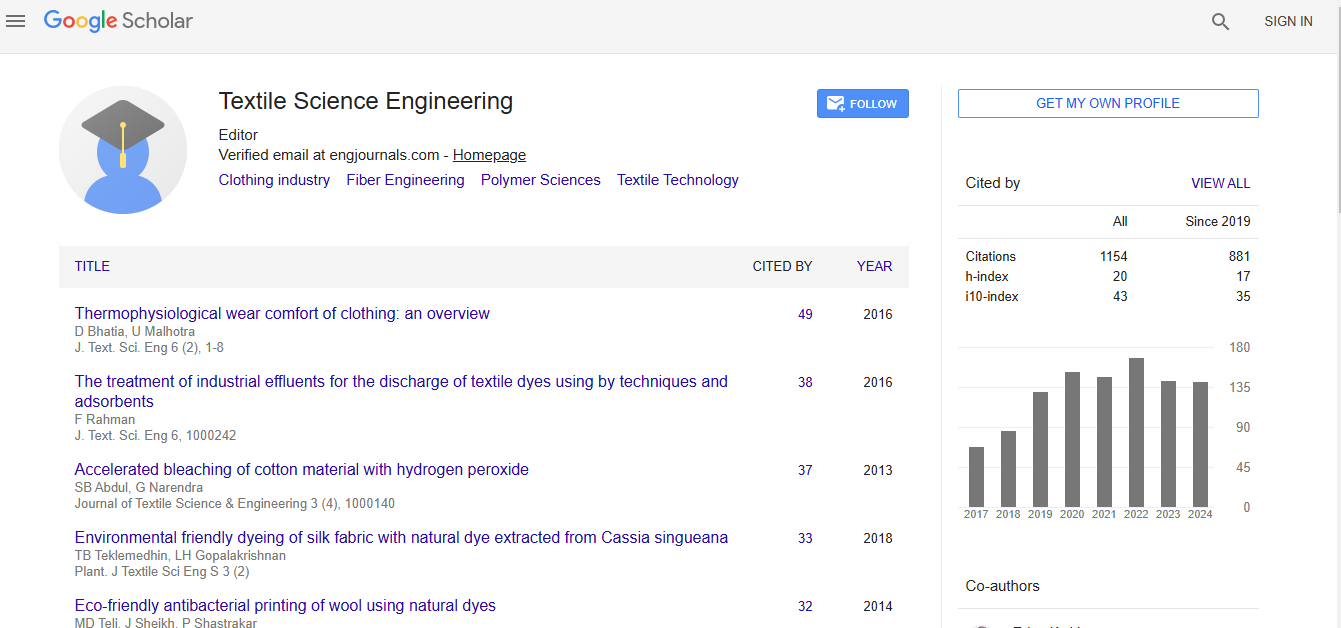
Journal of Textile Science & Engineering received 1008 citations as per Google Scholar report