Opinion - (2025) Volume 15, Issue 5
Received: 01-Oct-2025, Manuscript No. jprm-25-174467;
Editor assigned: 03-Oct-2025, Pre QC No. P-174467;
Reviewed: 17-Oct-2025, QC No. Q-174467;
Revised: 22-Oct-2025, Manuscript No. R-174467;
Published:
29-Oct-2025
, DOI: 10.37421/2161-105X.2025.15.762
Citation: Alvarez, Diego. ”Advancements and Challenges in Respiratory Diseases.” J Pulm Respir Med 15 (2025):762.
Copyright: © 2025 Alvarez D. This is an open-access article distributed under the terms of the Creative Commons Attribution License, which permits unrestricted use, distribution and reproduction in any medium, provided the original author and source are credited.
This article provides a comprehensive overview of idiopathic pulmonary fibrosis (IPF), detailing its diagnosis and the current treatment landscape. It underscores challenges like the disease's progressive nature and the vital need for early diagnosis to significantly improve patient outcomes. The piece also explores novel therapeutic approaches, which offers substantial encouragement for future advancements [1].
Here's the thing about chronic obstructive pulmonary disease (COPD): it consistently remains a major global health challenge. This review strongly emphasizes the disease's immense burden and delves into the current understanding of its complex mechanisms. What this really means is that strides are being made in refining diagnostic approaches and developing more effective, personalized management strategies [2].
This piece on asthma is quite comprehensive, examining its epidemiology, the underlying pathophysiology, and potential treatments emerging in the coming decade. It makes a strong point about asthma's inherent heterogeneity, suggesting future therapies will likely be much more targeted and individualized, moving beyond the traditional 'one size fits all' approach [3].
When it comes to lung cancer, this article meticulously lays out key advancements in screening, diagnostic techniques, and novel therapies. It's clear that early detection remains critically important. However, the true game-changer is the rapid development of targeted treatments and immunotherapies, which are fundamentally changing how this disease is approached and managed [4].
This review offers a contemporary look at pulmonary hypertension, detailing the evolving understanding of its pathology and the expansion of treatment options. The article emphasizes the crucial multidisciplinary approach needed for accurate diagnosis and effective management, showing how far we've progressed in improving patient quality of life [5].
Let's break down cystic fibrosis: this article points to a new era in its treatment, largely driven by innovative modulator therapies. These drugs are genuinely transformative, addressing the underlying genetic defect rather than just managing symptoms. What this really means is a significant improvement in lung function and overall prognosis for many patients [6].
This concise review on Acute Respiratory Distress Syndrome (ARDS) gives a clear picture of its complexities. It emphasizes that while significant progress has been made in supportive care, particularly with advanced ventilator strategies, ARDS still carries a high mortality rate. The piece hints at the ongoing search for more targeted therapies to improve outcomes [7].
Interstitial lung disease (ILD) is a broad and challenging category, and this article effectively outlines its diagnosis and treatment. It highlights the importance of precise classification and early intervention, especially for progressive fibrotic ILDs where anti-fibrotic therapies are showing real promise in slowing disease progression. That's a big deal for patient care [8].
This article provides an update on managing community-acquired pneumonia (CAP). It's a common condition, and what's interesting is the ongoing evolution of diagnostic tools and principles of antimicrobial stewardship. The key takeaway is the need for tailored treatment plans, considering local epidemiology and patient-specific risk factors to enhance outcomes [9].
This piece on bronchiectasis highlights recent advances in treatment, which is genuinely great news. It emphasizes that while managing exacerbations is crucial, there is increased focus on long-term strategies, including new inhaled therapies and a better understanding of underlying causes. It's about breaking the cycle of infection and inflammation to preserve lung function [10].
This article provides a comprehensive overview of idiopathic pulmonary fibrosis (IPF), detailing its diagnosis and the current treatment landscape. It underscores challenges like the disease's progressive nature and the vital need for early diagnosis to significantly improve patient outcomes. The piece also explores novel therapeutic approaches, which offers substantial encouragement for future advancements [1]. Here's the thing about chronic obstructive pulmonary disease (COPD): it consistently remains a major global health challenge. This review strongly emphasizes the disease's immense burden and delves into the current understanding of its complex mechanisms. What this really means is that strides are being made in refining diagnostic approaches and developing more effective, personalized management strategies [2].
This piece on asthma is quite comprehensive, examining its epidemiology, the underlying pathophysiology, and potential treatments emerging in the coming decade. It makes a strong point about asthma's inherent heterogeneity, suggesting future therapies will likely be much more targeted and individualized, moving beyond the traditional 'one size fits all' approach [3]. When it comes to lung cancer, this article meticulously lays out key advancements in screening, diagnostic techniques, and novel therapies. It's clear that early detection remains critically important. However, the true game-changer is the rapid development of targeted treatments and immunotherapies, which are fundamentally changing how this disease is approached and managed [4].
This review offers a contemporary look at pulmonary hypertension, detailing the evolving understanding of its pathology and the expansion of treatment options. The article emphasizes the crucial multidisciplinary approach needed for accurate diagnosis and effective management, showing how far we've progressed in improving patient quality of life [5]. Let's break down cystic fibrosis: this article points to a new era in its treatment, largely driven by innovative modulator therapies. These drugs are genuinely transformative, addressing the underlying genetic defect rather than just managing symptoms. What this really means is a significant improvement in lung function and overall prognosis for many patients [6].
This concise review on Acute Respiratory Distress Syndrome (ARDS) gives a clear picture of its complexities. It emphasizes that while significant progress has been made in supportive care, particularly with advanced ventilator strategies, ARDS still carries a high mortality rate. The piece hints at the ongoing search for more targeted therapies to improve outcomes [7]. Interstitial lung disease (ILD) is a broad and challenging category, and this article effectively outlines its diagnosis and treatment. It highlights the importance of precise classification and early intervention, especially for progressive fibrotic ILDs where anti-fibrotic therapies are showing real promise in slowing disease progression. That's a big deal for patient care [8].
This article provides an update on managing community-acquired pneumonia (CAP). It's a common condition, and what's interesting is the ongoing evolution of diagnostic tools and principles of antimicrobial stewardship. The key takeaway is the need for tailored treatment plans, considering local epidemiology and patient-specific risk factors to enhance outcomes [9]. This piece on bronchiectasis highlights recent advances in treatment, which is genuinely great news. It emphasizes that while managing exacerbations is crucial, there is increased focus on long-term strategies, including new inhaled therapies and a better understanding of underlying causes. It's about breaking the cycle of infection and inflammation to preserve lung function [10].
This data highlights critical advancements and ongoing challenges across various respiratory diseases. Idiopathic Pulmonary Fibrosis (IPF) emphasizes early diagnosis and novel therapeutic approaches despite its progressive nature. Chronic Obstructive Pulmonary Disease (COPD) remains a significant global health challenge, driving refined diagnostics and personalized management strategies. Asthma research points towards more targeted future therapies due to its inherent heterogeneity. Advancements in lung cancer are transforming care through improved screening, diagnosis, and the rapid development of targeted treatments and immunotherapies. Pulmonary Hypertension (PH) now benefits from an evolving understanding of its pathology and expanded treatment options, underscoring the need for a multidisciplinary approach to enhance patient quality of life. Cystic Fibrosis (CF) treatment has entered a new era with transformative modulator therapies that address the underlying genetic defect, leading to significant improvements in lung function and prognosis. Acute Respiratory Distress Syndrome (ARDS) continues to pose a high mortality risk despite progress in supportive care, prompting an ongoing search for targeted therapies. Interstitial Lung Disease (ILD) diagnosis and treatment focus on precise classification and early intervention, with anti-fibrotic therapies showing promise for progressive fibrotic ILDs. Updates in Community-Acquired Pneumonia (CAP) management involve evolving diagnostic tools and antimicrobial stewardship, stressing tailored treatment plans. Finally, bronchiectasis treatment emphasizes long-term strategies, including new inhaled therapies, to break the cycle of infection and inflammation and preserve lung function.
None
None
1. Michael K, Jürgen B, Francesco B. "Idiopathic Pulmonary Fibrosis: An Update on Diagnosis and Treatment".Dtsch Arztebl Int 117 (2020):863-872.
Indexed at, Google Scholar, Crossref
2. Alvar A, David MM, Jadwiga AW. "Chronic obstructive pulmonary disease".Lancet 397 (2021):349-361.
Indexed at, Google Scholar, Crossref
3. Robert PS, Stephen JS, Homer AB. "Asthma: Epidemiology, pathophysiology, and treatment beyond the next decade".J Allergy Clin Immunol 145 (2020):1-16.
Indexed at, Google Scholar, Crossref
4. Ramaswamy G, Balazs H, Lecia VS. "Lung cancer in 2022: screening, diagnosis, and novel therapies".Nat Rev Clin Oncol 20 (2023):69-70.
Indexed at, Google Scholar, Crossref
5. Mark RJ, Jason TE, Daniel RB. "Pulmonary Hypertension: A Contemporary Review".Cardiol Clin 38 (2020):191-210.
Indexed at, Google Scholar, Crossref
6. Kevin LP, Jennifer LT, Steven DN. "Cystic fibrosis: a new era in treatment".Expert Rev Respir Med 14 (2020):585-602.
Indexed at, Google Scholar, Crossref
7. Michael JW, William AM, Jason RM. "Acute respiratory distress syndrome: a concise review".Am J Emerg Med 38 (2020):794-800.
Indexed at, Google Scholar, Crossref
8. David RM, Lisa AM, Robert PB. "Interstitial Lung Disease: Diagnosis and Treatment".Ann Am Thorac Soc 18 (2021):1-10.
Indexed at, Google Scholar, Crossref
9. Stefano T, Andrew IM, Jason PJ. "Updates in the Management of Community-Acquired Pneumonia".Med Clin North Am 104 (2020):441-456.
Indexed at, Google Scholar, Crossref
10. Pallavi SL, Rahul RS, Ajay CK. "Bronchiectasis: Recent advances in treatment".Curr Opin Pulm Med 26 (2020):300-307.
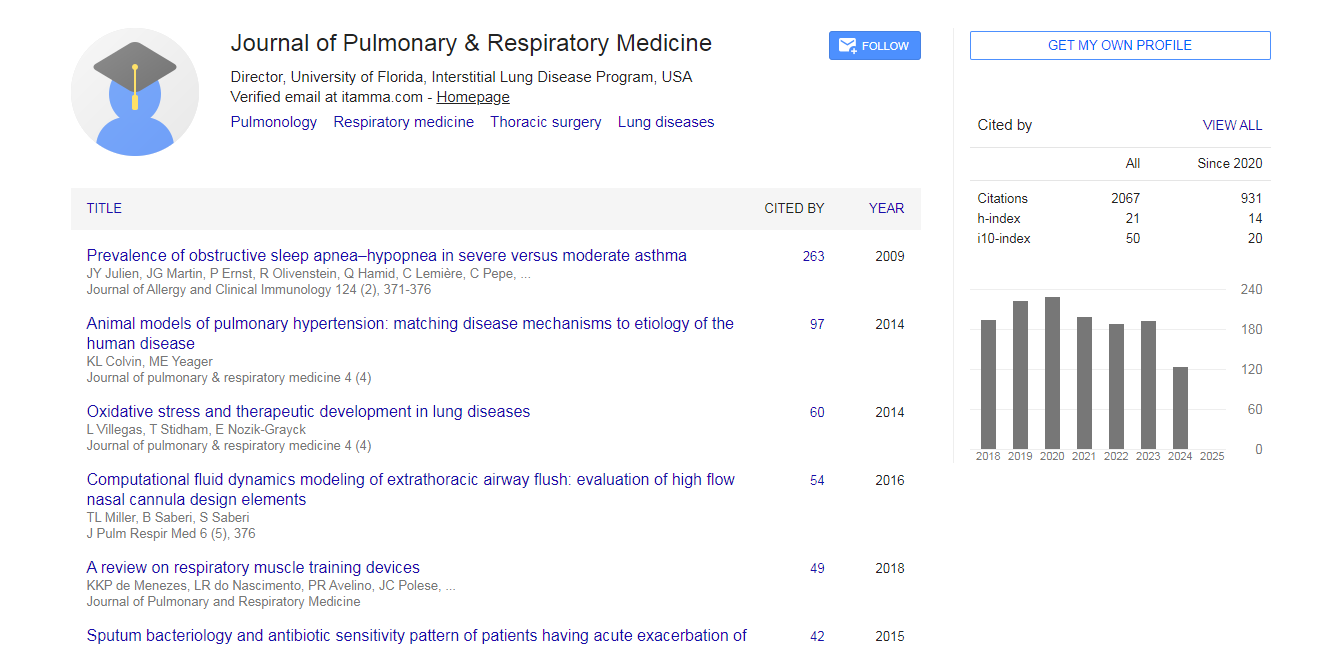
Pulmonary & Respiratory Medicine received 1690 citations as per Google Scholar report