Perspective - (2025) Volume 15, Issue 6
Received: 31-Oct-2025, Manuscript No. jtese-26-184262;
Editor assigned: 03-Nov-2025, Pre QC No. P-184262;
Reviewed: 17-Nov-2025, QC No. Q-184262;
Revised: 21-Nov-2025, Manuscript No. R-184262;
Published:
28-Nov-2025
, DOI: 10.37421/2165-8064.2025.15.685
Citation: Delgado, Rosa. ”Advanced Textile Testing: Comfort, Durability, and Performance.” J Textile Sci Eng 15 (2025):685.
Copyright: © 2025 Delgado R. This is an open-access article distributed under the terms of the Creative Commons Attribution License, which permits unrestricted use, distribution and reproduction in any medium, provided the original author and source are credited.
The intricate relationship between textile properties and their real-world performance is a cornerstone of modern material science and product development. Advanced textile testing methodologies have emerged as indispensable tools for dissecting this complex interplay, offering insights crucial for both functional efficacy and consumer acceptance. The quest for enhanced wearer comfort, a multifaceted attribute, necessitates a comprehensive evaluation that bridges subjective human perception with objective scientific measurement. This involves a deep dive into how various textile characteristics influence the wearer's sensory experience, encompassing aspects from tactile feel to thermal regulation [1].
Understanding the impact of fabric structure on thermal comfort is paramount, especially for active wear and performance textiles. Sophisticated testing techniques are employed to precisely link microclimate parameters, such as heat and moisture transfer, with specific fabric construction variables. This granular understanding allows for the deliberate design of textiles optimized for diverse climatic conditions and physical activities, ensuring optimal thermal balance [2].
The durability of technical textiles, particularly their resilience against abrasion and pilling, is a critical performance indicator, especially for applications demanding longevity and robustness. Advanced instrumental techniques play a pivotal role in quantifying the degradation processes that occur under simulated wear conditions. Such studies are vital for developing more resilient textile products by understanding how fiber properties, yarn characteristics, and fabric finishing treatments contribute to long-term performance [3].
Beyond mechanical and thermal considerations, the sensory aspects of textile comfort, specifically tactile properties like softness and smoothness, significantly influence consumer choice and satisfaction. A combination of instrumental measurements and psychophysical evaluations is employed to establish a quantifiable correlation between a fabric's surface characteristics and the perceived comfort it elicits. This research is vital for the meticulous optimization of the hand-feel of apparel and home textiles [4].
For sportswear, in particular, the durability under strenuous use is a non-negotiable requirement. Assessments of tensile strength, tear resistance, and colorfastness after repeated washing and exposure are essential performance metrics. Standardized testing procedures are rigorously applied to evaluate these aspects, ensuring that sports apparel not only withstands demanding conditions but also maintains its aesthetic appeal and functional integrity over time [5].
Innovative finishing treatments are continuously being developed to imbue textiles with enhanced functional and comfort properties. Sophisticated testing equipment is used to quantify improvements in critical areas such as moisture management, breathability, and antimicrobial activity. These advanced finishes can significantly elevate wearer comfort and hygiene, particularly for specialized applications requiring specific performance attributes [6].
The automotive industry places stringent demands on textile materials, requiring exceptional durability against rigorous wear and diverse environmental conditions. Standardized tests are employed to meticulously evaluate abrasion resistance, UV degradation, and pilling propensity. The insights gained are instrumental in the selection and development of materials that can sustain their performance and aesthetic qualities throughout a vehicle's operational lifespan [7].
The interplay between fabric stiffness, drape, and perceived comfort is another crucial area of investigation. Sophisticated measuring instruments are utilized to precisely quantify these mechanical properties. These objective measurements are then correlated with subjective wearer feedback obtained through sensory evaluation panels, providing essential data for designing garments that balance structural integrity with comfortable movement and wearability [8].
Moisture management is a fundamental property for performance textiles, directly impacting comfort during physical exertion. Dynamic vapor transfer and wicking tests are employed to scientifically assess a fabric's ability to transport and evaporate moisture effectively. This research provides a solid foundation for the development of textiles that enhance thermal regulation and minimize the sensation of clamminess, thereby improving the overall wearer experience [9].
The durability of textiles, especially their resistance to repeated laundering and wear, is a critical determinant of their lifecycle and overall consumer satisfaction. Studies meticulously evaluate the impact of numerous washing cycles on the mechanical properties and dimensional stability of various fabric types. By employing standardized tests, it becomes possible to predict the service life of garments and inform more judicious material selection for improved longevity and sustained performance [10].
The field of textile science extensively utilizes advanced testing methods to ascertain the critical performance characteristics of fabrics, ranging from wearer comfort to material longevity. Objective and subjective assessments are synergistically employed, integrating mechanical and physical evaluations with direct wearer feedback to predict real-world performance and consumer satisfaction. Parameters such as moisture management, thermal regulation, tactile properties, and resistance to abrasion and tearing are rigorously investigated using standardized protocols to ensure accuracy and reliability in predicting how textiles will perform and how consumers will perceive them [1].
Fabric structure plays a pivotal role in determining thermal comfort, and sophisticated testing techniques are instrumental in elucidating these relationships. By analyzing microclimate parameters like heat and moisture transfer in conjunction with fabric construction variables such as yarn type, weave density, and finishing treatments, researchers can engineer textiles with optimized thermal regulation capabilities. This allows for the creation of materials tailored for specific climates and activities, enhancing wearer well-being [2].
The wear durability of technical textiles, particularly their resistance to abrasion and pilling, is a significant concern for applications requiring sustained performance. Advanced instrumental techniques are employed to quantitatively assess the degradation processes that occur under simulated wear conditions. Understanding how fiber properties, yarn characteristics, and fabric finishing treatments influence this long-term performance is crucial for the development of more robust and resilient textile products [3].
Sensory perception of textile comfort, especially tactile properties like softness and smoothness, is deeply intertwined with consumer preference. The use of both instrumental measurements and psychophysical evaluations allows for the precise correlation of fabric surface characteristics with perceived comfort. This line of research is vital for the meticulous refinement of the hand-feel of apparel and home textiles, directly impacting product appeal and marketability [4].
For sportswear, evaluating durability under strenuous conditions is paramount. This involves rigorous testing of tensile strength, tear resistance, and colorfastness following repeated washing and exposure to various elements. The application of standardized testing procedures ensures that sports apparel meets the high-performance demands, guaranteeing longevity and aesthetic preservation even under intense use [5].
Innovative finishing treatments are a key area of development for enhancing the comfort and functionality of textiles. Sophisticated testing equipment is utilized to quantify the improvements achieved in moisture management, breathability, and antimicrobial activity. These advanced finishes demonstrably enhance wearer comfort and hygiene, making them valuable for specialized textile applications [6].
The automotive sector relies heavily on textiles that exhibit exceptional durability under demanding wear and environmental stresses. Standardized tests are critical for assessing abrasion resistance, UV degradation, and pilling propensity. The insights derived from these evaluations are indispensable for selecting and creating materials that maintain their functional and aesthetic integrity throughout the lifespan of a vehicle [7].
The mechanical properties of fabrics, including stiffness and drape, have a direct impact on perceived comfort. Sophisticated measuring instruments are employed to quantify these properties, which are then correlated with wearer feedback from sensory evaluation panels. This comprehensive approach is essential for designing garments that offer both structural integrity and freedom of movement, contributing to a comfortable wearing experience [8].
Moisture management is a critical aspect of comfort in performance textiles, particularly during physical activity. Scientific assessments using dynamic vapor transfer and wicking tests accurately measure a fabric's capacity to transport and evaporate moisture. This research underpins the development of textiles that effectively regulate body temperature and prevent the sensation of dampness, thereby enhancing wearer comfort [9].
The longevity and consumer satisfaction associated with textiles are significantly influenced by their durability against repeated laundering and wear. This involves detailed evaluations of how various washing cycles affect the mechanical properties and dimensional stability of different fabric types. Standardized testing methodologies are used to forecast the service life of garments and to guide the selection of materials that offer superior longevity and sustained performance characteristics [10].
This collection of research highlights the critical role of advanced textile testing in ensuring both wearer comfort and garment durability. Studies explore the integration of subjective comfort assessments with objective evaluations of mechanical and physical properties, emphasizing the need for standardized protocols. Key areas of investigation include moisture management, thermal regulation, tactile properties, abrasion and tear resistance, and the impact of fabric structure and finishing treatments on performance. The research covers diverse applications from active wear and upholstery to automotive textiles, all aiming to develop more resilient, comfortable, and long-lasting textile products through rigorous scientific evaluation.
None
None
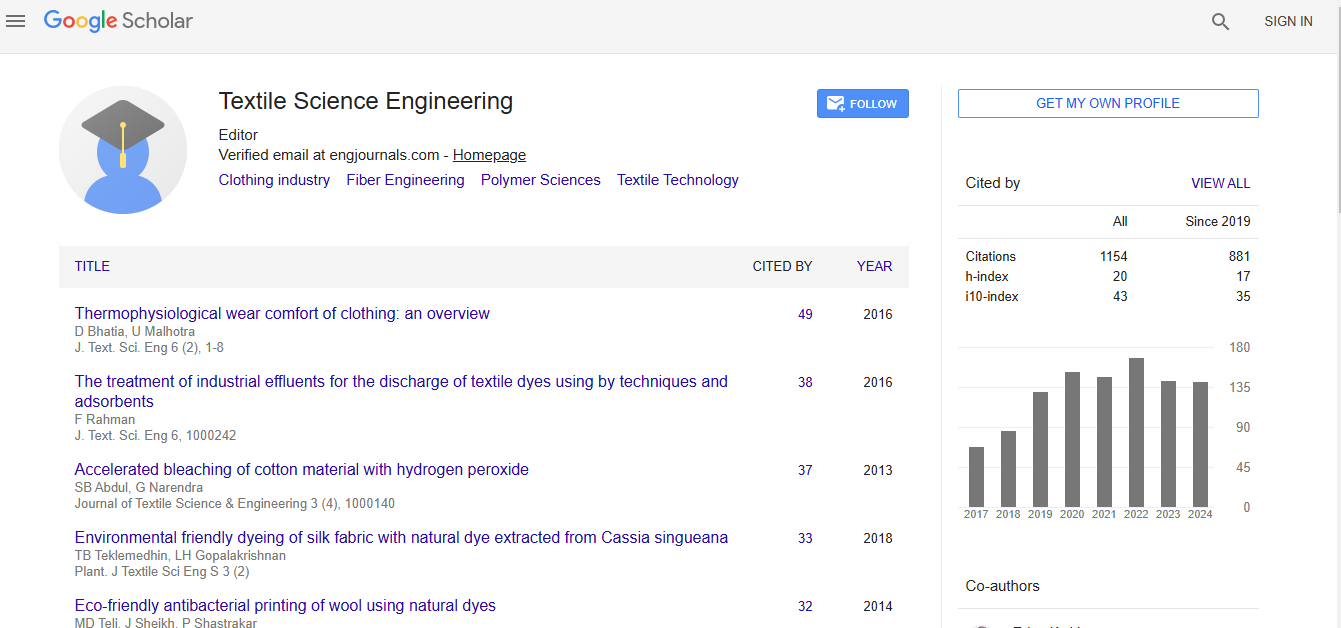
Journal of Textile Science & Engineering received 1008 citations as per Google Scholar report