Short Communication - (2025) Volume 14, Issue 6
Received: 01-Dec-2025, Manuscript No. jbfa-25-176855;
Editor assigned: 03-Dec-2025, Pre QC No. P-176855;
Reviewed: 17-Dec-2025, QC No. Q-176855;
Revised: 22-Dec-2025, Manuscript No. R-176855;
Published:
29-Dec-2025
, DOI: 10.37421/2161-0673.2025.14.568
Citation: Foster, Selena. ”Advanced Tech Driving Financial Industry Transformation.” J Bus Fin Aff 14 (2025):568.
Copyright: © 2025 Foster S. This is an open-access article distributed under the terms of the Creative Commons Attribution License, which permits unrestricted use, distribution and reproduction in any medium, provided the original author and source are credited.
This comprehensive work provides a detailed quantitative overview of Artificial Intelligence (AI) applications in finance, highlighting its transformative potential across various financial sectors. It meticulously examines current trends, essential technologies, and the persistent challenges involved in integrating Artificial Intelligence (AI) into modern financial products and services, emphasizing its critical impact on operational efficiency, robust risk management strategies, and enhanced client experience [1].
This extensive survey offers an in-depth analysis of blockchain technology's application within financial services. This analysis covers its significant potential to fundamentally revolutionize core areas such as secure payments, streamlined trading processes, and efficient lending mechanisms. It further discusses the intricate underlying mechanisms, crucial benefits, and existing challenges, including issues like scalability limitations, complex regulatory hurdles, and interoperability concerns that urgently need addressing for wider adoption [2].
This focused study explores the dynamic emerging field of RegTech, meticulously analyzing how various technological innovations are actively reshaping financial regulatory compliance frameworks. The document carefully examines the primary drivers behind RegTech's rapid growth, its practical applications in vital areas such as anti-money laundering (AML) and sophisticated risk management, and the profound implications for both regulatory bodies and financial institutions in cultivating a more efficient and consistently effective regulatory environment [3].
This insightful review deeply delves into the practical application of Artificial Intelligence (AI) and Machine Learning (ML) techniques in credit scoring. It notably highlights their substantial potential to significantly enhance accuracy and operational efficiency when compared to conventional, traditional methods. The work discusses a range of algorithms, diverse data sources, and the complex challenges associated with model interpretability, while also proposing crucial future research directions for developing robust and fair credit assessment practices within the evolving digital finance era [4].
This critical inquiry investigates the profound potential effects of Central Bank Digital Currencies (CBDCs) on commercial bank lending behavior and, more broadly, on overall financial stability. It comprehensively analyzes various CBDC designs and their intricate implications for credit supply dynamics, patterns of deposit reallocation, and potential systemic risks, thereby offering valuable insights for policymakers actively considering the introduction of digital fiat currencies [5].
This comprehensive document explores open banking as a truly transformative paradigm within financial services. This transformation is primarily driven by API-based data sharing protocols and significantly enhanced customer control over their financial information. It thoroughly examines the myriad opportunities for innovation, the creation of highly personalized financial products, and increased market competition, alongside the inherent challenges related to stringent data security, paramount privacy concerns, and the complexities of regulatory harmonization across diverse jurisdictions [6].
This detailed bibliometric analysis explores the rapidly growing intersection of FinTech and sustainable finance. It effectively maps out emerging research trends and identifies key thematic areas. The analysis distinctly highlights how technological innovations can significantly facilitate ESG (Environmental, Social, and Governance) data collection, promote impact investing strategies, and support the development of green financial products, ultimately contributing to a more sustainable global economy through improved transparency and efficiency [7].
This essential work explores the significant and escalating cybersecurity challenges confronting the rapidly evolving FinTech industry. These challenges range from pervasive data breaches and various forms of financial fraud to highly sophisticated cyberattacks. It precisely identifies key vulnerabilities present in digital financial ecosystems and thoroughly discusses strategic approaches, including the implementation of robust security frameworks and strict regulatory compliance, all necessary to effectively mitigate risks and consistently maintain consumer trust [8].
This detailed investigation examines the disruptive impact of Peer-to-Peer (P2P) lending platforms on traditional banking sectors. It presents compelling evidence primarily drawn from the Chinese market. The work analyzes how P2P lending specifically affects bank profitability, overall loan growth rates, and market share distribution, thereby offering crucial insights into evolving competitive dynamics and the transforming landscape of financial intermediation in the contemporary FinTech era [9].
This comprehensive systematic review thoroughly examines the profound and far-reaching impact of InsurTech on the traditional insurance industry. It covers a wide array of innovations, spanning from personalized pricing models to advanced Artificial Intelligence (AI)-driven claims processing systems. The review meticulously analyzes how technology is fundamentally reshaping product design, optimizing distribution channels, and enhancing customer engagement strategies, while also clearly identifying the strategic challenges and abundant opportunities for both incumbent firms and innovative new entrants [10].
The rapid advancement of financial technology, commonly known as FinTech, is fundamentally reshaping the global financial landscape. Artificial Intelligence (AI) and Machine Learning (ML) are central to this profound evolution, providing critical quantitative insights into their widespread applications across diverse financial sectors. These powerful technologies consistently enhance operational efficiency, refine complex risk management processes, and significantly improve client experiences, driving transformative changes in how financial products and services are conceptualized and delivered. For example, AI and Machine Learning techniques are proving remarkably effective in credit scoring, consistently offering enhanced accuracy and operational efficiency when compared to conventional, traditional methods. Current discussions actively revolve around various innovative algorithms, diverse data sources, and the critical challenge of model interpretability, all pointing towards essential future research for developing fair, transparent, and robust credit assessment practices within the rapidly evolving digital finance era [1], [4].
Blockchain technology represents another pivotal innovation poised to revolutionize numerous financial services. This distributed ledger technology is analyzed for its immense potential in areas including secure and efficient payments, streamlined trading processes, and innovative lending mechanisms. Despite its significant promise, the technology currently faces considerable hurdles such as scalability limitations, complex regulatory environments, and critical interoperability challenges that urgently need comprehensive addressing for its broader adoption. Complementing this, the emergence of Central Bank Digital Currencies (CBDCs) introduces new and profound considerations for commercial bank lending behavior and, more broadly, for overall financial stability. Various intricate CBDC designs are meticulously analyzed for their implications on credit supply dynamics, patterns of deposit reallocation, and potential systemic risks, thereby offering essential insights for policymakers actively exploring the introduction of digital fiat currencies [2], [5].
Regulatory technology, or RegTech, is also actively reshaping financial regulatory compliance through the strategic application of technological innovations. This emerging field diligently examines the primary drivers of RegTech's rapid growth and its practical, widespread applications in vital areas such as sophisticated anti-money laundering (AML) protocols and comprehensive risk management strategies, ultimately creating a more efficient, effective, and adaptive regulatory environment for both regulatory bodies and financial institutions alike. However, the burgeoning and highly interconnected FinTech industry concurrently faces significant and escalating cybersecurity challenges. These range from pervasive data breaches and various forms of financial fraud to highly sophisticated and persistent cyberattacks. Identifying key vulnerabilities inherent in digital financial ecosystems and implementing robust security frameworks alongside stringent regulatory compliance measures are absolutely essential to effectively mitigate these mounting risks and consistently maintain invaluable consumer trust [3], [8].
Open banking represents a profound paradigm shift in modern financial services. It is primarily facilitated by API-based data sharing protocols and simultaneously empowers customers with significantly greater control over their personal financial data. This transformative model fosters abundant opportunities for innovation, the creation of highly personalized financial products and services, and a heightened level of market competition across the industry. Yet, it also raises critical concerns regarding stringent data security, paramount privacy considerations, and the complex need for regulatory harmonization across diverse international jurisdictions. Furthermore, Peer-to-Peer (P2P) lending platforms have exerted a considerable and disruptive impact on traditional banking sectors. Compelling evidence drawn primarily from markets like China distinctly illustrates how P2P lending specifically influences bank profitability, overall loan growth rates, and shifts in market share distribution, thus highlighting evolving competitive dynamics within the rapidly transforming landscape of financial intermediation [6], [9].
Finally, the traditional insurance industry is undergoing a profound and comprehensive transformation with the advent of InsurTech. This field introduces a wide array of innovations, spanning from highly personalized pricing models to advanced Artificial Intelligence (AI)-driven claims processing systems. This systematic review meticulously examines how technology is fundamentally reshaping product design, optimizing distribution channels, and significantly enhancing customer engagement strategies, while also clearly outlining the strategic challenges and abundant opportunities presented for both incumbent firms and innovative new entrants alike. In parallel, FinTech plays an increasingly crucial role in advancing sustainable finance initiatives. A detailed bibliometric analysis distinctly indicates how technological innovations can effectively facilitate efficient ESG (Environmental, Social, and Governance) data collection, promote responsible impact investing strategies, and support the accelerated development of green financial products, ultimately contributing to a more sustainable and transparent global economy through enhanced operational efficiency [10], [7].
The financial industry is undergoing a significant transformation, driven by a suite of advanced technologies. Artificial Intelligence (AI) is a primary force, offering a quantitative overview of its applications that promise to enhance efficiency, refine risk management, and elevate client experiences across diverse financial sectors. Blockchain technology, while facing hurdles like scalability and regulation, holds the potential to revolutionize key financial services, including payments, trading, and lending. Simultaneously, RegTech is leveraging technological innovations to reshape and improve financial regulatory compliance, particularly in anti-money laundering and risk management, fostering a more efficient regulatory landscape. Open Banking emerges as a new paradigm, enabling API-based data sharing that fuels innovation, delivers personalized financial products, and intensifies market competition. The insurance sector is also being profoundly impacted by InsurTech, which brings innovations like tailored pricing and AI-powered claims processing, creating both strategic challenges and opportunities. This wave of digitalization, however, necessitates addressing significant cybersecurity challenges, from data breaches to sophisticated cyberattacks, requiring robust security frameworks and compliance to maintain trust. Furthermore, the intersection of FinTech with sustainable finance is critical, as technology can facilitate ESG data collection, support impact investing, and develop green financial products, contributing to a more sustainable global economy. AI and Machine Learning are also enhancing credit scoring accuracy, while Central Bank Digital Currencies (CBDCs) are poised to affect commercial bank lending and financial stability. Lastly, Peer-to-Peer (P2P) lending platforms are actively disrupting traditional banking, influencing profitability and market share dynamics.
None
None
Indexed at, Google Scholar, Crossref
Indexed at, Google Scholar, Crossref
Indexed at, Google Scholar, Crossref
Indexed at, Google Scholar, Crossref
Indexed at, Google Scholar, Crossref
Indexed at, Google Scholar, Crossref
Indexed at, Google Scholar, Crossref
Indexed at, Google Scholar, Crossref
Indexed at, Google Scholar, Crossref
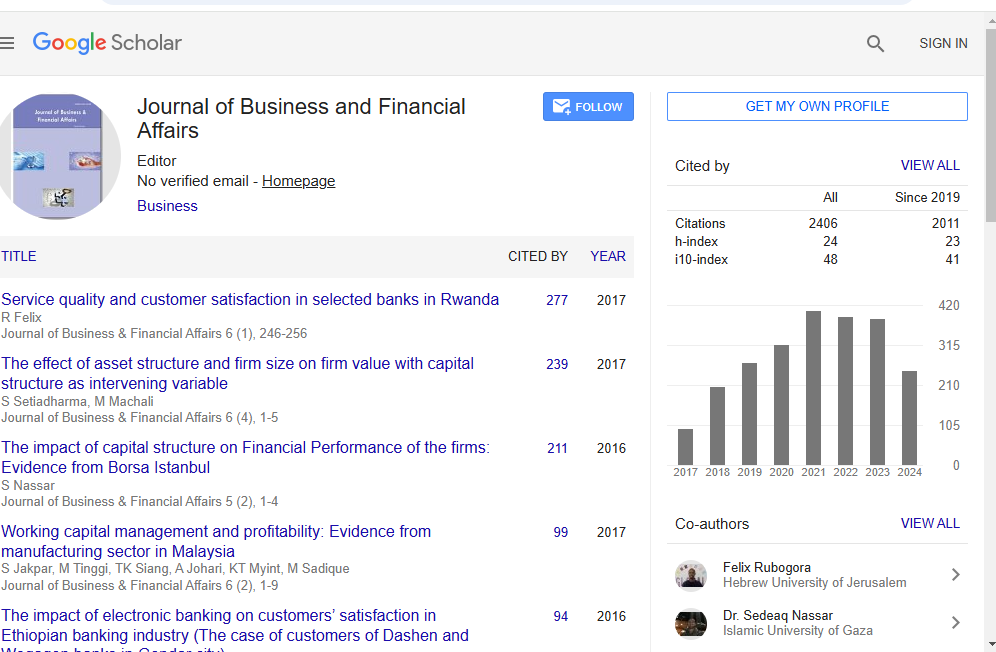
Journal of Business & Financial Affairs received 1726 citations as per Google Scholar report