Perspective - (2025) Volume 11, Issue 3
Received: 01-Jun-2025, Manuscript No. jssc-26-188280;
Editor assigned: 03-Jun-2025, Pre QC No. P-188280;
Reviewed: 17-Jun-2025, QC No. Q-188280;
Revised: 23-Jun-2025, Manuscript No. R-188280;
Published:
30-Jun-2025
, DOI: 10.37421/2472-0437.2025.11.302
Citation: Khan, Mohammed. ”Advanced Optimization Techniques
for Steel Roof Trusses.” J Steel Struct Constr 11 (2025):302.
Copyright: © 2025 Khan M. This is an open-access article distributed under the terms of the Creative Commons Attribution License, which permits unrestricted use, distribution
and reproduction in any medium, provided the original author and source are credited.
The structural optimization of steel roof trusses is a critical area of research aimed at enhancing efficiency, safety, and cost-effectiveness in construction. Numerous studies have explored various facets of this optimization process, employing diverse methodologies and addressing distinct design considerations. A significant focus has been on minimizing the weight of trusses while maintaining structural integrity and adhering to stringent strength and stability constraints. This involves leveraging advanced computational techniques, such as metaheuristic algorithms combined with finite element analysis, to navigate the complex design space and identify optimal member sizes and configurations, thereby achieving substantial weight reductions and effectively handling varied loading conditions and geometric complexities [1].
Furthermore, the performance of steel roof trusses, particularly under seismic events, is heavily influenced by the details of their connections. Research has delved into the impact of different connection types, employing advanced numerical modeling to simulate their behavior under dynamic loading. These investigations highlight how connection detailing profoundly affects the overall stiffness and ductility of the truss, directly impacting its load-carrying capacity during earthquakes. Consequently, guidelines for selecting optimal connection strategies are proposed to bolster resilience and cost-effectiveness in steel structures [2].
Topology optimization presents another powerful avenue for achieving efficient material distribution within a given design domain. This approach iteratively removes material from low-stress regions, refining the remaining structure to achieve significantly lighter and more efficient truss designs, especially for complex geometries and load cases, utilizing gradient-based optimization methods [3].
The advent of artificial intelligence has also revolutionized structural optimization. Machine learning algorithms are being employed for rapid structural optimization by training models on extensive simulation data. This allows for the prediction of optimal designs without the need for computationally intensive finite element analysis in every iteration, thereby accelerating the design process and identifying efficient solutions for diverse truss configurations and loading scenarios [4].
Multi-objective optimization extends the scope of truss design by simultaneously considering multiple design goals. For instance, the concurrent minimization of weight and cost is addressed using Pareto-based evolutionary algorithms to identify optimal solutions that balance these competing objectives. This provides engineers with flexibility in selecting designs that best align with project priorities, offering valuable insights into the trade-offs between economic and structural efficiency [5].
Ensuring structural stability is paramount, and research has explicitly addressed the influence of buckling constraints in the optimization process. By integrating advanced buckling analysis, these studies ensure the stability of truss members under various load conditions, highlighting that neglecting buckling can lead to unconservous designs. Robust optimization strategies that account for buckling phenomena are crucial for achieving safe and efficient structures [6].
Beyond static performance, the long-term durability of steel roof trusses is also a key consideration. Frameworks have been developed for optimizing trusses with fatigue life as a design criterion, combining structural analysis with fatigue prediction models. This approach aims to enhance long-term durability under cyclic loading by optimizing member sizing and connection details, emphasizing the importance of fatigue considerations for extending service life and achieving robust fatigue performance [7].
For highly complex and computationally expensive structural models, surrogate-assisted optimization offers a significant advancement. By developing accurate surrogate models, the number of high-fidelity simulations required is drastically reduced, leading to faster convergence to optimal designs. This efficiency is particularly beneficial for intricate truss structures and varying loading conditions [8].
Aerodynamic considerations also play a role in optimizing steel roof trusses. Research has explored shape optimization to improve aerodynamic performance and reduce wind loads. By integrating computational fluid dynamics (CFD) with structural optimization, truss geometries can be modified for enhanced wind resistance, leading to substantial reductions in wind-induced forces and contributing to more efficient and safer designs [9].
Finally, the inherent uncertainties in material properties and manufacturing tolerances necessitate robust design approaches. Probabilistic methods are employed to account for variations in material strength and dimensional accuracy, aiming to develop designs that maintain acceptable performance levels despite these variabilities, thereby leading to more reliable and cost-effective steel roof structures [10].
The fundamental objective of structural optimization for steel roof trusses is to achieve designs that are both economically viable and structurally sound. A primary strategy involves minimizing the overall weight of the truss while ensuring it can withstand anticipated loads without failure. This is often accomplished through the integration of metaheuristic algorithms with finite element analysis, a computational framework that systematically explores a wide range of design parameters, including member sizes and connectivity, to identify the most efficient configurations that satisfy strength and stability requirements, proving effective even under complex loading scenarios and geometric variations [1].
In the context of seismic resilience, the choice of connection type plays a pivotal role in the behavior of steel roof trusses. Research employing advanced numerical simulations has demonstrated that the detailing of bolted and welded connections significantly influences the stiffness and ductility of the entire structure. A well-designed connection system can enhance the truss's ability to dissipate energy during an earthquake, thus improving its overall seismic performance and providing engineers with strategies to optimize these crucial elements for greater safety and cost-effectiveness [2].
Topology optimization offers a more fundamental approach to design efficiency by focusing on the optimal distribution of material within a defined space. Through iterative processes that remove material from less stressed areas, this method can yield truss designs that are not only lighter but also more structurally efficient than those developed through traditional design practices, particularly when dealing with complex shapes and loading conditions [3].
The integration of artificial intelligence, specifically machine learning, is rapidly transforming the speed and efficiency of structural optimization. By training predictive models on vast datasets generated from simulations, it becomes possible to forecast optimal truss designs much faster than through conventional iterative analysis. This AI-driven approach accelerates the design cycle and identifies innovative, efficient solutions for various structural challenges [4].
Addressing multiple design objectives simultaneously, such as minimizing both weight and cost, is crucial for practical engineering applications. Multi-objective optimization techniques, like those employing Pareto-based evolutionary algorithms, allow for the generation of a spectrum of optimal solutions. These solutions illustrate the inherent trade-offs between competing goals, empowering engineers to select the most appropriate design based on specific project constraints and priorities, thereby achieving a balance between structural performance and economic considerations [5].
Structural stability, particularly against buckling, is a non-negotiable aspect of truss design. Studies incorporating explicit buckling constraints into the optimization process ensure that individual members and the overall structure remain stable under all operational loads. This proactive approach prevents potential failures that could arise from underestimating or ignoring buckling phenomena, leading to more reliable and secure steel roof structures [6].
For structures subjected to repetitive loading, fatigue life becomes a critical design parameter. Optimization frameworks that consider fatigue life aim to extend the serviceability of steel roof trusses by carefully sizing members and detailing connections to resist crack initiation and propagation. By integrating fatigue analysis with structural optimization, engineers can design for enhanced long-term durability and reduced maintenance needs [7].
In scenarios involving computationally intensive analyses, surrogate-assisted optimization provides a powerful solution. This method involves creating simplified but accurate models (surrogates) of the complex structural behavior. By reducing the number of high-fidelity simulations required, surrogate-assisted optimization significantly speeds up the process of finding optimal designs for intricate truss systems and demanding load conditions [8].
The external forces acting on roof structures, such as wind loads, can be substantial. Aerodynamic shape optimization focuses on modifying the geometry of truss elements to reduce these wind-induced forces. By coupling computational fluid dynamics with structural optimization, designs can be achieved that not only perform well structurally but also exhibit improved aerodynamic characteristics, leading to safer and more resource-efficient structures [9].
Finally, recognizing that real-world conditions involve variability in materials and manufacturing, robust optimization addresses these uncertainties. Probabilistic methods are used to account for variations in steel strength and dimensional accuracy, ensuring that the designed trusses maintain their performance levels under a range of possible conditions, thereby contributing to the overall reliability and cost-effectiveness of steel roof construction [10].
This collection of research papers explores various advanced techniques for optimizing steel roof trusses. The studies cover weight minimization using metaheuristic algorithms and finite element analysis, the impact of connection types on seismic performance, and topology optimization for efficient material distribution. Additionally, the research highlights the application of artificial intelligence and machine learning for accelerated design, multi-objective optimization considering weight and cost, and the critical importance of accounting for buckling constraints and fatigue life. The use of surrogate-assisted optimization for complex models and aerodynamic shape optimization to reduce wind loads are also investigated. Finally, robust optimization methods are presented to address uncertainties in material properties and manufacturing tolerances, all aiming to create safer, more efficient, and cost-effective steel roof structures.
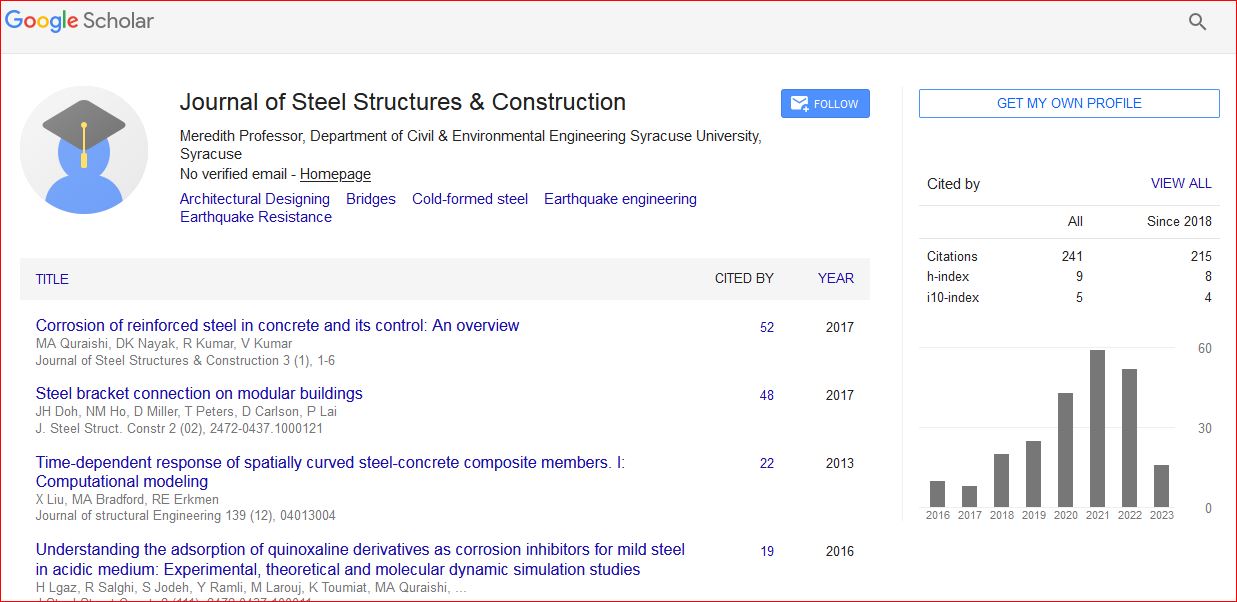
Journal of Steel Structures & Construction received 583 citations as per Google Scholar report