Brief Report - (2025) Volume 10, Issue 3
Received: 01-May-2025, Manuscript No. jncr-26-190075;
Editor assigned: 05-May-2025, Pre QC No. P-190075;
Reviewed: 19-May-2025, QC No. Q-190075;
Revised: 22-May-2025, Manuscript No. R-190075;
Published:
29-May-2025
, DOI: 10.37421/2572-0813.2025.10.292
Citation: Rahman, Liyana. ”Advanced Nanoscale Structure Characterization Techniques.” J Nanosci Curr Res 10 (2025):292.
Copyright: © 2025 Rahman L. This is an open-access article distributed under the terms of the Creative Commons Attribution License, which permits unrestricted use, distribution and reproduction in any medium, provided the original author and source are credited.
Characterizing nanoscale structures with high resolution is a critical endeavor for progress in numerous scientific and technological domains, including nanoscience, materials science, and biophysics. This foundational understanding allows for precise visualization and analysis of features at the atomic and molecular level, paving the way for innovation. Advanced electron microscopy techniques, such as aberration-corrected transmission electron microscopy (TEM) and scanning transmission electron microscopy (STEM), have emerged as pivotal tools, enabling unparalleled detail in imaging crystalline and amorphous nanomaterials. These methods facilitate the determination of atomic arrangements, identification of defects, and analysis of interfaces with atomic-scale precision, which is essential for understanding material properties and designing next-generation electronic and catalytic materials [1].
Complementing electron microscopy, scanning probe microscopy (SPM) offers a versatile suite of techniques, including atomic force microscopy (AFM) and scanning tunneling microscopy (STM), for nanoscale surface characterization. These methods excel in mapping topography and probing mechanical, electrical, and magnetic properties with remarkable nanoscale precision. Their non-destructive nature and adaptability make them indispensable for studying a wide range of sample types, from conductors to biological specimens, revealing intricate surface details that are otherwise inaccessible [2].
Super-resolution optical microscopy represents another transformative advancement, allowing imaging beyond the traditional diffraction limit. Techniques like stimulated emission depletion (STED), photoactivated localization microscopy (PALM), and stochastic optical reconstruction microscopy (STORM) have revolutionized the ability to visualize biological and material nanostructures with unprecedented detail. This capability is crucial for unraveling complex nanoscale organization and dynamics in cellular imaging and material defect analysis, thereby enhancing our understanding of biological processes and optimizing material performance [3].
X-ray scattering techniques, including small-angle X-ray scattering (SAXS) and wide-angle X-ray scattering (WAXS), provide powerful non-destructive means to probe the structure of nanoscale materials. These methods yield valuable information regarding particle size, shape, distribution, and crystallinity, offering insights into mesoscopic structures across diverse applications, from polymers and colloids to nanoparticles and porous materials. Their ability to reveal structural characteristics without altering the sample makes them highly advantageous for materials research [4].
Spectroscopic techniques, when integrated with high-resolution microscopy, are vital for a comprehensive understanding of nanoscale structures, particularly concerning their elemental composition and chemical states. Methods such as energy-dispersive X-ray spectroscopy (EDS) and electron energy loss spectroscopy (EELS) within electron microscopes, along with Raman and infrared spectroscopy coupled with SPM, provide crucial data for material identification and the analysis of nanoscale chemical variations, thereby elucidating structure-property relationships [5].
Three-dimensional imaging of nanoscale structures offers a more complete picture of their internal morphology and organization. Advancements in techniques like focused ion beam-scanning electron microscopy (FIB-SEM) tomography and cryo-electron tomography (cryo-ET) are instrumental in reconstructing complex nanoscale architectures. This capability is particularly significant for detailed spatial analysis of materials and biological systems, providing a deeper comprehension of intricate three-dimensional arrangements [6].
The development of in-situ and operando characterization techniques allows for the study of nanoscale structures under dynamic conditions that mimic their actual working environments. By employing methods such as in-situ TEM/STEM, in-situ AFM, and synchrotron-based techniques, researchers can observe nanoscale processes like catalysis, battery charging, and molecular self-assembly as they occur. This approach is critical for gaining insights into structure-property relationships during operational states, bridging the gap between static characterization and real-world performance [7].
Scanning probe microscopy has seen continuous innovation, particularly in the design of novel probes and the functionalization of their tips. These advancements push the boundaries of probing localized electronic, magnetic, and chemical properties at the single-molecule and atomic scales. Improvements in probe fabrication and control are essential for achieving higher sensitivity and spatial resolution, further expanding the capabilities of AFM and STM for detailed nanoscale analysis [8].
Furthermore, the integration of machine learning and artificial intelligence into nanoscale characterization workflows is poised to revolutionize data analysis and interpretation. AI algorithms can automate complex image processing tasks, identify subtle patterns, and even predict material properties from high-resolution structural data. This synergy promises to accelerate scientific discovery and optimize the utilization of advanced characterization tools [9].
Collectively, these advanced characterization techniques provide essential insights for understanding fundamental material properties, designing novel nanomaterials with tailored functionalities, and developing sophisticated nanoscale devices that drive technological progress across a multitude of fields. The ongoing evolution of these methodologies ensures a continuous expansion of our capabilities at the nanoscale [10].
High-resolution characterization of nanoscale structures is fundamental to advancing fields such as nanoscience, materials science, and biophysics. This article explores advanced techniques enabling precise visualization and analysis at the atomic and molecular levels. Key methodologies include advanced electron microscopy, such as aberration-corrected TEM and STEM, which provide atomic-scale resolution for characterizing crystalline and amorphous nanomaterials. These techniques are crucial for determining atomic arrangements, identifying defects, and analyzing interfaces, essential for understanding material properties and designing next-generation electronic and catalytic materials [1].
Scanning probe microscopy (SPM), encompassing AFM and STM, offers versatile tools for nanoscale surface characterization. These methods are vital for mapping topography and probing mechanical, electrical, and magnetic properties with nanoscale precision. Their non-destructive nature and adaptability make them indispensable for studying the surfaces of insulators, conductors, and biological samples, revealing intricate surface details [2].
Super-resolution optical microscopy has dramatically enhanced our ability to image nanostructures beyond the diffraction limit. Techniques like STED, PALM, and STORM allow for unprecedented detail in cellular imaging and material defect analysis, crucial for unraveling complex nanoscale organization and dynamics. This helps in understanding biological processes and optimizing material performance [3].
X-ray scattering techniques, such as SAXS and WAXS, serve as powerful non-destructive methods for probing the structure of nanoscale materials. They provide information on particle size, shape, distribution, and crystallinity, offering insights into mesoscopic structures. Their application spans a wide range of materials, including polymers, colloids, nanoparticles, and porous materials [4].
Spectroscopic techniques, when combined with high-resolution microscopy, are vital for determining the elemental composition and chemical state of nanoscale structures. Methods like EDS and EELS in electron microscopy, alongside Raman and infrared spectroscopy for SPM, provide crucial data for material identification and understanding nanoscale chemical variations [5].
Three-dimensional imaging of nanoscale structures is instrumental in gaining a comprehensive understanding of their internal morphology and organization. Techniques such as FIB-SEM tomography and cryo-ET are pivotal for reconstructing complex nanoscale architectures in both materials and biological systems, enabling detailed spatial analysis [6].
In-situ and operando characterization techniques enable the study of nanoscale structures under dynamic conditions, simulating their actual working environments. By using in-situ TEM/STEM, in-situ AFM, and synchrotron-based methods, researchers can observe nanoscale processes such as catalysis, battery charging, and molecular self-assembly, providing critical insights into structure-property relationships during operation [7].
Advances in scanning probe microscopy are driven by novel probe designs and tip functionalization strategies. These innovations enhance the ability to probe localized electronic, magnetic, and chemical properties at the single-molecule and atomic scales. Enhanced probe fabrication and control are key to achieving higher sensitivity and spatial resolution in SPM [8].
The integration of machine learning and artificial intelligence into nanoscale characterization workflows is transforming data analysis and interpretation. AI algorithms can automate image processing, identify complex patterns, and predict material properties from high-resolution structural data, thereby accelerating discovery and optimizing the use of advanced characterization tools [9].
Collectively, these advanced techniques are indispensable for understanding fundamental nanoscale properties, designing novel nanomaterials, and developing sophisticated nanoscale devices. Their continued development and application promise to drive significant advancements across diverse scientific and technological frontiers [10].
This document outlines various advanced techniques for characterizing nanoscale structures. It highlights the importance of high-resolution imaging and analysis in fields like nanoscience and materials science. Key methodologies discussed include advanced electron microscopy (TEM, STEM), scanning probe microscopy (AFM, STM), and super-resolution optical microscopy, which enable visualization at the atomic and molecular levels. The content also covers X-ray scattering for structural analysis, spectroscopic methods for elemental and chemical composition, and 3D imaging techniques for morphology. Furthermore, it addresses in-situ and operando characterization for dynamic processes and the emerging role of AI and machine learning in data analysis. These techniques are crucial for understanding material properties, designing new nanomaterials, and developing advanced nanoscale devices.
None.
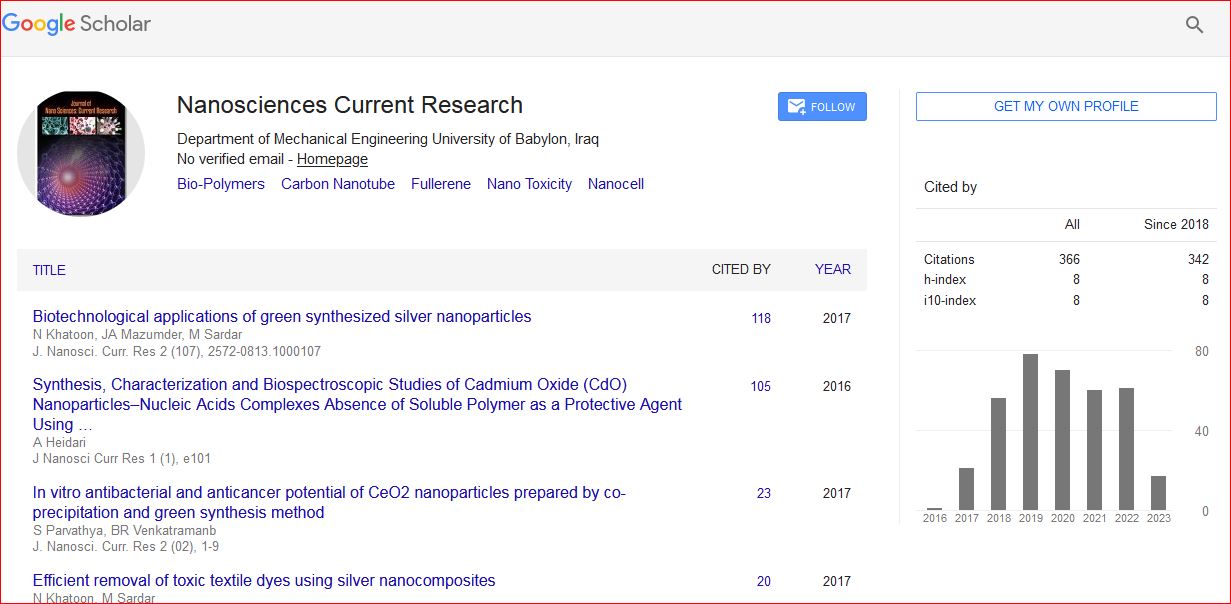
Journal of Nanosciences: Current Research received 387 citations as per Google Scholar report