Opinion - (2025) Volume 14, Issue 6
Received: 01-Dec-2025, Manuscript No. idse-26-183634;
Editor assigned: 03-Dec-2025, Pre QC No. P-183634;
Reviewed: 17-Dec-2025, QC No. Q-183634;
Revised: 22-Dec-2025, Manuscript No. R-183634;
Published:
29-Dec-2025
, DOI: 10.37421/2168-9768.2025.14.521
Citation: Conti, Alessandra. ”Advanced Irrigation and Drainage
System Design.” Irrigat Drainage Sys Eng 14 (2025):521.
Copyright: © 2025 Conti A. This is an open-access article distributed under the terms of the Creative Commons Attribution License, which permits unrestricted use, distribution
and reproduction in any medium, provided the original author and source are credited.
The effective management of water resources in agricultural systems is paramount for ensuring food security and sustainable land use. Advanced computational techniques are increasingly being employed to model and analyze complex irrigation and drainage systems, allowing for more precise predictions of flow patterns and optimized system designs [1].
These sophisticated modeling approaches, including computational fluid dynamics (CFD) and finite element analysis (FEA), are crucial for understanding the intricate interactions between water, soil, and infrastructure, thereby identifying potential issues before they impact productivity. In the realm of subsurface drainage, the design configurations play a critical role in enhancing agricultural land productivity and mitigating waterlogging, particularly in challenging soil types like clayey soils. Comparative studies have evaluated conventional layouts against novel, optimized designs, highlighting how tailored spacing and depth, informed by detailed soil surveys and hydrological modeling, can lead to significant improvements in crop yields and reductions in environmental risks associated with excess soil moisture [2].
For arid and semi-arid regions facing water scarcity, the efficiency of micro-irrigation systems is of utmost importance. Research has focused on the design and optimization of sprinkler and drip irrigation parameters to maximize water use efficiency and minimize energy consumption. The findings consistently underscore the necessity of appropriate system selection, uniform water application, and diligent maintenance for achieving sustainability under water-limited conditions [3].
Climate change presents a significant challenge to the established practices of irrigation. The impact of altered precipitation patterns and increased evapotranspiration rates on water availability and demand necessitates adaptive strategies in the design and performance of surface irrigation systems. Hydrological modeling is being used to simulate these effects, emphasizing the need for flexible design approaches and enhanced water management practices to maintain system viability [4].
The hydraulic design of pumping stations is a critical component of large-scale irrigation projects, with a strong emphasis on energy efficiency and system reliability. The selection of appropriate pump types, impeller designs, and control strategies significantly influences operational costs and equipment lifespan. Accurate estimations of flow and head, considering system hydraulics and fluctuating energy prices, are essential for optimal design [5].
Integrated approaches to designing irrigation and drainage networks are gaining traction, especially in peri-urban agricultural areas. By combining hydrological modeling with spatial analysis, it is possible to optimize water conveyance and wastewater management, thereby minimizing environmental pollution and maximizing water reuse. This integrated perspective recognizes the interconnectedness of irrigation and drainage as vital components of sustainable water infrastructure [6].
Remote sensing and Geographic Information Systems (GIS) offer powerful tools for the optimal design and management of irrigation systems. Satellite imagery and spatial data enable precise delineation of command areas, accurate assessment of crop water requirements, and effective monitoring of system performance. These technologies are proving to be cost-effective and highly accurate in improving irrigation planning and water allocation strategies [7].
Pressurized irrigation pipelines are susceptible to water hammer phenomena, which can cause significant damage. Analysis of hydraulic transients, often triggered by valve operations or pump failures, is crucial for designing effective mitigation measures. Practical guidelines for surge protection devices and operational procedures are essential for preventing pipeline damage and ensuring the safety and longevity of these systems [8].
Drainage water management strategies in agricultural watersheds have profound economic and environmental implications. Evaluating options such as controlled drainage, constructed wetlands, and edge-of-field treatments through lifecycle assessment and cost-benefit analysis reveals that integrated approaches, combining both structural and non-structural measures, are most effective in reducing nutrient pollution and improving overall water quality [9].
Open channel irrigation canals require careful hydraulic design to manage sediment transport and control erosion. Incorporating principles of open channel hydraulics and sediment dynamics is essential for maintaining stable canal cross-sections and minimizing maintenance. Accurate estimation of flow velocities and bed shear stresses is critical to prevent excessive scour or deposition, ensuring the long-term functionality of these vital water conveyance structures [10].
The analysis of complex irrigation and drainage systems has been significantly advanced by the adoption of sophisticated numerical methods. Techniques such as computational fluid dynamics (CFD) and finite element analysis (FEA) are now integral to accurately predicting flow patterns, optimizing the design of pipe networks, and evaluating the influence of diverse soil hydraulic properties on system performance and water management. These high-resolution modeling approaches are vital for detecting potential issues like erosion, sedimentation, and uneven water distribution [1].
In the context of agricultural productivity, the effectiveness of subsurface drainage systems, particularly in clayey soils prone to waterlogging, is a critical research area. Studies have systematically compared conventional drainage layouts with innovative, optimized designs derived from hydraulic principles and empirical field data. The findings consistently point to the significant benefits of precisely tailored drainage spacing and depth, guided by comprehensive soil surveys and hydrological modeling, in boosting crop yields and minimizing environmental hazards linked to saturated soil conditions [2].
For regions grappling with water scarcity, such as arid and semi-arid environments, the optimization of micro-irrigation systems is a key focus. Research efforts are directed towards refining sprinkler and drip irrigation parameters to achieve peak water use efficiency and reduce energy consumption. A central conclusion from this work is the indispensable role of selecting appropriate systems, ensuring uniform water application, and implementing consistent maintenance practices for sustainable agricultural water management [3].
The escalating impact of climate change necessitates a re-evaluation of irrigation system designs. For surface irrigation systems, altered precipitation patterns and amplified evapotranspiration rates present substantial challenges to water availability and demand. Hydrological models are being employed to simulate these climatic effects, underscoring the urgent need for adaptive design strategies and improved water management protocols to sustain the efficacy of surface irrigation [4].
Efficient hydraulic design of pumping stations is fundamental to the operation of large-scale irrigation projects. Key considerations include maximizing energy efficiency and ensuring operational reliability. The selection of suitable pump types, impeller configurations, and advanced control strategies directly impacts operational costs and the longevity of the installed equipment. Precise calculations of flow rates and head, informed by system hydraulics and energy market dynamics, are indispensable for achieving optimal design outcomes [5].
An integrated approach to designing interconnected irrigation and drainage networks is proving to be highly effective, particularly in the complex environment of peri-urban agriculture. This methodology synergistically combines hydrological modeling with spatial analysis to enhance water conveyance efficiency and improve wastewater management. The primary objectives are to mitigate environmental pollution and maximize opportunities for water reuse, highlighting the importance of viewing irrigation and drainage as a unified system for sustainable water management [6].
The application of remote sensing and Geographic Information Systems (GIS) has revolutionized the optimal design and ongoing management of irrigation systems. By leveraging satellite imagery and diverse spatial datasets, it becomes feasible to accurately delineate command areas, precisely assess crop-specific water requirements, and effectively monitor the real-time performance of irrigation infrastructure. These advanced technological tools offer both cost-effectiveness and a high degree of accuracy in enhancing irrigation planning and water allocation strategies [7].
Within pressurized irrigation pipelines, the phenomenon of water hammer poses a significant risk to system integrity. Hydraulic transient analysis is employed to predict and understand pressure surges that can occur due to operational events like rapid valve closure or unexpected pump shutdowns. This research provides critical practical guidance on the design of surge protection devices and the implementation of safe operational procedures to avert pipeline damage and ensure overall system security [8].
Strategies for managing drainage water in agricultural watersheds are under scrutiny for their economic viability and environmental footprint. Comprehensive evaluations using lifecycle assessment and cost-benefit analysis for various techniques, including controlled drainage, the implementation of constructed wetlands, and edge-of-field treatments, reveal that integrated strategies are most effective. These combined structural and non-structural measures offer the optimal solution for reducing nutrient runoff and improving water quality standards [9].
The hydraulic design of open channel irrigation canals is a specialized field that must account for the complexities of sediment transport and the need for effective erosion control. This design process integrates fundamental principles of open channel hydraulics with an understanding of sediment dynamics to ensure the stability of canal cross-sections and minimize ongoing maintenance. Accurate predictions of flow velocities and bed shear stresses are paramount to prevent excessive scour or undesirable sediment deposition, thereby maintaining the canal's operational efficiency [10].
This collection of research explores various facets of irrigation and drainage system design and management. It highlights the use of advanced numerical modeling techniques like CFD and FEA for system analysis and optimization. Studies also focus on subsurface drainage in clayey soils to improve agricultural productivity and reduce waterlogging. The efficiency of micro-irrigation systems in arid regions, adaptive strategies for surface irrigation under climate change, and the hydraulic design of pumping stations for energy efficiency are discussed. Integrated approaches to irrigation and drainage networks in peri-urban areas are presented, alongside the application of remote sensing and GIS for better planning and management. The research also addresses water hammer mitigation in pressurized pipelines and the economic and environmental assessment of drainage water management strategies. Finally, the hydraulic design of open channel canals for sediment transport and erosion control is detailed.
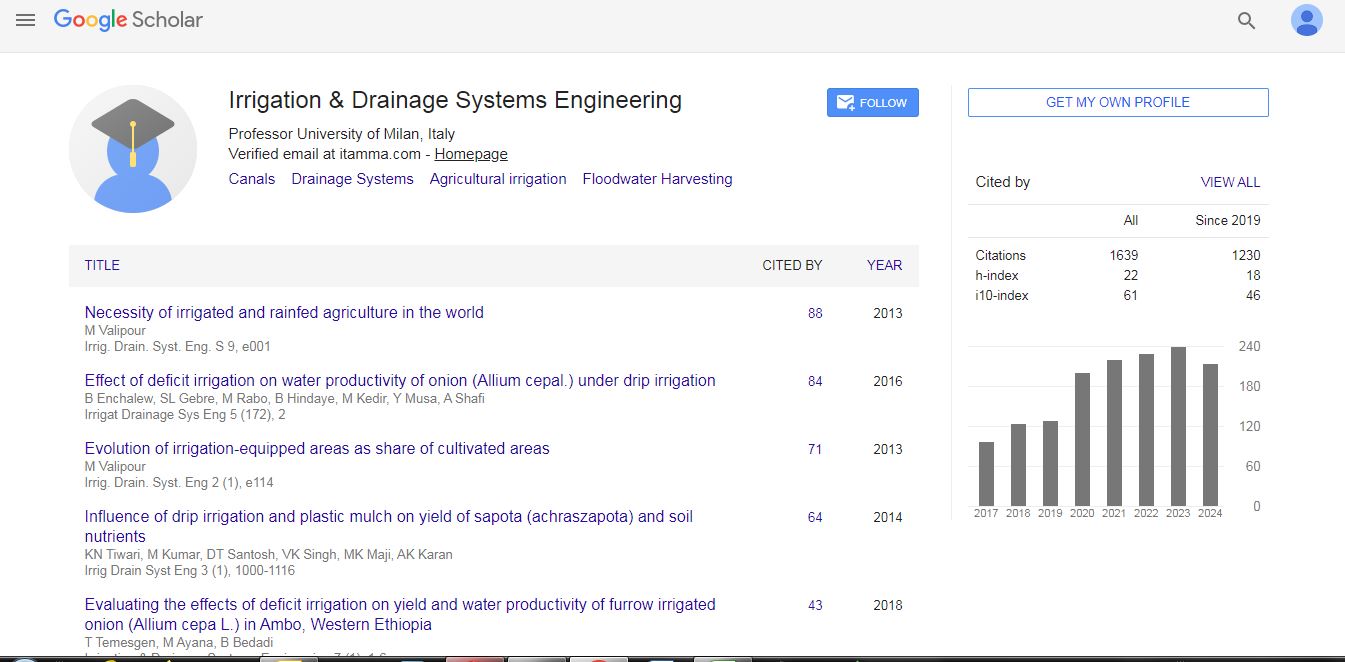
Irrigation & Drainage Systems Engineering received 835 citations as per Google Scholar report