Brief Report - (2025) Volume 11, Issue 5
Received: 01-Oct-2025, Manuscript No. JOV-26-186435;
Editor assigned: 03-Oct-2025, Pre QC No. P-186435;
Reviewed: 17-Oct-2025, QC No. Q-186435;
Revised: 22-Oct-2025, Manuscript No. R-186435;
Published:
29-Oct-2025
, DOI: 10.37421/2471-9544.2025.11.321
Citation: Petrovic, Sofia. ”Advanced Imaging: Radiant Echoes in Vasculitis Diagnosis.” J Vasc 11 (2025):321.
Copyright: © 2025 Petrovic S. This is an open-access article distributed under the terms of the Creative Commons Attribution License, which permits unrestricted use, distribution and reproduction in any medium, provided the original author and source are credited.
The intricate landscape of vasculitis, particularly its impact on the arterial tree, necessitates advanced imaging modalities for accurate diagnosis and monitoring. High-resolution ultrasound, employing techniques that illuminate fragmented arterial involvement, offers significant diagnostic and prognostic value by revealing the heterogeneous manifestations of vasculitis within the arterial network [1].
This approach is crucial for understanding early inflammatory changes and long-term arterial damage. Contrast-enhanced ultrasound (CEUS) extends this diagnostic capability by visualizing the microvasculature within vasculitic lesions. It demonstrates how blood flow dynamics can signify active inflammation and detects subtle changes with enhanced perfusion patterns, even in fragmented arterial segments, thereby contributing to a deeper understanding of 'radiant echoes' [2].
Advanced magnetic resonance imaging (MRI) techniques, including gadolinium-enhanced sequences and flow-sensitive imaging, are instrumental in assessing vasculitis. These methods map inflammation, stenosis, and aneurysms across fragmented arterial segments, providing a comprehensive view of vascular damage critical for patient management [3].
Positron emission tomography/computed tomography (PET-CT) imaging plays a vital role in detecting inflammatory activity within the arterial wall. By visualizing metabolic processes associated with vasculitis, this technique can identify active inflammation in larger vessels, even when the arterial tree appears fragmented [4].
Doppler ultrasound techniques are particularly adept at assessing blood flow patterns in complex or fragmented arterial systems. They provide crucial 'radiant echoes' by identifying turbulent flow, aliasing, and spectral broadening as indicators of stenosis or vascular wall abnormalities, especially in challenging anatomical locations [5].
Multidetector CT angiography (MDCT-A) offers detailed vascular imaging, yielding 'radiant echoes' that are invaluable for delineating the extent of vasculitis within a fragmented arterial tree. This modality aids significantly in surgical planning and monitoring treatment response when traditional methods are insufficient [6].
The correlation between imaging findings, referred to as 'radiant echoes,' and clinical outcomes in vasculitis patients is a key area of research. Patterns of arterial wall thickening, luminal narrowing, and collateralization visualized through various imaging modalities can predict disease progression and the risk of complications [7].
Despite advancements, current imaging techniques face limitations in fully capturing the dynamic and fragmented nature of vasculitis. Integrated 'radiant echoes' from complementary modalities are essential for a more complete understanding and improved management of this challenging disease [8].
Specific subtypes of vasculitis benefit from advanced imaging techniques like spectral Doppler and power Doppler. These methods generate 'radiant echoes' that identify characteristic vascular wall abnormalities and flow disturbances, aiding in differentiating vasculitic involvement from other arteriopathies [9].
Artificial intelligence (AI) is emerging as a powerful tool in interpreting complex vascular imaging in vasculitis. AI enhances the extraction of 'radiant echoes,' improving the detection of subtle changes, lesion segmentation, and prediction of disease progression, thereby supporting personalized patient care [10].
Vascular imaging plays a pivotal role in understanding and managing vasculitis, a condition that often affects the arterial tree in a fragmented manner. High-resolution ultrasound techniques are instrumental in illuminating these complex patterns, offering valuable diagnostic and prognostic insights into the heterogeneous manifestations of vasculitis within the arterial network. This advanced imaging aids in discerning early inflammatory changes and the subsequent long-term sequelae of arterial damage, underscoring the need for a multi-modal approach [1].
Contrast-enhanced ultrasound (CEUS) further enhances the visualization of vasculitic lesions by focusing on the microvasculature. This modality reveals blood flow dynamics indicative of active inflammation and detects subtle abnormalities that might be missed by conventional ultrasound. The detailed assessment of perfusion patterns, even in fragmented arterial segments, contributes significantly to the understanding of 'radiant echoes' in vasculitis [2].
Advanced magnetic resonance imaging (MRI) modalities, such as those employing gadolinium contrast and flow-sensitive sequences, provide comprehensive assessments of the arterial tree in vasculitis. These techniques are adept at mapping inflammation, stenosis, and aneurysms across fragmented arterial segments, offering a detailed picture of vascular compromise that is vital for effective patient management [3].
Positron emission tomography/computed tomography (PET-CT) imaging contributes to the diagnostic armamentarium by visualizing metabolic activity associated with arterial wall inflammation. This technique effectively identifies active inflammation in larger vessels, even when the arterial tree's integrity is compromised by fragmentation due to disease progression or prior damage [4].
Doppler ultrasound techniques are particularly effective in assessing the hemodynamic consequences of vasculitis within complex and fragmented arterial systems. By evaluating blood flow patterns, these methods generate crucial 'radiant echoes' that highlight turbulent flow, aliasing, and spectral broadening, serving as key indicators of stenosis and vascular wall abnormalities, especially in difficult anatomical regions [5].
Multidetector CT angiography (MDCT-A) provides highly detailed anatomical information of the vasculature, yielding 'radiant echoes' that are indispensable for defining the extent of vasculitis within a fragmented arterial tree. The precision of MDCT-A greatly assists in pre-surgical planning and in monitoring the effectiveness of therapeutic interventions [6].
Research is increasingly focusing on the correlation between imaging findings, termed 'radiant echoes,' and the clinical trajectory of patients with vasculitis. The patterns of arterial wall changes and flow disturbances observed through various imaging modalities can serve as critical biomarkers for predicting disease progression, treatment response, and the likelihood of developing complications [7].
Despite the considerable advancements in imaging, significant challenges remain in fully characterizing the dynamic and fragmented nature of vasculitis within the arterial tree. The integration of 'radiant echoes' from complementary imaging modalities is deemed essential for achieving a more holistic understanding and improving the management strategies for this complex condition [8].
For specific vasculitis subtypes, advanced Doppler ultrasound techniques, including spectral and power Doppler, are crucial for generating 'radiant echoes' that identify characteristic vascular wall abnormalities and flow disturbances. This diagnostic precision aids in differentiating vasculitic involvement from other arteriopathies [9].
The integration of artificial intelligence (AI) into the interpretation of complex vascular imaging in vasculitis represents a frontier in improving diagnostic accuracy. AI algorithms can enhance the extraction and analysis of 'radiant echoes,' leading to more sensitive detection of subtle lesions, improved segmentation, and more accurate predictions of disease progression, thereby personalizing patient care [10].
This compilation of research explores the critical role of advanced imaging techniques in diagnosing and monitoring vasculitis, particularly its impact on the arterial tree. Various modalities, including high-resolution ultrasound, contrast-enhanced ultrasound (CEUS), advanced MRI, PET-CT, Doppler ultrasound, and MDCT-A, are highlighted for their ability to provide 'radiant echoes' â?? key imaging findings that reveal inflammation, stenosis, and vascular damage. These techniques are essential for understanding the fragmented nature of arterial involvement in vasculitis, offering diagnostic and prognostic value. The research also touches upon the correlation between imaging biomarkers and clinical outcomes, the challenges in imaging this complex disease, and the emerging role of artificial intelligence in enhancing diagnostic accuracy and personalized patient care. A multi-modal imaging approach is consistently emphasized as crucial for comprehensive assessment and management.
None
None
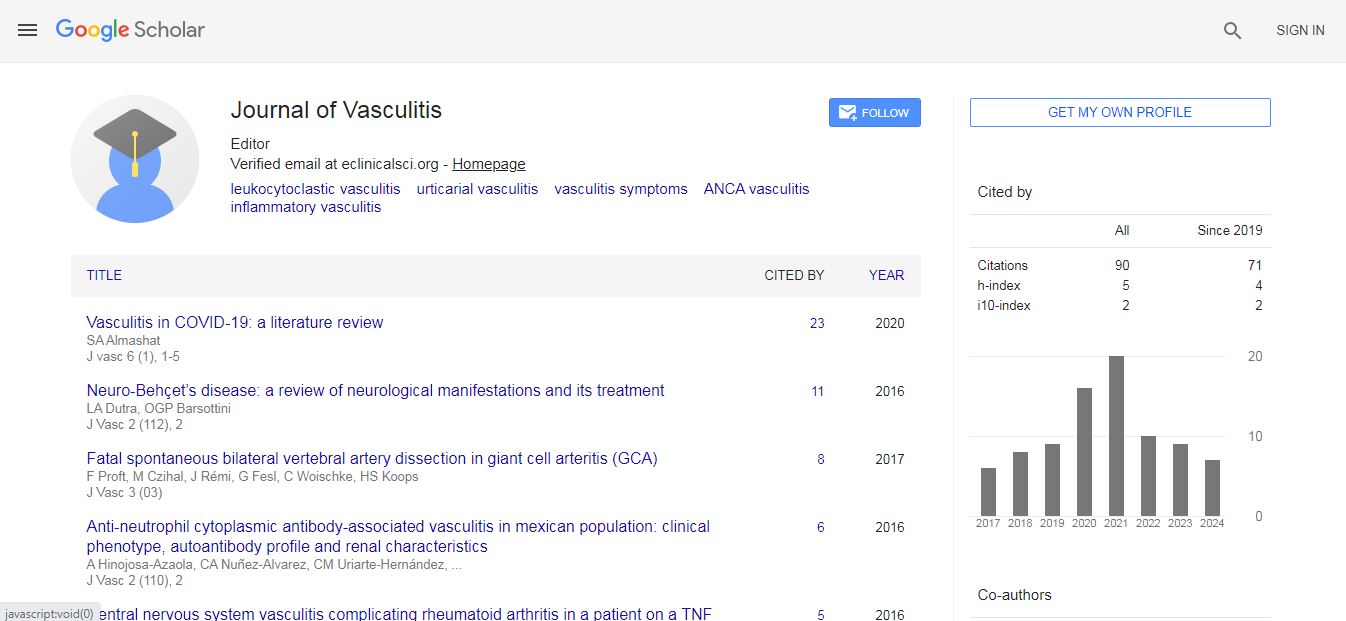
Journal of Vasculitis received 83 citations as per Google Scholar report