Commentary - (2025) Volume 15, Issue 6
Received: 01-Dec-2025, Manuscript No. jprm-26-181321;
Editor assigned: 03-Dec-2025, Pre QC No. P-181321;
Reviewed: 17-Dec-2025, QC No. Q-181321;
Revised: 22-Dec-2025, Manuscript No. R-181321;
Published:
29-Dec-2025
, DOI: 10.37421/2161-105X.2025.15.775
Citation: Sergeeva, Natalia. ”Advanced Imaging & AI Transform Pulmonary Care.” J Pulm Respir Med 15 (2025):757.
Copyright: © 2025 Sergeeva N. This is an open-access article distributed under the terms of the Creative Commons Attribution License, which permits unrestricted use, distribution and reproduction in any medium, provided the original author and source are credited.
The application of Artificial Intelligence (AI) in chest Computed Tomography (CT) is transforming the early detection and diagnosis of various pulmonary diseases. AI algorithms significantly improve diagnostic accuracy and efficiency, particularly in complex conditions like interstitial lung disease, pneumonia, and lung cancer, through automated image analysis and feature extraction [1].
Magnetic Resonance Imaging (MRI) shows promising capabilities and future prospects for diagnosing and monitoring interstitial lung diseases (ILDs). Various MRI techniques, including proton, hyperpolarized gas, and ultrashort echo time sequences, can provide vital functional and structural information without using ionizing radiation, positioning MRI as a strong alternative or complementary tool to CT [2].
Quantitative CT plays an emerging role in the comprehensive assessment and management of Chronic Obstructive Pulmonary Disease (COPD). Quantitative measures such as emphysema index, airway wall thickness, and gas trapping offer personalized insights into disease progression, phenotype, and treatment response, moving beyond traditional spirometry methods [3].
The utility of MRI extends to diagnosing and monitoring Acute Respiratory Distress Syndrome (ARDS). Advanced MRI techniques, including lung perfusion and ventilation imaging, serve as non-invasive tools to assess lung injury, edema, and alveolar recruitment, providing a valuable radiation-free option for critically ill patients [4].
CT pulmonary angiography (CTPA) is a highly accurate diagnostic modality for acute pulmonary embolism (PE). Systematic reviews and meta-analyses confirm its high sensitivity and specificity, underscoring its crucial role in the diagnostic algorithm for suspected PE, with careful attention to technique and interpretation being paramount [5].
Dual-Energy CT (DECT) has diverse applications in lung cancer imaging, offering distinct advantages over conventional single-energy CT. DECT improves lesion characterization, helps differentiate benign from malignant nodules, aids in assessing lymph node involvement, detects distant metastases, and evaluates treatment response comprehensively [6].
Free-breathing lung MRI demonstrates feasibility and utility in pediatric patients with cystic fibrosis. This non-invasive technique effectively visualizes lung structural changes, inflammation, and air trapping, providing a radiation-free alternative for long-term monitoring in this vulnerable population [7].
AI models show promising accuracy in diagnosing COVID-19 from chest CT images. Systematic reviews and meta-analyses conclude that AI-powered systems can be valuable tools for rapid and efficient diagnosis, especially in settings with limited resources, though further validation remains necessary [8].
Low-Dose CT (LDCT) lung cancer screening represents a critical advancement. Narrative reviews discuss recent guideline updates, eligibility criteria, the benefits of early detection, and the challenges like false positives and incidental findings, emphasizing its significant role in reducing lung cancer mortality [9].
Advanced MRI techniques are also outlined for evaluating pulmonary hypertension (PH). Cardiac MRI assesses right ventricular function and morphology, while pulmonary perfusion and flow imaging provide insights into hemodynamics and vascular remodeling, offering a comprehensive, non-invasive assessment tool for diagnosis and monitoring of PH [10].
Medical imaging continues to evolve with significant advancements across various modalities for diagnosing and managing pulmonary diseases. Artificial Intelligence (AI) is at the forefront of this evolution, particularly in chest Computed Tomography (CT). AI algorithms enhance diagnostic accuracy and efficiency for conditions such as interstitial lung disease, pneumonia, and lung cancer, by automating complex image analysis and feature extraction [1]. This demonstrates a shift towards more precise and efficient diagnostic workflows, especially in challenging cases.
Magnetic Resonance Imaging (MRI) presents a compelling alternative, particularly for patients requiring radiation-free options. Its capabilities are expanding in diagnosing and monitoring interstitial lung diseases (ILDs), employing techniques like proton, hyperpolarized gas, and ultrashort echo time sequences to provide critical functional and structural insights [2]. Moreover, MRI has shown significant utility in assessing Acute Respiratory Distress Syndrome (ARDS) through lung perfusion and ventilation imaging, offering a non-invasive way to evaluate lung injury, edema, and alveolar recruitment in critically ill patients [4]. This makes MRI an invaluable tool for long-term monitoring, exemplified by its application in pediatric cystic fibrosis patients, where free-breathing lung MRI visualizes structural changes, inflammation, and air trapping effectively [7].
CT-based imaging, while involving radiation, offers its own set of advanced applications. Quantitative CT is transforming the assessment and management of Chronic Obstructive Pulmonary Disease (COPD). By providing measures such as emphysema index, airway wall thickness, and gas trapping, it offers personalized data on disease progression, phenotype, and treatment response, moving beyond conventional spirometry [3]. Furthermore, CT pulmonary angiography (CTPA) remains a highly sensitive and specific method for diagnosing acute pulmonary embolism (PE), crucial for timely intervention and patient management [5]. The precision of these CT modalities is also evident in Dual-Energy CT (DECT) for lung cancer imaging, which improves lesion characterization, differentiates nodules, assesses lymph node involvement, and evaluates treatment responses more effectively than standard CT [6].
The integration of AI further optimizes CT imaging, as seen in its promising performance for COVID-19 diagnosis from chest CT images. AI-powered systems provide rapid and efficient diagnostic support, particularly in resource-constrained environments, although ongoing validation is key [8]. Beyond diagnosis, Low-Dose CT (LDCT) lung cancer screening has become a vital tool for reducing mortality through early detection. Current guidelines, eligibility criteria, and considerations regarding false positives and incidental findings are continually refined to maximize its benefits [9].
Advanced MRI techniques also provide comprehensive non-invasive assessments for conditions like pulmonary hypertension (PH). Cardiac MRI helps evaluate right ventricular function and morphology, while pulmonary perfusion and flow imaging offer insights into hemodynamics and vascular remodeling, improving diagnosis and monitoring without the need for ionizing radiation [10]. This array of sophisticated imaging techniques, both CT and MRI-based, often augmented by AI, collectively contributes to a more accurate, efficient, and patient-centric approach to diagnosing and managing complex pulmonary conditions.
Advances in medical imaging, encompassing both Computed Tomography (CT) and Magnetic Resonance Imaging (MRI), are revolutionizing the diagnosis and management of pulmonary diseases. Artificial Intelligence (AI) significantly enhances chest CT capabilities, improving diagnostic accuracy and efficiency for conditions like interstitial lung disease, pneumonia, and lung cancer, by automating image analysis. AI models also show promise in rapid COVID-19 diagnosis from CT scans. Quantitative CT offers personalized insights for Chronic Obstructive Pulmonary Disease (COPD) management, detailing disease progression and treatment response with measures like emphysema index. Specialized CT modalities like CT pulmonary angiography (CTPA) are crucial for diagnosing acute pulmonary embolism (PE), while Dual-Energy CT (DECT) provides superior lesion characterization and staging for lung cancer. Low-Dose CT (LDCT) lung cancer screening plays a vital role in early detection and mortality reduction. MRI, as a radiation-free alternative, is increasingly valuable. It's used for diagnosing and monitoring interstitial lung diseases (ILDs) and Acute Respiratory Distress Syndrome (ARDS), assessing lung injury and function. Free-breathing lung MRI is particularly beneficial for long-term monitoring in pediatric cystic fibrosis patients. Furthermore, advanced MRI techniques are essential for evaluating pulmonary hypertension (PH), providing comprehensive assessments of cardiac function and vascular remodeling. Collectively, these imaging innovations, often supported by AI, lead to more precise, efficient, and safer patient care in pulmonary medicine.
None
None
1. Yuancheng W, Xudong W, Lei Z. "Artificial Intelligence for Early Detection and Diagnosis of Pulmonary Diseases on Chest Computed Tomography: A Systematic Review".J Healthc Eng 2022 (2022):4310319.
Indexed at, Google Scholar, Crossref
2. Eva MF, Michael PS, Philippe AC. "Magnetic resonance imaging for interstitial lung diseases: a state-of-the-art review".Eur Radiol 33 (2023):521-536.
Indexed at, Google Scholar, Crossref
3. John DNJ, Eric AH, David AL. "Quantitative CT Imaging in Chronic Obstructive Pulmonary Disease: A New Paradigm for Management".Radiology 295 (2020):284-297.
Indexed at, Google Scholar, Crossref
4. Felix D, Stefan WW, Simon R. "Magnetic resonance imaging in acute respiratory distress syndrome: current status and future directions".Intensive Care Med Exp 10 (2022):54.
Indexed at, Google Scholar, Crossref
5. Zhaorui S, Wei Z, Yi Y. "Diagnostic accuracy of CT pulmonary angiography for acute pulmonary embolism: a systematic review and meta-analysis of prospective studies".Eur Radiol 31 (2021):5040-5051.
Indexed at, Google Scholar, Crossref
6. Qi C, Xiaohong H, Yizhen S. "Applications of Dual-Energy CT in Lung Cancer: A Comprehensive Review".Front Oncol 11 (2021):730623.
Indexed at, Google Scholar, Crossref
7. Sabine LM, Janette CH, Laura EG. "Free-breathing lung MRI for the diagnosis and follow-up of children with cystic fibrosis".Eur Radiol 32 (2022):4744-4754.
Indexed at, Google Scholar, Crossref
8. Junwei L, Weiming S, Liang L. "Artificial intelligence for COVID-19 diagnosis on chest CT: a systematic review and meta-analysis".Eur Radiol 32 (2022):172-184.
Indexed at, Google Scholar, Crossref
9. Yuji N, Kiyoshi M, Satoshi T. "Low-Dose CT Lung Cancer Screening: A Narrative Review".Diagnostics (Basel) 12 (2022):1851.
Indexed at, Google Scholar, Crossref
10. Hyo-Won K, Young JK, Joung SK. "Advanced MR imaging techniques in pulmonary hypertension: state of the art and future perspectives".Eur Radiol 30 (2020):433-446.
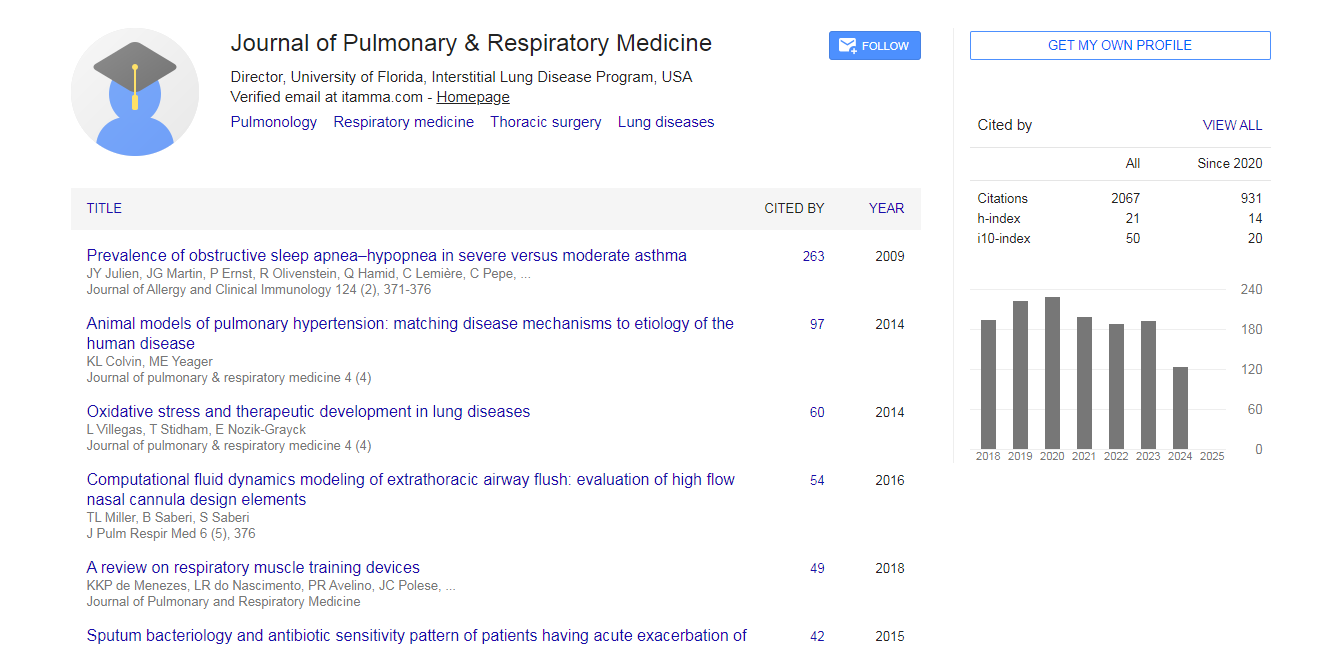
Pulmonary & Respiratory Medicine received 1690 citations as per Google Scholar report