Brief Report - (2025) Volume 15, Issue 5
Received: 01-Sep-2025, Manuscript No. jtese-26-184244;
Editor assigned: 03-Sep-2025, Pre QC No. P-184244;
Reviewed: 17-Sep-2025, QC No. Q-184244;
Revised: 22-Sep-2025, Manuscript No. R-184244;
Published:
29-Sep-2025
, DOI: 10.37421/2165-8064.2025.15.668
Citation: Lan, Nguyen Thi. ”Advanced Antimicrobial Textiles for Critical Applications.” J Textile Sci Eng 15 (2025):668.
Copyright: © 2025 Lan T. Nguyen This is an open-access article distributed under the terms of the Creative Commons Attribution License, which permits unrestricted use, distribution and reproduction in any medium, provided the original author and source are credited.
The growing imperative for advanced antimicrobial textiles in healthcare and protective applications has spurred considerable research into novel finishing techniques and materials. This field is driven by the critical need to mitigate the spread of infections, enhance patient safety, and improve the longevity of textile products exposed to microbial challenges. The development of antimicrobial finishes often involves the integration of active agents onto or within textile substrates, aiming for effective and durable antimicrobial activity. These agents can range from nanoparticles with inherent antimicrobial properties to chemically synthesized compounds or naturally derived substances, each offering unique advantages and challenges in their application. A significant avenue of research focuses on the synergistic effects achieved by combining different antimicrobial agents or employing advanced material fabrication techniques. This approach seeks to broaden the spectrum of activity, overcome microbial resistance mechanisms, and improve the overall performance and longevity of the antimicrobial effect on the textile. The application of silver nanoparticles (AgNPs) has been widely explored due to their well-established broad-spectrum antimicrobial efficacy against bacteria, fungi, and viruses. Their integration into textile matrices, such as cotton fabrics, has demonstrated significant potential for medical textiles, offering enhanced protection against a wide range of pathogens. Similarly, quaternary ammonium compounds (QACs) represent another class of potent antimicrobial agents frequently utilized in textile finishing. Their cationic nature allows for strong interaction with negatively charged microbial cell membranes, leading to cell disruption and death. Combining QACs with other agents can further enhance their effectiveness and durability. Chitosan, a natural biopolymer derived from chitin, has garnered attention for its intrinsic antimicrobial properties and its ability to serve as a carrier for other antimicrobial agents. Chitosan-based coatings, often incorporated with essential oils, offer a sustainable and eco-friendly route to impart antimicrobial characteristics to protective textiles, including personal protective equipment. Nanofibrous membranes produced through electrospinning techniques provide a high surface area and porous structure that can effectively encapsulate and control the release of antimicrobial agents. These materials are particularly promising for advanced wound dressings and medical garments, where sustained antimicrobial activity is crucial for healing and infection prevention. Photocatalytic materials, such as titanium dioxide (TiO2) nanoparticles, offer a distinct approach to antimicrobial textile finishing. When activated by UV irradiation, TiO2 generates reactive oxygen species that can effectively inactivate microorganisms, providing a self-sanitizing solution for textiles used in high-risk environments. Surface modification techniques, including plasma treatment, play a vital role in enhancing the antimicrobial performance of textiles. Plasma functionalization can alter the surface chemistry of fibers, promoting better adhesion of antimicrobial agents and intrinsically improving the textile's resistance to microbial growth through the creation of reactive species. The exploration of naturally derived antimicrobial agents, including plant extracts and essential oils, aligns with the growing demand for sustainable and eco-friendly textile solutions. These agents are often biodegradable and possess low toxicity, presenting a viable alternative to synthetic antimicrobial compounds for various applications.
Research into novel antimicrobial finishes for medical textiles has identified several key strategies for imparting durable antimicrobial properties. One significant approach involves the co-functionalization of cotton fabrics with silver nanoparticles and quaternary ammonium compounds. This combination has been shown to enhance efficacy against a wide array of bacteria and fungi, maintaining its effectiveness even after multiple laundering cycles, thus making these textiles suitable for critical healthcare environments. Another notable development in antimicrobial textile technology is the investigation of chitosan-based coatings. When these coatings incorporate essential oils, they demonstrate a significant reduction in bacterial adhesion and proliferation. This method is recognized for offering a sustainable and environmentally friendly approach to developing antimicrobial properties, particularly for personal protective equipment. Advanced manufacturing techniques, such as electrospinning, are being utilized to create nanofibrous membranes embedded with antimicrobial agents. These membranes are particularly well-suited for applications like advanced wound dressings and medical garments. The resulting materials are characterized by excellent porosity, high surface area, and a sustained release of antibacterial compounds, which aids in promoting faster healing and preventing infections. The integration of photocatalytic antimicrobial finishes, specifically using titanium dioxide (TiO2) nanoparticles, into textile substrates represents a innovative strategy. These TiO2 nanoparticle coatings on cotton fabrics have demonstrated effective bacterial inactivation when exposed to UV irradiation, offering a self-sanitizing capability for textiles utilized in high-risk settings. Plasma treatment is emerging as a crucial surface modification technique for enhancing the antimicrobial performance of textiles. This process involves functionalizing the textile surface to create reactive species. Plasma treatment can improve the adhesion of antimicrobial agents and inherently boost the textile's resistance to microbial growth, expanding its applicability in demanding environments. In the pursuit of sustainable textile finishing, the review of naturally derived antimicrobial agents, including plant extracts and essential oils, highlights their biodegradability and low toxicity. These natural alternatives are presented as a sustainable option to conventional synthetic antimicrobial compounds, particularly for medical and protective textile applications. The development of durable antimicrobial finishes for polyester fabrics has been explored using polyhexamethylene guanidine (PHMG). Incorporating PHMG into polyester textiles has resulted in excellent antimicrobial activity against common nosocomial pathogens, coupled with good wash durability, making them suitable for hospital textiles. A synergistic approach involving the combination of zinc oxide (ZnO) nanoparticles with established antimicrobial finishing agents has been investigated. This synergistic application on cotton fabrics has resulted in significantly enhanced antimicrobial efficacy and improved durability against microbial challenges relevant to medical settings. The functionalization of textile surfaces with antimicrobial peptides (AMPs) is a promising area for medical applications. AMPs offer potent and specific antimicrobial activity, with a reduced likelihood of developing microbial resistance. This bio-based approach presents a novel avenue for developing advanced antimicrobial textiles. Finally, a novel method for imparting antimicrobial properties to reusable face masks has been developed using copper-based nanoparticles. These nanoparticles are embedded within a polymer matrix, and the resulting material exhibits significant antiviral and antibacterial efficacy, while also maintaining good breathability and durability, crucial for respiratory protection.
This collection of research focuses on developing advanced antimicrobial textiles for critical applications, particularly in healthcare and protective wear. Studies explore various strategies, including the integration of silver nanoparticles and quaternary ammonium compounds, chitosan-based coatings with essential oils, and electrospun nanofibers for wound dressings. Photocatalytic TiO2 nanoparticle finishes, plasma surface modification, and the use of naturally derived antimicrobial agents are also investigated for their effectiveness and sustainability. Durable finishes using polyhexamethylene guanidine and synergistic combinations of zinc oxide nanoparticles with other agents are highlighted for their efficacy against pathogens. Furthermore, the application of antimicrobial peptides and copper nanoparticle-based coatings for face masks demonstrate innovative approaches to enhance textile safety and performance. The research collectively emphasizes improved antimicrobial activity, durability, and the development of eco-friendly solutions.
None
None
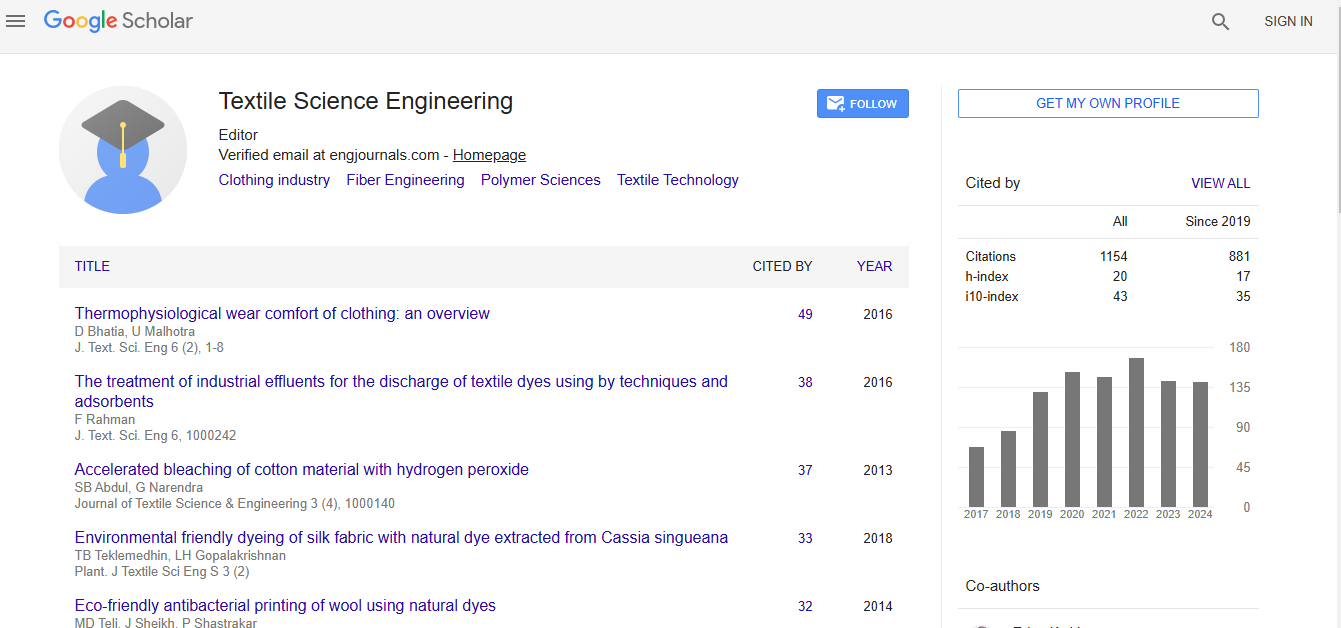
Journal of Textile Science & Engineering received 1008 citations as per Google Scholar report