Commentary - (2025) Volume 16, Issue 4
Received: 31-Jul-2025, Manuscript No. gjto-25-176003;
Editor assigned: 04-Aug-2025, Pre QC No. P-176003;
Reviewed: 14-Aug-2025, QC No. QC-176003;
Revised: 21-Aug-2025, Manuscript No. R-176003;
Published:
28-Aug-2025
, DOI: 10.37421/2229-8711.2025.16.456
Citation: Dobrev, Helena. ”Additive Manufacturing: Overview, Applications, Challenges, Opportunities.” Global J Technol Optim 16 (2025):456.
Copyright: © 2025 Dobrev H. This is an open-access article distributed under the terms of the Creative Commons Attribution License, which permits unrestricted use, distribution and reproduction in any medium, provided the original author and source are credited.
This paper offers a thorough overview of additive manufacturing, detailing various processes like powder bed fusion and directed energy deposition, and exploring the properties of materials used. It highlights the current state of the technology, its capabilities across different industries, and emerging applications that are pushing the boundaries of what's possible in manufacturing, from custom parts to complex structures [1]. This review focuses on the additive manufacturing of metallic materials, which is crucial for high-performance applications. It covers various metal additive manufacturing technologies, the characteristics of different metal powders, and how process parameters influence the microstructure and mechanical properties of final parts. The discussion also touches on common defects and strategies for quality control [2].
Here's the thing, additive manufacturing is transforming the biomedical field, enabling the creation of custom implants, prosthetics, and tissue engineering scaffolds. This review looks at the range of materials suitable for these applications, including biocompatible polymers and ceramics, and outlines the different printing techniques used to achieve specific anatomical structures and functional properties for patient-specific solutions [3]. This article delves into the current challenges facing additive manufacturing, such as process control, material certification, and scalability, while also highlighting the significant opportunities it presents for innovation in design and supply chain optimization. It offers a clear perspective on future trends, including the integration of AI and new material development, suggesting directions for research and industrial adoption [4]. Let's break it down: this comprehensive review explores the additive manufacturing of polymers, covering various printing techniques like FDM, SLA, and SLS, and discussing the properties and applications of different polymer types. It highlights how polymer selection and processing parameters impact the mechanical, thermal, and chemical characteristics of printed parts, which is crucial for performance [5].
This paper focuses on the sustainability aspects of additive manufacturing, evaluating its environmental impact from a life cycle perspective. It discusses how AM can contribute to reduced material waste, energy efficiency, and localized production, but also acknowledges challenges like waste from support structures and the energy consumption of certain processes. The goal is to provide a balanced view on making AM more environmentally friendly [6]. What this really means is that artificial intelligence and machine learning are revolutionizing additive manufacturing by enabling smarter design optimization, predictive quality control, and adaptive process monitoring. This review examines how AI/ML algorithms are applied to enhance material selection, improve print parameters, detect defects in real-time, and ultimately accelerate the development and adoption of AM technologies [7]. This article explores the recent progress in using additive manufacturing for creating medical devices, from surgical instruments to personalized implants and drug delivery systems. It highlights innovations in biocompatible materials and advanced printing techniques that allow for intricate geometries and tailored mechanical properties, leading to improved patient outcomes and expanded treatment options [8].
This paper discusses the unique opportunities and significant challenges associated with additive manufacturing in the aerospace industry. It covers how AM enables lightweight designs, reduced part count, and complex geometries essential for aircraft performance, while also addressing hurdles like material qualification, stringent quality control, and the need for standardized certification processes for flight-critical components [9]. Here's the deal, this review focuses on the current state of additive manufacturing for ceramics, a class of materials known for their high temperature resistance and hardness, but also their brittleness. It examines different AM techniques suitable for ceramics, such as stereolithography and binder jetting, and discusses the challenges in achieving dense, defect-free ceramic parts with specific microstructures for advanced applications [10].
This paper offers a thorough overview of additive manufacturing, detailing various processes like powder bed fusion and directed energy deposition, and exploring the properties of materials used. It highlights the current state of the technology, its capabilities across different industries, and emerging applications that are pushing the boundaries of what's possible in manufacturing, from custom parts to complex structures [1]. This article delves into the current challenges facing additive manufacturing, such as process control, material certification, and scalability. It also highlights the significant opportunities it presents for innovation in design and supply chain optimization, offering a clear perspective on future trends, including the integration of AI and new material development, suggesting directions for research and industrial adoption [4].
This review focuses on the additive manufacturing of metallic materials, which is crucial for high-performance applications. It covers various metal additive manufacturing technologies, the characteristics of different metal powders, and how process parameters influence the microstructure and mechanical properties of final parts. The discussion also touches on common defects and strategies for quality control [2]. Let's break it down: this comprehensive review explores the additive manufacturing of polymers, covering various printing techniques like FDM, SLA, and SLS, and discussing the properties and applications of different polymer types. It highlights how polymer selection and processing parameters impact the mechanical, thermal, and chemical characteristics of printed parts, which is crucial for performance [5]. Here's the deal, this review focuses on the current state of additive manufacturing for ceramics, a class of materials known for their high temperature resistance and hardness, but also their brittleness. It examines different AM techniques suitable for ceramics, such as stereolithography and binder jetting, and discusses the challenges in achieving dense, defect-free ceramic parts with specific microstructures for advanced applications [10].
Here's the thing, additive manufacturing is transforming the biomedical field, enabling the creation of custom implants, prosthetics, and tissue engineering scaffolds. This review looks at the range of materials suitable for these applications, including biocompatible polymers and ceramics, and outlines the different printing techniques used to achieve specific anatomical structures and functional properties for patient-specific solutions [3]. This article explores the recent progress in using additive manufacturing for creating medical devices, from surgical instruments to personalized implants and drug delivery systems. It highlights innovations in biocompatible materials and advanced printing techniques that allow for intricate geometries and tailored mechanical properties, leading to improved patient outcomes and expanded treatment options [8].
This paper discusses the unique opportunities and significant challenges associated with additive manufacturing in the aerospace industry. It covers how AM enables lightweight designs, reduced part count, and complex geometries essential for aircraft performance, while also addressing hurdles like material qualification, stringent quality control, and the need for standardized certification processes for flight-critical components [9].
What this really means is that artificial intelligence and machine learning are revolutionizing additive manufacturing by enabling smarter design optimization, predictive quality control, and adaptive process monitoring. This review examines how AI/ML algorithms are applied to enhance material selection, improve print parameters, detect defects in real-time, and ultimately accelerate the development and adoption of AM technologies [7]. This paper focuses on the sustainability aspects of additive manufacturing, evaluating its environmental impact from a life cycle perspective. It discusses how AM can contribute to reduced material waste, energy efficiency, and localized production, but also acknowledges challenges like waste from support structures and the energy consumption of certain processes. The goal is to provide a balanced view on making AM more environmentally friendly [6].
This collection of papers offers a comprehensive overview of additive manufacturing (AM), detailing various processes, material properties, and diverse applications across different industries [1]. It emphasizes AM's crucial role in high-performance applications like metallic materials, considering their microstructure and mechanical properties [2]. Here's the thing, AM is transforming the biomedical field, enabling custom implants and tissue engineering with biocompatible polymers and ceramics [3], alongside recent advancements in medical devices for improved patient outcomes [8]. The technology also addresses current challenges such as process control and material certification, while highlighting opportunities through AI integration and new material development [4, 7]. Let's break it down: specific focus areas include the additive manufacturing of polymers, discussing various printing techniques and their impact on part characteristics [5], and ceramics, where challenges in achieving dense, defect-free parts are explored [10]. What this really means is that sustainability aspects are critically evaluated, noting AM's potential for reduced waste and energy efficiency, while also acknowledging environmental challenges [6]. Additionally, the aerospace industry leverages AM for lightweight designs and reduced part counts, although facing hurdles in material qualification and certification processes [9].
None
None
T. D, H. W, Z. C. "Additive Manufacturing: Status, Capabilities, and Emerging Applications".Prog. Mater. Sci. 102 (2019):1-78.
Indexed at, Google Scholar, Crossref
B. Z, H. L, Y. L. "Additive manufacturing of metallic materials: a review".Mater. Des. 193 (2020):108712.
Indexed at, Google Scholar, Crossref
J.M. L, H.J. P, J.S. L. "Additive manufacturing for biomedical applications: A review".Biomaterials 261 (2020):120272.
Indexed at, Google Scholar, Crossref
D.L. B, J.P. K, M.C. L. "Additive Manufacturing: Challenges, opportunities, and future perspectives".CIRP Ann. Manuf. Technol. 70 (2021):669-693.
Indexed at, Google Scholar, Crossref
Y. G, S. L, J. Z. "Additive manufacturing of polymers: A comprehensive review".Prog. Polym. Sci. 128 (2022):101539.
Indexed at, Google Scholar, Crossref
T.D. N, N.X. L, V.T. N. "Sustainability in Additive Manufacturing: A comprehensive review".J. Cleaner Prod. 388 (2023):135759.
Indexed at, Google Scholar, Crossref
M.K. G, V.K. S, D. K. "Artificial intelligence and machine learning in additive manufacturing: A review".J. Manuf. Syst. 69 (2023):110-128.
Indexed at, Google Scholar, Crossref
S. S, G. M, M. W. "Recent advances in additive manufacturing of medical devices".J. Mater. Sci. Mater. Med. 34 (2023):44.
Indexed at, Google Scholar, Crossref
H. B, P. S, G. C. "Additive manufacturing of aerospace components: Challenges and opportunities".J. Manuf. Syst. 58 (2021):304-322.
Indexed at, Google Scholar, Crossref
P. L, C. Y, Z. F. "Additive manufacturing of ceramics: A review".Ceram. Int. 50 (2024):1-28.
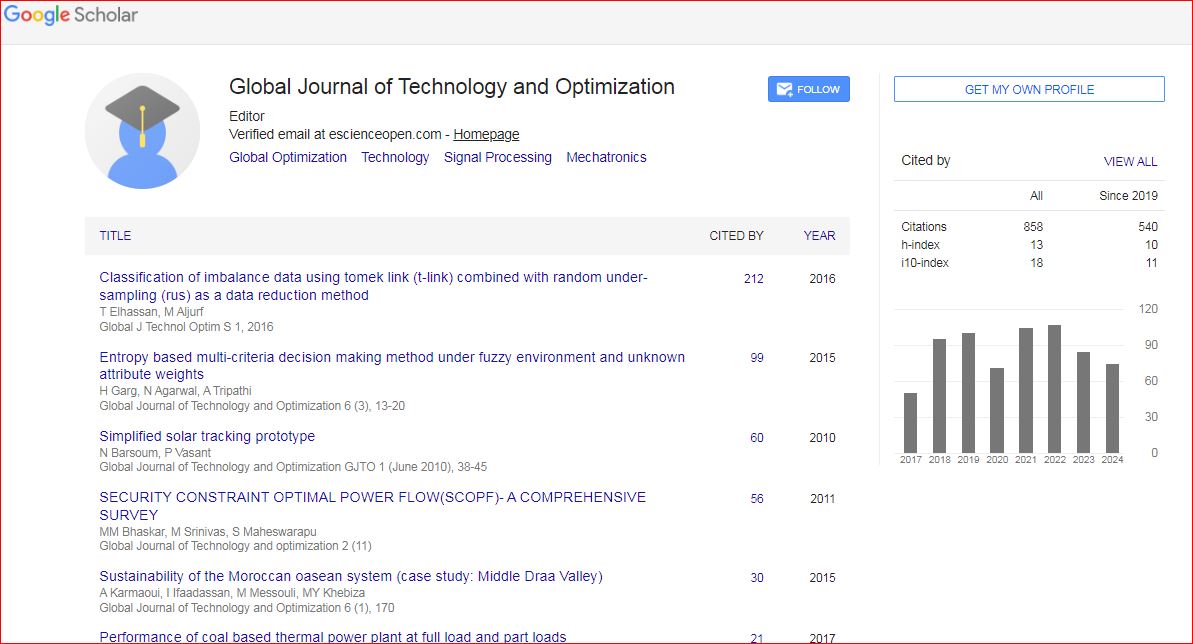
Global Journal of Technology and Optimization received 847 citations as per Google Scholar report