Opinion - (2025) Volume 17, Issue 4
Received: 01-Jul-2025, Manuscript No. jcst-25-174953;
Editor assigned: 03-Jul-2025, Pre QC No. P-174953;
Reviewed: 17-Jul-2025, QC No. Q-174953;
Revised: 22-Jul-2025, Manuscript No. R-174953;
Published:
29-Jul-2025
, DOI: 10.37421/1948-5956.2025.17.716
Citation: Petrova, Elena. ”ADCs: Transforming Cancer Treatment
Innovations.” J Cancer Sci Ther 17 (2025):716.
Copyright: © 2025 Petrova E. This is an open-access article distributed under the terms of the Creative Commons Attribution License, which permits unrestricted use,
distribution and reproduction in any medium, provided the original author and source are credited.
This review dives into the next wave of Antibody-Drug Conjugates targeting solid tumors. It breaks down how new linker technologies and novel targets are pushing the boundaries, while also confronting the persistent challenges of resistance and identifying patient populations that benefit most [1].
This review explains the core ways Antibody-Drug Conjugates work, how cancer cells sometimes become resistant, and what that means for their ongoing use in the clinic. It offers a solid understanding of the current landscape and future directions for these therapies [2].
This piece focuses on how Antibody-Drug Conjugates are changing the game in breast cancer treatment. It details the ADCs currently in use and those coming through the pipeline, outlining both their successes and the hurdles still to overcome in this specific cancer type [3].
This article unpacks the exciting progress of Antibody-Drug Conjugates in treating solid tumors. It shines a light on novel targets and refined strategies that are making these therapies more effective in difficult-to-treat cancers [4].
This review gives a comprehensive look at Antibody-Drug Conjugates, covering how they're designed, how they work, and their various uses in the clinic. It also points out where the field is headed and the major obstacles still to tackle [5].
This article hones in on the critical role of linker technology in the design and performance of Antibody-Drug Conjugates. It details recent breakthroughs in linkers and how these advancements influence ADC stability, the controlled release of the drug, and ultimately, its effectiveness in treating disease [6].
This paper tackles the crucial topic of toxicity and safety for Antibody-Drug Conjugates. It lays out the mechanisms behind adverse effects, outlines current ways to manage them, and explores innovative strategies aimed at making these powerful therapies safer for patients [7].
This extensive review covers Antibody-Drug Conjugates from a drug delivery standpoint. It provides a thorough overview of how these targeted therapies work, their applications in cancer, and the innovations driving their development, showcasing the complex interplay of biology and engineering [8].
This update explores the dynamic field of Antibody-Drug Conjugates, focusing on advancements in their design. It highlights how refined conjugation techniques and new drug payloads are being used to improve therapeutic effectiveness and minimize side effects, pushing the boundaries of what these therapies can achieve [9].
This review provides a solid foundation on Antibody-Drug Conjugates, tracing their development trajectory and highlighting the major hurdles faced in making them more effective. It also offers insights into where these therapies are likely headed, underscoring the ongoing innovation in the field [10].
Antibody-Drug Conjugates (ADCs) represent a significant advancement in cancer therapy, leveraging the precision of antibodies to deliver potent cytotoxic drugs directly to cancer cells. These innovative therapies are continuously evolving, with recent developments focusing on next-generation ADCs for solid tumors that integrate new linker technologies and target novel biomarkers. Such advancements aim to overcome previous limitations and enhance therapeutic efficacy, even as challenges like drug resistance and precise patient selection persist [1, 4]. Understanding the fundamental mechanisms of ADC action is crucial for optimizing their clinical application. This includes how they bind to target cells, internalize, and release their cytotoxic payload, alongside recognizing the various ways cancer cells develop resistance, which dictates their ongoing utility and future development in oncology [2, 5].
The landscape of ADCs extends across various cancer types, notably making a substantial impact in breast cancer treatment. Here, specific ADCs currently in use and those undergoing clinical trials are transforming treatment paradigms, demonstrating both remarkable successes and inherent hurdles that require further investigation and refinement. The ongoing progress in this specialized area highlights the tailored potential of ADCs [3]. More broadly, the strategic development of ADCs is driven by identifying emerging targets and devising new strategies to render these therapies more effective, particularly in hard-to-treat solid tumors where conventional approaches have often fallen short [4].
A comprehensive understanding of ADCs also encompasses their design principles, operational mechanisms, and diverse clinical applications. The field is rapidly advancing, with researchers continually exploring new frontiers while simultaneously addressing significant obstacles to their widespread and effective use. This involves a deep dive into the molecular biology and engineering aspects that underpin these complex drugs [5, 8]. Critical to ADC performance is linker technology, which dictates the stability of the conjugate in circulation and the controlled release of the drug within the target cell. Recent breakthroughs in linker design are paramount, directly influencing the overall effectiveness and safety profile of ADCs [1, 6].
Beyond efficacy, the toxicity and safety of ADCs are paramount concerns in clinical practice. Researchers actively investigate the mechanisms underlying adverse effects, working to establish effective management strategies. The development of novel approaches to enhance the safety profile of these powerful therapeutic agents is a continuous endeavor, ensuring that patients receive maximum benefit with minimal harm [7]. The evolution of ADCs, from their initial conceptualization through current innovations, represents a dynamic interplay of biology and engineering, fundamentally reshaping drug delivery in cancer therapy. This includes a thorough overview of their function and application in oncology, driven by constant innovation [8].
Further advancements in ADC design involve refining conjugation techniques and incorporating novel drug payloads. These sophisticated modifications are designed to improve therapeutic effectiveness while concurrently minimizing undesirable side effects, pushing the boundaries of what these therapies can achieve. Such refinements are crucial for unlocking the full potential of ADCs [9]. Looking back, the development trajectory of ADCs has been marked by significant challenges. Overcoming these hurdles has propelled the field forward, with an unwavering focus on innovation shaping future perspectives and ensuring the continued evolution of these life-changing treatments [10].
Antibody-Drug Conjugates (ADCs) are transforming cancer treatment, with ongoing advancements focusing on next-generation therapies for solid tumors. Key innovations include new linker technologies and the identification of novel targets to enhance effectiveness and overcome resistance [1, 4]. These treatments leverage the precision of antibodies to deliver cytotoxic drugs directly to cancer cells, with research actively detailing their mechanisms of action, how cancer cells develop resistance, and their evolving clinical applications [2, 5]. Specific applications in breast cancer demonstrate the tailored potential of ADCs, highlighting both successes and remaining challenges [3]. The comprehensive development of ADCs involves intricate design, understanding how they function, and their diverse clinical utility, while also addressing significant obstacles and future directions [5, 8]. Linker technology is a critical aspect, influencing ADC stability and controlled drug release, with recent breakthroughs directly impacting their therapeutic performance [1, 6]. Patient safety is a major consideration, with extensive research dedicated to understanding ADC toxicity, managing adverse effects, and developing strategies to improve their safety profile [7]. The field continues to progress through refined conjugation techniques and new drug payloads, all aimed at enhancing therapeutic efficacy and minimizing side effects [9]. This continuous innovation, despite past development hurdles, defines the promising future of ADCs in cancer therapy [10].
Indexed at, Google Scholar, Crossref
Indexed at, Google Scholar, Crossref
Indexed at, Google Scholar, Crossref
Indexed at, Google Scholar, Crossref
Indexed at, Google Scholar, Crossref
Indexed at, Google Scholar, Crossref
Indexed at, Google Scholar, Crossref
Indexed at, Google Scholar, Crossref
Indexed at, Google Scholar, Crossref
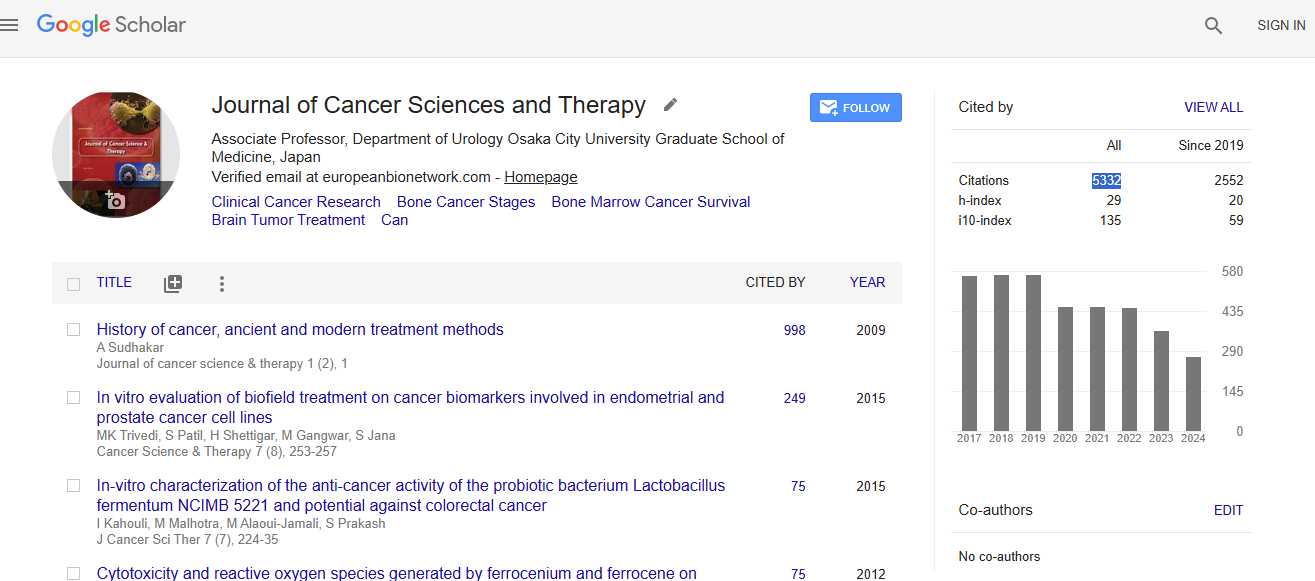
Cancer Science & Therapy received 5332 citations as per Google Scholar report