Short Communication - (2025) Volume 14, Issue 3
Received: 01-May-2025, Manuscript No. mcce-26-190173;
Editor assigned: 05-May-2025, Pre QC No. P-190173;
Reviewed: 19-May-2025, QC No. Q-190173;
Revised: 22-May-2025, Manuscript No. R-190173;
Published:
29-May-2025
, DOI: 10.37421/2470-6965.2025.14.408
Citation: Watanabe, Kenji. ”ACTs Efficacy: Combating Resistance With Innovation.” Malar Contr Elimination 14 (2025):408.
Copyright: © 2025 Watanabe K. This is an open-access article distributed under the terms of the Creative Commons Attribution License, which permits unrestricted use, distribution and reproduction in any medium, provided the original author and source are credited.
Artemisinin-based combination therapies (ACTs) have served as the primary treatment for malaria for almost two decades, significantly contributing to a substantial decline in malaria-related deaths, particularly in sub-Saharan Africa. Their efficacy stems from the synergistic action of artemisinin derivatives, which act rapidly against the parasite, and a partner drug that eliminates any residual parasites [1].
The widespread implementation of ACTs has undeniably saved millions of lives. This success is largely attributed to their high effectiveness and favorable safety profile. Maintaining their continued efficacy involves ensuring access to quality-assured medicines and actively monitoring for the emergence and spread of drug resistance [2].
Understanding the genetic underpinnings of artemisinin resistance is paramount for predicting its propagation and shaping effective treatment guidelines. Mutations within the parasite's K13 gene are identified as the principal drivers of this resistance, consequently impacting the parasite's susceptibility to ACTs [3].
The profound impact of ACTs on malaria mortality has dramatically reshaped the landscape of malaria control efforts globally. This success highlights the critical importance of sustained financial commitment to antimalarial drug research and development, alongside the strategic deployment of effective drug interventions [4].
In geographical areas experiencing high incidences of artemisinin resistance, alternative treatment regimens are actively being investigated and deployed. These strategies include the reintroduction of older antimalarial drugs in specific contexts or the utilization of novel drug combinations designed to circumvent existing resistance mechanisms [5].
The effectiveness of ACTs is not uniform across all regions where malaria is endemic. A variety of factors, including the quality of the dispensed drugs, patient adherence to prescribed treatment regimens, and the specific genetic makeup of the circulating parasite strains, can influence treatment outcomes and the rate at which resistance develops [6].
The development of artemisinin resistance is a multifaceted phenomenon, frequently characterized by the gradual accumulation of multiple genetic mutations over time. A comprehensive understanding of these evolutionary pathways is essential for accurately forecasting future resistance trends and formulating effective counter-strategies against this growing threat [7].
The continuous surveillance of artemisinin resistance stands as a global health priority. This surveillance encompasses molecular monitoring of parasite populations and the execution of clinical trials designed to evaluate the real-world efficacy of ACTs. Early detection plays a crucial role in preventing widespread treatment failures and preserving the effectiveness of current therapies [8].
The remarkable success of ACTs in reducing malaria-related deaths represents a significant public health achievement. However, the persistent and evolving threat of drug resistance underscores the imperative for adaptive treatment strategies and ongoing innovation in both malaria treatment and prevention methodologies [9].
The future trajectory of malaria control is intrinsically linked to our collective capacity to preserve the effectiveness of existing treatments while simultaneously pioneering new tools to combat this devastating disease. This necessitates a comprehensive and integrated approach encompassing advancements in drug discovery, diagnostic capabilities, and robust vector control measures [10].
Artemisinin-based combination therapies (ACTs) have been instrumental in malaria treatment for nearly two decades, leading to a significant decrease in malaria mortality, especially in sub-Saharan Africa. The effectiveness of ACTs relies on the rapid action of artemisinin derivatives against the parasite and the partner drug's ability to eliminate remaining parasites. However, the emergence of artemisinin resistance poses a substantial threat to these gains, highlighting the need for continuous surveillance and the development of novel treatment strategies [1].
The extensive deployment of ACTs has demonstrably saved millions of lives, a success attributed to their high efficacy and excellent safety profile. Efforts to sustain their effectiveness include ensuring access to quality-assured medicines and vigilant monitoring for the emergence and spread of drug resistance [2].
Understanding the genetic basis of artemisinin resistance is crucial for predicting its spread and informing treatment guidelines. Mutations in the parasite's K13 gene are the primary drivers of this resistance, affecting the parasite's sensitivity to ACTs [3].
The impact of ACTs on malaria mortality has been profound, transforming the landscape of malaria control. This success underscores the importance of sustained investment in antimalarial drug development and effective drug deployment strategies [4].
In regions experiencing high levels of artemisinin resistance, alternative treatment regimens are being explored and implemented. This includes a return to older drugs in some contexts or the use of novel drug combinations to overcome resistance mechanisms [5].
The effectiveness of ACTs is not uniform across all geographical areas. Factors such as drug quality, adherence to treatment, and parasite genetics influence treatment outcomes and the rate of resistance development [6].
The development of artemisinin resistance is a complex phenomenon, often involving a stepwise accumulation of mutations. Understanding these pathways is critical for predicting future resistance trends and developing counter-strategies [7].
Surveillance for artemisinin resistance is a global priority. This involves molecular monitoring of parasite populations and clinical trials to assess the efficacy of ACTs in real-world settings. Early detection is key to preventing widespread treatment failures [8].
The success of ACTs in reducing malaria mortality has been a public health triumph. However, the ongoing threat of resistance necessitates adaptive strategies and continued innovation in malaria treatment and prevention [9].
The future of malaria control hinges on our ability to maintain the efficacy of current treatments while developing new tools to combat the disease. This includes a multipronged approach involving drug development, diagnostics, and vector control [10].
Artemisinin-based combination therapies (ACTs) have been highly effective in reducing malaria mortality for nearly two decades, particularly in sub-Saharan Africa. Their success is due to the rapid action of artemisinins combined with partner drugs. However, emerging artemisinin resistance, driven by genetic mutations, poses a significant threat. Maintaining ACT efficacy requires robust surveillance, ensuring drug quality, promoting treatment adherence, and developing new treatment strategies and tools. The global effort to combat malaria relies on continued investment in research, adaptive strategies, and innovative approaches to drug development, diagnostics, and vector control.
None
None
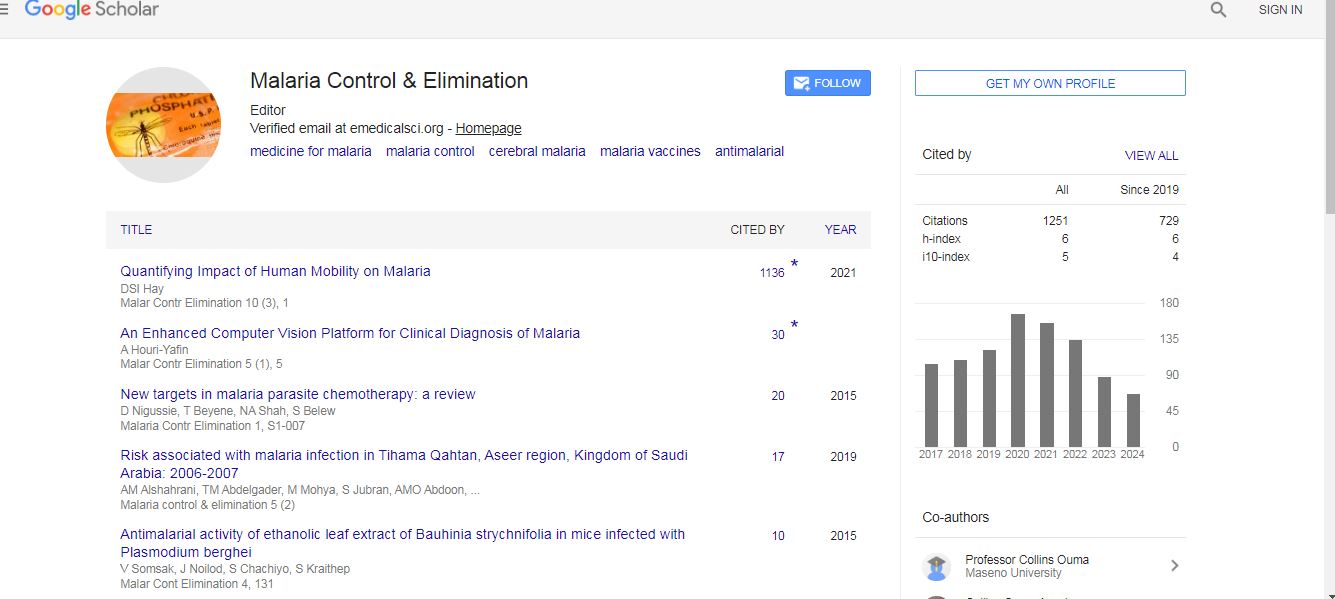
Malaria Control & Elimination received 1187 citations as per Google Scholar report