Perspective - (2025) Volume 13, Issue 3
Received: 02-Jun-2025, Manuscript No. jcdd-25-176799;
Editor assigned: 04-Jun-2025, Pre QC No. P-176799;
Reviewed: 18-Jun-2025, QC No. Q-176799;
Revised: 23-Jun-2025, Manuscript No. R-176799;
Published:
30-Jun-2025
, DOI: 10.37421/2329-9517.2025.13.677
Citation: Ali, Yusuf. Accurate Blood Pressure: Monitoring, Management,
Innovation. J Cardiovasc Dis Diagn 13 (2025):677.
Copyright: © 2025 Ali Y. This is an open-access article distributed under the terms of the Creative Commons Attribution License, which permits unrestricted use, distribution
and reproduction in any medium, provided the original author and source are credited.
Wearable cuffless blood pressure monitors show potential for continuous, unobtrusive monitoring, though they currently face limitations in accuracy and reliability compared to traditional devices. Rigorous clinical validation and standardized regulatory approval are crucial for their effective clinical integration [1].
The European Society of Hypertension provides comprehensive recommendations for home blood pressure monitoring, stressing accurate measurements, device validation, and patient education for reliable readings. This includes guidance on device selection, measurement protocols, and interpreting readings in clinical settings [2].
The European Society of Hypertension also offers updated practical guidance on ambulatory blood pressure monitoring (ABPM), a vital tool for diagnosing masked and white-coat hypertension and assessing nocturnal blood pressure. ABPM's techniques, interpretation, and role in cardiovascular risk prediction highlight its superiority over office measurements in many scenarios [3].
Core principles for accurate blood pressure measurement in pediatric populations are essential for early hypertension detection and management. This involves appropriate cuff selection, proper positioning, using automated devices, and confirming elevated readings with repeated measurements, acknowledging unique physiological considerations [4].
An overview of blood pressure measurement techniques emphasizes proper methodology to avoid diagnostic errors. Automated office blood pressure (AOBP) readings offer a more accurate alternative to manual measurements, with home and ambulatory monitoring comprehensively assessing patient status and managing hypertension effectively [5].
A critical call to action highlights the importance of validating blood pressure monitors according to international standards for all devices, including clinical, home, and wearable technologies. Clinicians, manufacturers, and regulatory bodies must prioritize rigorous validation to ensure trustworthy measurements for patient care [6].
A scientific statement provides a comprehensive guide to accurate blood pressure measurements, noting that common technique errors significantly impact diagnosis. Key factors include patient preparation, proper positioning, correct cuff size, and using validated devices, offering practical recommendations for reliable readings across all settings [7].
Blood pressure variability (BPV), referring to fluctuations over time, holds clinical importance for cardiovascular risk assessment. Measured using ambulatory and home monitoring, BPV offers independent prognostic value beyond average blood pressure, guiding personalized hypertension management strategies [8].
Telemonitoring and telenursing interventions for blood pressure management in hypertensive patients demonstrate evidence of improving medication adherence, enhancing blood pressure control, and reducing healthcare costs. These digital strategies facilitate proactive and accessible hypertension care through remote data and personalized feedback [9].
Central blood pressure (BP), measured closer to the heart, is being assessed for its link to cardiovascular outcomes. Research explores whether central BP measurements provide superior predictive value compared to traditional brachial readings, with further study needed to solidify its role in clinical practice [10].
Accurate blood pressure measurement remains a cornerstone of cardiovascular health assessment and management. Errors in technique are common and significantly impact diagnosis and treatment outcomes. To counter this, comprehensive guidance details critical factors like proper patient preparation, correct cuff size, and the use of validated devices, offering practical recommendations for reliable readings across all settings [7]. Various measurement techniques exist, emphasizing proper methodology to avoid diagnostic pitfalls. Automated office blood pressure (AOBP) readings are often seen as a more accurate alternative to traditional manual measurements, playing a role alongside home and ambulatory monitoring in comprehensively assessing a patient's blood pressure status [5].
Different monitoring modalities provide unique insights. Home blood pressure monitoring, supported by comprehensive recommendations from the European Society of Hypertension, underscores the importance of accurate measurements, proper device validation, and patient education for reliable data. Key aspects include guidance on device selection, measurement protocols, and interpretation of readings in clinical settings [2]. Similarly, ambulatory blood pressure monitoring (ABPM), another focus of European Society of Hypertension recommendations, serves as a critical tool for diagnosing conditions like masked hypertension and white-coat hypertension, and for assessing nocturnal blood pressure. Its techniques, result interpretation, and role in predicting cardiovascular risk highlight its clinical value, often surpassing standard office measurements [3]. The landscape is also evolving with wearable cuffless blood pressure monitors, which offer potential for continuous, unobtrusive monitoring. However, these newer technologies face current limitations in accuracy and reliability compared to traditional cuff devices, necessitating rigorous clinical validation and standardized regulatory approval processes for their effective integration into clinical practice [1].
Ensuring the reliability of all blood pressure monitoring devices is paramount. There is a strong call for action stressing adherence to international standards for accuracy and reliability across all device types, whether used in clinics, at home, or as novel wearables. Clinicians, manufacturers, and regulatory bodies must prioritize rigorous validation to guarantee trustworthy measurements for optimal patient care [6]. Special considerations are also vital for specific patient groups, such as children and adolescents. Core principles for accurate blood pressure measurement in pediatric populations are essential for early detection and management of hypertension, including appropriate cuff selection based on arm circumference, proper positioning, and the use of automated devices, while acknowledging their unique physiological considerations [4].
Beyond single measurements, understanding blood pressure variability (BPV) is increasingly recognized as clinically important. BPV, which refers to blood pressure fluctuations over short or long periods, can be assessed using ambulatory and home monitoring. It provides independent prognostic value beyond average blood pressure levels, helping identify patients at higher risk for cardiovascular events and guiding more personalized hypertension management strategies [8]. Furthermore, the assessment of central blood pressure (BP), measured closer to the heart, is being reviewed for its link to cardiovascular outcomes. Exploring its physiological differences from peripheral BP, research aims to determine if central BP measurements provide superior predictive value for adverse cardiovascular events compared to traditional brachial readings, necessitating further research to solidify its role in routine clinical practice [10].
Technology also offers innovative solutions for managing hypertension. Telemonitoring and telenursing interventions for blood pressure management in hypertensive patients are supported by evidence. These digital health strategies can improve adherence to medication, enhance blood pressure control, and reduce healthcare costs by enabling remote data collection and personalized feedback, underscoring technology's growing role in more proactive and accessible hypertension care [9].
Accurate blood pressure measurement is fundamental to effectively managing hypertension, given that widespread errors in technique significantly impact diagnosis and treatment outcomes [7, 5]. To address this, European guidelines provide robust recommendations for both home [2] and ambulatory [3] monitoring, which are crucial for diagnosing conditions such as masked hypertension, white-coat hypertension, and for assessing cardiovascular risk. The evolving landscape includes wearable cuffless blood pressure monitors, offering promising avenues for continuous, unobtrusive monitoring. However, their current limitations in accuracy and reliability compared to traditional devices mean rigorous clinical validation and standardized regulatory approval are essential for their effective integration into clinical practice [1]. A broader call to action stresses the imperative for all blood pressure monitorsâ??from traditional clinical devices to home-use models and novel wearable technologiesâ??to adhere strictly to international validation standards, thereby ensuring consistently trustworthy measurements [6]. Specific populations, notably pediatric patients, require tailored approaches, including appropriate cuff sizes, proper positioning, and repeated measurements to accurately account for their unique physiological considerations [4]. Furthermore, understanding blood pressure variability offers independent prognostic value, extending beyond average blood pressure levels to help identify higher-risk patients and guide more personalized hypertension management strategies [8]. Emerging areas of research also focus on the assessment of central blood pressure for its potential to offer superior predictive value for adverse cardiovascular events compared to traditional brachial readings [10]. Complementing these developments is the growing role of telemonitoring and telenursing interventions, which leverage digital health strategies to improve medication adherence, enhance blood pressure control, and reduce healthcare costs through remote data collection and personalized feedback, enabling more proactive and accessible hypertension care [9].
Indexed at, Google Scholar, Crossref
Indexed at, Google Scholar, Crossref
Indexed at, Google Scholar, Crossref
Indexed at, Google Scholar, Crossref
Indexed at, Google Scholar, Crossref
Indexed at, Google Scholar, Crossref
Indexed at, Google Scholar, Crossref
Indexed at, Google Scholar, Crossref
Indexed at, Google Scholar, Crossref
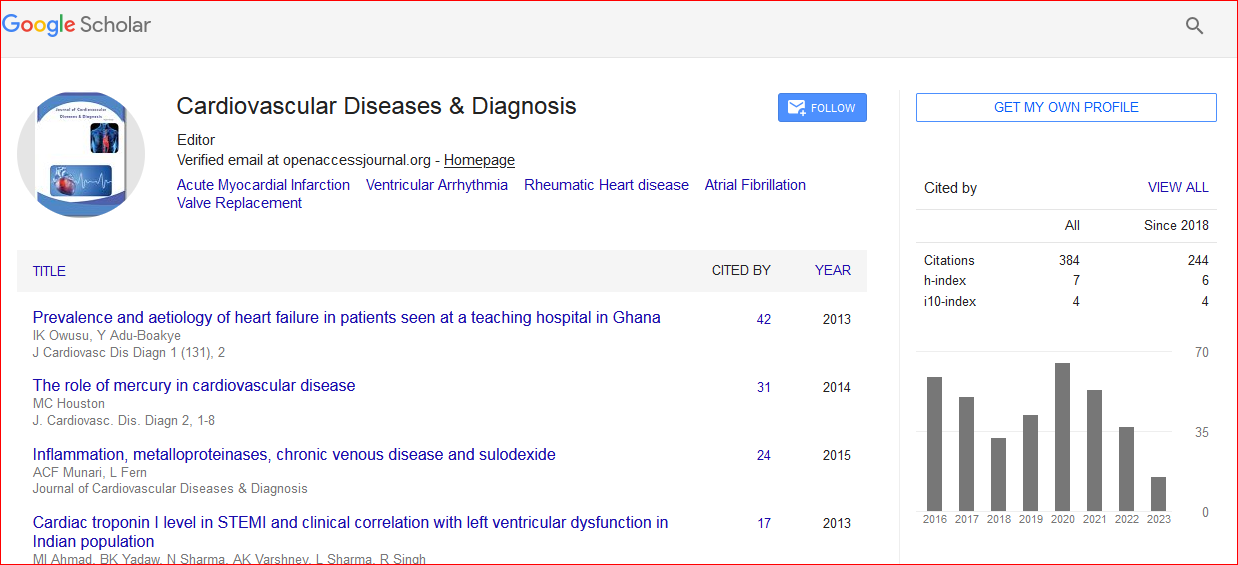
Cardiovascular Diseases & Diagnosis received 427 citations as per Google Scholar report