Opinion - (2025) Volume 17, Issue 4
Received: 01-Aug-2025, Manuscript No. jbabm-26-182347;
Editor assigned: 03-Aug-2025, Pre QC No. P-182347;
Reviewed: 17-Aug-2025, QC No. Q-182347;
Revised: 24-Aug-2025, Manuscript No. R-182347;
Published:
31-Aug-2025
, DOI: 10.37421/1948-593X.2025.17.505
Citation: Williams, Zoe K.. ”Accelerating Drug Discovery with High-Throughput Bioanalytical Methods.” J Bioanal Biomed 17 (2025):505.
Copyright: © 2025 W illiamsK. Zoe This is an open-access article distributed under the terms of the Creative Commons Attribution License, which permits unrestricted use, distribution and reproduction in any medium, provided the original author and source are credited.
The landscape of drug discovery is undergoing a profound transformation, driven by the imperative to accelerate the identification and development of novel therapeutic agents. At the forefront of this revolution are high-throughput bioanalytical methods, which provide the indispensable tools for analyzing vast biological and chemical datasets with unprecedented speed and accuracy [1].
These methods are essential for navigating the complex biological systems involved in disease and for efficiently evaluating the potential of candidate drug molecules. Without sophisticated bioanalytical techniques, the sheer volume of information generated in modern drug discovery efforts would be unmanageable, significantly hampering progress and increasing costs. The ability to rapidly screen compound libraries, identify relevant biomarkers, and understand how drugs interact with the body are all critical components that rely heavily on these advanced analytical capabilities [1].
Liquid chromatography coupled with tandem mass spectrometry (LC-MS/MS) has emerged as a foundational technique in quantitative bioanalysis within drug discovery programs. Its inherent sensitivity and selectivity allow for the precise measurement of analytes in complex biological matrices, making it a cornerstone for drug metabolism and pharmacokinetic (DMPK) studies [2].
Recent advancements in LC-MS/MS instrumentation have focused on improving speed and ionization efficiency, alongside the development of sophisticated data processing algorithms. These enhancements collectively boost throughput and enable the detection of analytes at ever-lower concentrations, further solidifying its role in high-throughput screening and analysis [2].
Immunoassays, particularly in their enzyme-linked immunosorbent assay (ELISA) and multiplexed formats, offer a complementary approach characterized by high specificity for target analytes. Their adaptability to high-throughput screening protocols makes them invaluable for various stages of drug development, including biomarker discovery and validation [3].
Innovations in labeling technologies, alongside increasing levels of automation and miniaturization, are continually expanding the scope and applicability of immunoassays. This allows for their use in detecting not only proteins but also small molecules and peptides within intricate biological samples, contributing significantly to early-stage drug characterization [3].
Microfluidic devices, commonly known as 'lab-on-a-chip' technologies, represent a paradigm shift in bioanalysis by enabling the precise manipulation and detection of biological samples on a miniaturized scale. These systems offer significant advantages, including drastic reductions in sample and reagent consumption, accelerated reaction kinetics, and the potential for integrated, fully automated workflows [4].
Their inherent characteristics make them exceptionally well-suited for high-throughput applications, streamlining many analytical processes that were previously time-consuming and resource-intensive in drug discovery pipelines [4].
The seamless integration of automation and robotics is a critical enabler of true high-throughput bioanalysis, allowing for the continuous processing of large sample batches and significantly reducing manual labor. Automated sample preparation, advanced liquid handling systems, and sophisticated robotic platforms are instrumental in minimizing experimental variability and accelerating the overall pace of drug discovery [5].
By automating repetitive and labor-intensive tasks, these technologies free up valuable scientific resources to focus on data interpretation and strategic decision-making, thereby enhancing efficiency and throughput across the board [5].
High-content screening (HCS) coupled with advanced imaging and data analysis techniques provides a powerful means to simultaneously assess multiple cellular responses to potential drug candidates. This multi-parametric approach maximizes the information gleaned from each experimental run, enabling a more comprehensive understanding of drug mechanisms of action and potential off-target effects early in the discovery process [6].
HCS allows researchers to observe complex cellular phenotypes, offering deeper insights into drug efficacy and safety profiles than traditional single-endpoint assays [6].
Bioinformatics and sophisticated data analytics are indispensable for effectively managing and interpreting the enormous datasets generated by high-throughput bioanalytical methods. Advanced algorithms, machine learning, and artificial intelligence are increasingly being employed to uncover hidden patterns, predict drug efficacy, and optimize drug candidates with greater precision and speed [7].
The ability to harness 'big data' is crucial for extracting meaningful biological insights and making informed decisions throughout the drug discovery lifecycle [7].
The development of highly sensitive and specific bioanalytical assays capable of accurately quantifying analytes within complex biological matrices, such as plasma, urine, and tissue, remains a paramount challenge. Assays that can reliably detect analytes at very low concentrations, even in the presence of numerous interfering substances, are vital for understanding drug pharmacokinetics, pharmacodynamics, and potential toxicity [8].
Addressing these challenges is fundamental to advancing drug safety and efficacy assessments [8].
Emerging point-of-care testing (POCT) technologies are also finding potential applications in drug discovery, particularly for enabling rapid in-situ monitoring and facilitating earlier decision-making. The development of miniaturized and portable bioanalytical devices holds the promise of faster data acquisition and the implementation of more agile and responsive drug development workflows [9].
This could lead to more efficient resource allocation and reduced timelines in preclinical and clinical development phases [9].
Finally, the quality control and rigorous validation of high-throughput bioanalytical methods are non-negotiable prerequisites for ensuring the reliability and reproducibility of generated data. Strict adherence to regulatory guidelines, the establishment of robust quality assurance systems, and comprehensive method validation are critical for the successful progression of drug candidates through the development pipeline and ultimately to regulatory approval [10].
Ensuring data integrity is fundamental to patient safety and the scientific rigor of the drug development process [10].
High-throughput bioanalytical methods are pivotal in modern drug discovery, serving as the engine for rapid screening and evaluation of potential therapeutics. These techniques are designed to handle immense volumes of data, allowing researchers to analyze vast compound libraries and identify promising drug candidates with remarkable efficiency [1].
The ability to quickly assess a drug's interaction with biological systems, its metabolic fate, and its pharmacokinetic profile is directly dependent on the speed and accuracy of these bioanalytical tools. Advancements in this area are crucial for reducing the time and cost associated with bringing new medicines to market [1].
Liquid chromatography coupled with tandem mass spectrometry (LC-MS/MS) stands as a cornerstone technology for quantitative bioanalysis in drug discovery due to its exceptional sensitivity and selectivity. Its role in accurately measuring drug concentrations in biological samples is indispensable for understanding how a drug behaves in the body [2].
Ongoing developments in LC-MS/MS instrumentation, including faster scanning capabilities and enhanced ionization sources, coupled with sophisticated data analysis algorithms, are continually pushing the boundaries of throughput and analytical sensitivity. This allows for the detection of analytes at picomolar and even femtomolar concentrations, which is critical for early drug evaluation [2].
Immunoassays, particularly ELISA and multiplexed formats, provide high specificity for their target analytes and are readily adaptable to high-throughput screening workflows. Their application extends to critical areas such as biomarker discovery and validation, aiding in the identification of novel therapeutic targets and diagnostic markers [3].
Innovations in labeling techniques, along with the widespread adoption of automation and miniaturization, are expanding the utility of immunoassays. They are now effectively used to detect a wide range of molecules, from proteins to small peptides, within complex biological matrices, facilitating comprehensive early-stage drug assessment [3].
Microfluidic devices, often termed 'lab-on-a-chip' systems, are revolutionizing bioanalysis by enabling sophisticated sample manipulation and detection on a microscopic scale. A key advantage of microfluidics is the substantial reduction in sample and reagent consumption, leading to cost savings and reduced waste. Furthermore, they facilitate faster reaction times and allow for the integration of multiple analytical steps into a single device, paving the way for fully automated, high-throughput workflows essential for modern drug discovery [4].
The integration of automation and robotics is fundamental to achieving true high-throughput capabilities in bioanalysis. Automated sample preparation, precise liquid handling systems, and advanced robotic platforms significantly minimize manual intervention, thereby reducing experimental variability and enhancing reproducibility. These systems enable the continuous processing of large sample batches, which is critical for accelerating the pace of drug discovery and ensuring consistent data quality [5].
High-content screening (HCS) represents a powerful approach that combines advanced imaging technologies with sophisticated data analysis to simultaneously evaluate multiple cellular responses to drug candidates. This multi-parametric analysis generates richer datasets, providing deeper insights into drug mechanisms of action, cellular toxicity, and pathway modulation than traditional assays. HCS allows for a more comprehensive early-stage characterization of drug candidates, potentially identifying liabilities or efficacy signals that might be missed by other methods [6].
Bioinformatics and data analytics are essential for processing and interpreting the immense volumes of data generated by high-throughput bioanalytical techniques. The application of advanced algorithms, machine learning, and artificial intelligence is crucial for identifying meaningful patterns, predicting drug efficacy, and optimizing drug candidates. These computational tools enable researchers to extract greater biological knowledge from complex datasets, accelerating the decision-making process in drug discovery [7].
A significant challenge in bioanalysis is the development of assays that are both sensitive and specific for quantifying analytes in complex biological matrices such as blood, plasma, urine, and tissue. Assays must be capable of accurately measuring analytes at extremely low concentrations, even in the presence of numerous endogenous compounds that could interfere with detection. Such robust assays are critical for reliable pharmacokinetic, pharmacodynamic, and toxicological assessments of drug candidates [8].
Point-of-care testing (POCT) technologies are being explored for their potential to accelerate drug discovery by enabling rapid, in-situ monitoring and facilitating quicker decision-making. The development of portable and miniaturized bioanalytical devices could lead to more agile and efficient drug development workflows, allowing for faster data acquisition and analysis closer to the point of sample collection [9].
This could have significant implications for both preclinical studies and early clinical trials [9].
Ensuring the reliability and reproducibility of data generated by high-throughput bioanalytical methods necessitates stringent quality control and thorough validation procedures. Adherence to regulatory guidelines, implementation of robust quality assurance systems, and comprehensive method validation are critical for the acceptance of bioanalytical data by regulatory agencies. These measures are fundamental to the successful progression of drug candidates through the development pipeline [10].
High-throughput bioanalytical methods are critical for accelerating drug discovery by enabling rapid screening of compound libraries, biomarker identification, and characterization of drug metabolism and pharmacokinetics. Key techniques include LC-MS/MS for sensitive quantification, immunoassays for specific detection, and microfluidics for miniaturized, automated analysis. Automation and robotics are essential for maximizing throughput and minimizing variability. High-content screening provides multi-parametric cellular insights, while bioinformatics and AI are crucial for managing and interpreting large datasets. Developing sensitive assays for complex biological matrices and ensuring rigorous quality control and validation are paramount. Emerging POCT technologies offer potential for faster in-situ monitoring, further streamlining the drug development process.
None
None
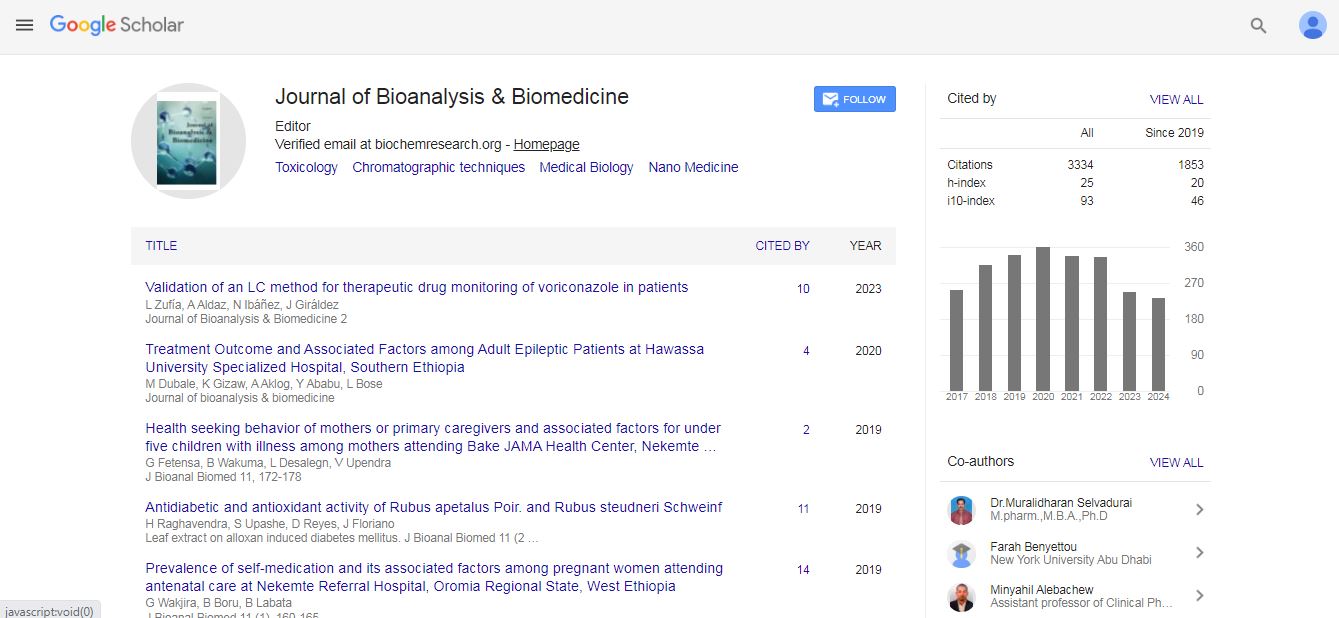
Journal of Bioanalysis & Biomedicine received 3099 citations as per Google Scholar report