Opinion - (127) Volume 17, Issue 3
Received: 01-Jun-2025
Editor assigned: 03-Jun-2025
Reviewed: 17-Jun-2025
Revised: 22-Jun-2025
Published:
29-Jun-2025
, DOI: 10.37421/1948-593X.2025.17.494
Citation: Okoye, Samuel T.. ”Accurate Drug Quantification In Biological Samples.” J Bioanal Biomed 17 (2025):494.
Copyright: © 2025 Okoye T .Samuel This is an open-access article distributed under the terms of the Creative Commons Attribution License, which permits unrestricted use, distribution and reproduction in any medium, provided the original author and source are credited.
The accurate quantification of small-molecule drugs within complex biological samples is a cornerstone of pharmaceutical research and development, underpinning crucial pharmacokinetic and pharmacodynamic studies. This process demands highly sensitive and selective analytical methodologies that can overcome the inherent challenges posed by biological matrices. Method validation plays a pivotal role in ensuring the reliability and reproducibility of these measurements, thereby safeguarding the integrity of research findings and ultimately, patient safety. Early work has illuminated the critical methodologies required for this task, emphasizing the need for robust approaches to tackle the intricacies of biological sample analysis. [1] Liquid chromatography coupled with tandem mass spectrometry (LC-MS/MS) has emerged as a preeminent technique for small-molecule drug quantification, often regarded as the gold standard in bioanalysis. Its ability to provide both separation and highly specific detection makes it indispensable for complex samples. Significant effort has been dedicated to optimizing chromatographic separation and mass spectrometric parameters to achieve unparalleled selectivity and sensitivity. The advancement of LC-MS/MS has revolutionized our capacity to accurately measure drug concentrations at very low levels. [2] Ultra-high-performance liquid chromatography (UHPLC) represents a significant evolution in chromatographic technology, offering substantial improvements in speed and resolution for the rapid and efficient quantification of specific drug classes. The adoption of UHPLC has led to higher throughput in bioanalytical laboratories, enabling faster turnaround times for critical studies. Understanding the nuances of column selection and mobile phase optimization is paramount when applying UHPLC to the analysis of complex biological matrices. [3] Chiral drugs, existing as enantiomers, often exhibit distinct pharmacological and toxicological profiles. The accurate quantification of individual enantiomers is therefore essential for a comprehensive understanding of their disposition and efficacy. This necessitates the development and application of specialized chiral separation techniques, such as those employing chiral stationary phases in HPLC or chiral selectors in capillary electrophoresis, to resolve these stereoisomers. [4] Dried blood spot (DBS) sampling offers a minimally invasive and convenient approach for collecting and storing biological samples for small-molecule drug analysis. This method simplifies sample collection, transport, and storage, while requiring a significantly reduced sample volume compared to traditional plasma collection. However, the unique characteristics of DBS matrices present specific extraction challenges and potential for matrix effects that must be carefully addressed. [5] Maintaining stringent quality control (QC) in bioanalytical laboratories is non-negotiable for ensuring the accuracy and reliability of small-molecule drug quantification. This involves the diligent use of certified reference materials, participation in proficiency testing programs, and the implementation of robust standard operating procedures. Adherence to regulatory expectations for bioanalytical method validation is fundamental throughout the drug development process. [6] Immunochemical methods, such as enzyme-linked immunosorbent assays (ELISA), offer an alternative approach for the high-throughput screening and quantification of certain small-molecule drugs. The development of highly specific antibodies is key to the success of these assays. Immunoassays can provide advantages in terms of speed and cost-effectiveness, particularly for analyzing large numbers of samples, though considerations regarding specificity and potential cross-reactivity must be carefully managed. [7] Ion mobility spectrometry coupled with mass spectrometry (IMS-MS) is emerging as a powerful tool for enhancing the separation and identification of small-molecule drugs in complex biological matrices. IMS introduces an additional dimension of separation based on ion size and shape, which can significantly improve peak capacity and reduce the impact of isobaric interferences. This technique holds considerable promise for resolving closely related compounds, such as isomers and metabolites. [8] Gas chromatography coupled with tandem mass spectrometry (GC-MS/MS) is well-suited for the quantification of volatile or semi-volatile small-molecule drugs, particularly in plasma. Analyzing such compounds often requires specific strategies, including derivatization, to enhance their detectability and chromatographic behavior. GC-MS/MS methods have proven effective for therapeutic drug monitoring, providing valuable insights into patient drug exposure. [9] Efficient sample preparation is a critical prerequisite for the accurate and sensitive bioanalysis of small-molecule drugs. A wide array of techniques exists, including liquid-liquid extraction, solid-phase extraction, and in-solution digestion, each with its own advantages and limitations regarding efficiency, recovery, and the potential for introducing matrix effects. The judicious selection of an appropriate extraction method is paramount for achieving optimal method sensitivity and accuracy. [10]
Accurate and reliable measurement of small-molecule drugs in biological samples is fundamental for drug development, requiring sophisticated analytical methodologies. These methods must contend with the complexities of biological matrices, necessitating careful validation to ensure the trustworthiness of pharmacokinetic and pharmacodynamic data. The foundational principles of bioanalytical method development and validation for small-molecule drugs have been extensively detailed, highlighting the essential considerations for achieving accurate quantitation. [1] The evolution of analytical instrumentation has led to LC-MS/MS becoming a benchmark technique for quantifying small-molecule drugs, due to its exceptional sensitivity and selectivity. The optimization of chromatographic parameters and mass spectrometric settings is a continuous endeavor to maximize performance. Strategies for sample preparation, such as protein precipitation and solid-phase extraction, are integral to minimizing interference from biological components, thereby enhancing the accuracy of measurements. [2] UHPLC has significantly advanced the field by enabling rapid and efficient separations, which is particularly beneficial for high-throughput bioanalytical laboratories. The benefits of reduced analysis times and improved resolution offered by UHPLC translate into greater efficiency in drug quantification. Careful consideration of column selection and mobile phase composition is crucial for achieving optimal results when analyzing complex biological samples. [3] The presence of enantiomers in drug molecules often leads to differential pharmacological effects, making the accurate quantification of each enantiomer vital. Specialized chiral separation techniques are indispensable for resolving enantiomers. The application of chiral stationary phases in HPLC and the use of chiral selectors in capillary electrophoresis are key strategies employed to achieve this separation, providing critical data for understanding enantioselective drug disposition. [4] DBS sampling presents an attractive alternative for sample collection due to its ease of use and minimal invasiveness. It simplifies logistics for sample collection, storage, and transport, while also reducing the required sample volume. However, the extraction of analytes from DBS cards requires specific optimization, and potential matrix effects unique to this sampling method must be thoroughly investigated and mitigated. [5] Robust quality control measures are imperative in bioanalytical laboratories to guarantee the accuracy and reliability of small-molecule drug quantitation. The consistent use of certified reference materials and engagement in proficiency testing programs are vital components of a strong QC system. Adherence to established standard operating procedures and meeting stringent regulatory requirements for method validation are essential for supporting drug development. [6] Immunochemical assays, such as ELISA, offer a high-throughput approach for the quantification of certain small-molecule drugs, particularly in screening applications. The development of specific antibodies is central to these methods. While immunoassays can be rapid and cost-effective for large sample volumes, careful attention must be paid to their specificity and the potential for cross-reactivity with structurally similar compounds. [7] IMS-MS is gaining prominence as a novel technique for enhancing the analytical capabilities in bioanalysis. By introducing a separation dimension based on ion mobility, IMS-MS can improve peak resolution and minimize interferences from isobaric compounds. This advanced technique shows significant promise for the complex task of resolving isomers and identifying metabolites in biological samples. [8] GC-MS/MS is a well-established technique for the analysis of volatile and semi-volatile small-molecule drugs, such as certain anti-malarial agents in plasma. The analysis of these compounds may necessitate derivatization strategies to facilitate their detection and chromatographic behavior. The application of GC-MS/MS for therapeutic drug monitoring demonstrates its utility in clinical settings for managing drug therapy. [9] Effective sample preparation is a critical determinant of success in bioanalytical studies of small-molecule drugs. A comparative evaluation of different extraction techniques, including LLE, SPE, and in-solution digestion, highlights their varied efficiencies and potential for matrix effects across different biological matrices. The selection of the most appropriate sample preparation method is crucial for achieving the required sensitivity and accuracy. [10]
This collection of articles explores various methodologies for the accurate quantification of small-molecule drugs in biological samples. Key techniques discussed include LC-MS/MS, UHPLC, GC-MS/MS, immunochemical assays, and IMS-MS, each offering unique advantages for specific applications. The importance of method validation, quality control, and sample preparation techniques like DBS sampling and traditional extraction methods is emphasized throughout. The challenges of analyzing chiral drugs and the need for specialized separation techniques are also highlighted. These advancements collectively contribute to robust bioanalytical capabilities essential for drug development and therapeutic drug monitoring.
None
None
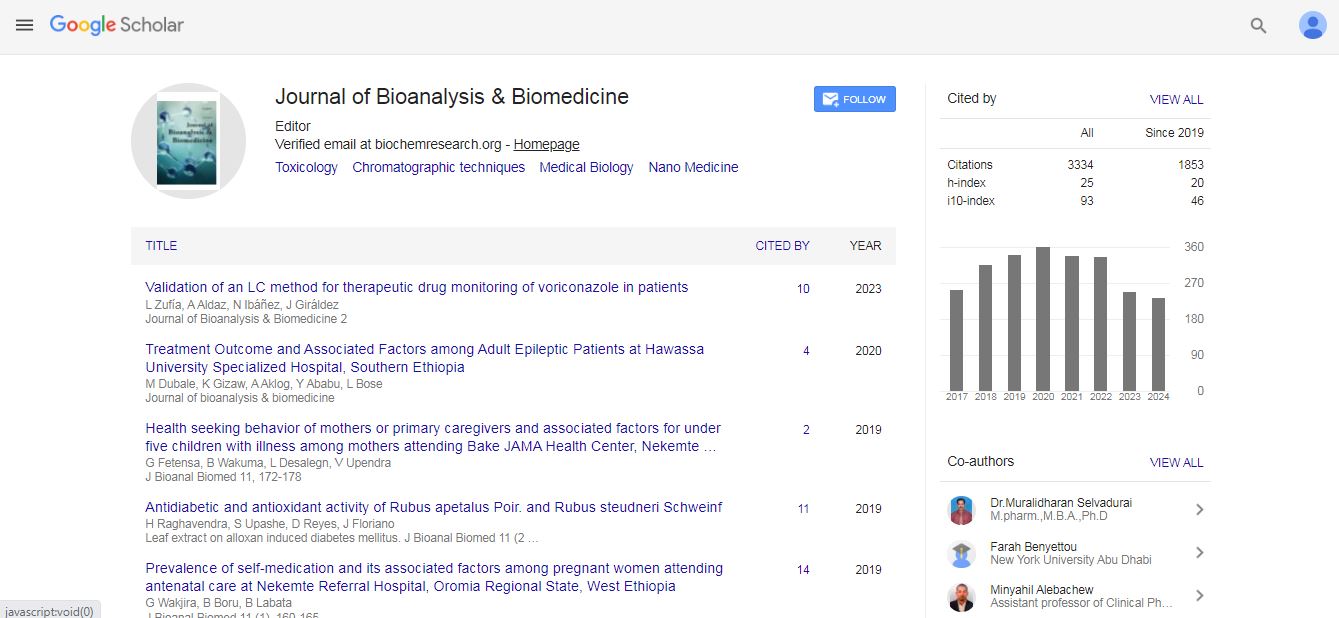
Journal of Bioanalysis & Biomedicine received 3099 citations as per Google Scholar report