Parkinson's disease (PD) surgery was introduced in the 1930s and has undergone many adaptations as physicians have acquired knowledge, skills and experience. Early pallidotomy and thalamotomy procedures created irreversible damage - with varying levels of precision - by arterial ligation, thermal or chemical destruction, or radiofrequency ablation. Although not curative, the thalamotomy had a dramatic effect on the tremors, and the pallidotomy was variably effective for rigidity, bradykinesia and dystonia. However, with the widespread use of levodopa in the late 1960s, injury procedures declined sharply. Over time, the motor complications associated with the chronic use of levodopa, combined with improved techniques have renewed interest in surgical procedures.1 Thalamotomy and pallidotomy are still practiced in some cases, but they ultimately been exceeded by adjustable neurostimulation.
Deep brain stimulation (DBS), which essentially mimics a lesional effect, was approved by the FDA for PD in 2002 and quickly became the most common surgical procedure for Parkinson's disease.2,3 In the appropriate candidate - a person suffering from a moderate illness who remains sensitive to levodopa but suffers from debilitating complications (motor fluctuations or dyskinesia) - it can be extremely beneficial.
Review: Molecular and Genetic Medicine
Review: Molecular and Genetic Medicine
Review Article: Molecular and Genetic Medicine
Review Article: Molecular and Genetic Medicine
Research Article: Molecular and Genetic Medicine
Research Article: Molecular and Genetic Medicine
Commentary: Molecular and Genetic Medicine
Commentary: Molecular and Genetic Medicine
Mini Review: Molecular and Genetic Medicine
Mini Review: Molecular and Genetic Medicine
Opinion: Molecular and Genetic Medicine
Opinion: Molecular and Genetic Medicine
Research Article: Molecular and Genetic Medicine
Research Article: Molecular and Genetic Medicine
Research Article: Molecular and Genetic Medicine
Research Article: Molecular and Genetic Medicine
Editorial: Molecular and Genetic Medicine
Editorial: Molecular and Genetic Medicine
Mini Review: Molecular and Genetic Medicine
Mini Review: Molecular and Genetic Medicine
Review Article: Molecular and Genetic Medicine
Review Article: Molecular and Genetic Medicine
Review Article: Molecular and Genetic Medicine
Review Article: Molecular and Genetic Medicine
Research Article: Molecular and Genetic Medicine
Research Article: Molecular and Genetic Medicine
Review Article: Molecular and Genetic Medicine
Review Article: Molecular and Genetic Medicine
Review Article: Molecular and Genetic Medicine
Review Article: Molecular and Genetic Medicine
Letter to Editor: Molecular and Genetic Medicine
Letter to Editor: Molecular and Genetic Medicine
Keynote: Molecular and Genetic Medicine
Keynote: Molecular and Genetic Medicine
Posters & Accepted Abstracts: Molecular and Genetic Medicine
Posters & Accepted Abstracts: Molecular and Genetic Medicine
Posters-Accepted Abstracts: Molecular and Genetic Medicine
Posters-Accepted Abstracts: Molecular and Genetic Medicine
Scientific Tracks Abstracts: Journal of Molecular Biomarkers & Diagnosis
Scientific Tracks Abstracts: Molecular Biomarkers & Diagnosis
Scientific Tracks Abstracts: Journal of Tissue Science and Engineering
Scientific Tracks Abstracts: Journal of Tissue Science and Engineering
Scientific Tracks Abstracts: Journal of Tissue Science and Engineering
Scientific Tracks Abstracts: Journal of Tissue Science and Engineering
Posters & Accepted Abstracts: Journal of Tissue Science and Engineering
Posters & Accepted Abstracts: Journal of Tissue Science and Engineering
Scientific Tracks Abstracts: Journal of Tissue Science and Engineering
Scientific Tracks Abstracts: Journal of Tissue Science and Engineering
Keynote: Metabolomics:Open Access
Keynote: Metabolomics:Open Access
Scientific Tracks Abstracts: Journal of Cytology & Histology
Scientific Tracks Abstracts: Journal of Cytology & Histology
Accepted Abstracts: Metabolomics:Open Access
Accepted Abstracts: Metabolomics:Open Access
Posters: Metabolomics:Open Access
Posters: Metabolomics:Open Access
Scientific Tracks Abstracts: Metabolomics:Open Access
Scientific Tracks Abstracts: Metabolomics:Open Access
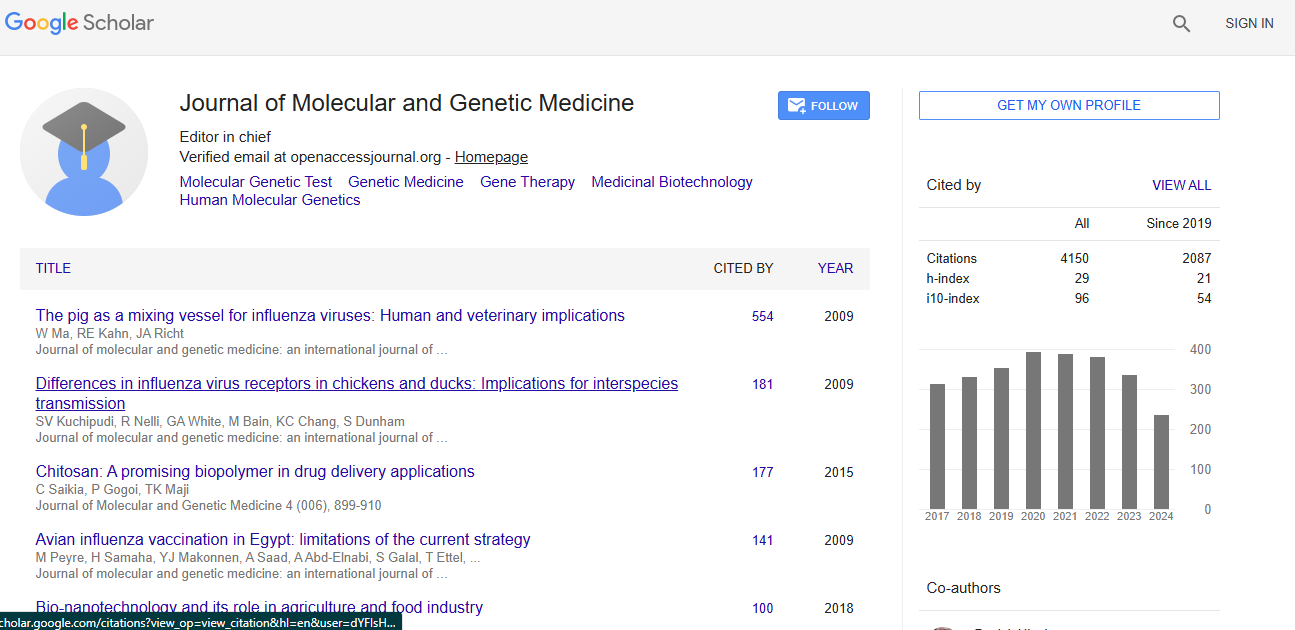
Molecular and Genetic Medicine received 3919 citations as per Google Scholar report

 Spanish
  Chinese
  Russian
  German
  French
  Japanese
  Portuguese
  Hindi
Hindi 