Evolutionary programming is one of the four central paradigms of the evolutionary algorithm. It is similar to genetic programming but the program structure to be optimized is set, while its numerical parameters can evolve. It was first used in the United States by Lawrence J. Fogel to use simulated evolution as a learning mechanism that seeks to produce artificial intelligence. He used, and created, finite-state machines as predictors. Evolutionary programming is actually a large evolutionary computing dialect with no fixed structure, in contrast to some of the other dialects. At the time, artificial intelligence was limited to two primary research avenues: modeling the human brain or "neural networks" and modeling the problem-solving behavior of human experts or "heuristic programming." The former was concerned with creating neuron mathematical models and their interaction, but nothing was then understood about how the brain actually functions. The latter method was initially performed by search-based approaches and subsequently joined by knowledge-based approaches or "expert framework." The heuristic approach demands knowledge of the problem area and some form of expertise. Both focused on emulating humans as the most developed, evolved intelligent organism.
Research Article: Journal of Applied & Computational Mathematics
Research Article: Journal of Applied & Computational Mathematics
Research Article: Journal of Applied & Computational Mathematics
Research Article: Journal of Applied & Computational Mathematics
Research Article: Journal of Applied & Computational Mathematics
Research Article: Journal of Applied & Computational Mathematics
Research Article: Journal of Applied & Computational Mathematics
Research Article: Journal of Applied & Computational Mathematics
Posters & Accepted Abstracts: Advances in Recycling & Waste Management
Posters & Accepted Abstracts: Advances in Recycling & Waste Management
Posters & Accepted Abstracts: Journal of Biometrics & Biostatistics
Posters & Accepted Abstracts: Journal of Biometrics & Biostatistics
Scientific Tracks Abstracts: Journal of Applied & Computational Mathematics
Scientific Tracks Abstracts: Journal of Applied & Computational Mathematics
Scientific Tracks Abstracts: Journal of Mass Communication & Journalism
Scientific Tracks Abstracts: Journal of Mass Communication & Journalism
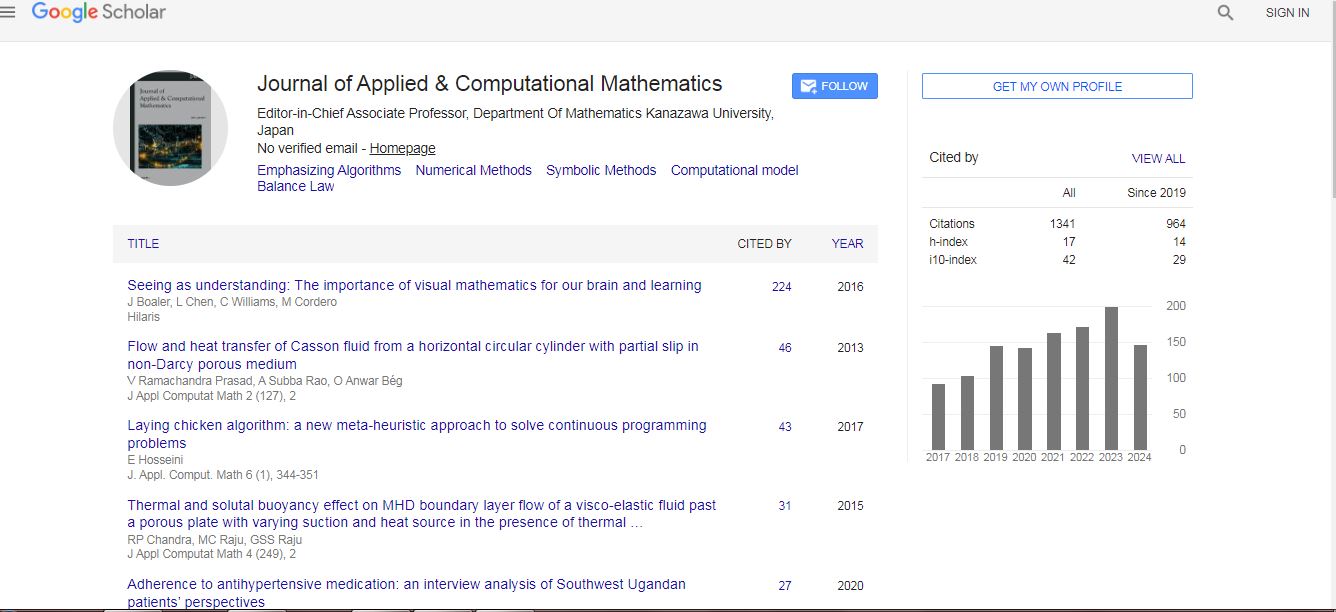
Journal of Applied & Computational Mathematics received 1282 citations as per Google Scholar report

 Spanish
  Chinese
  Russian
  German
  French
  Japanese
  Portuguese
  Hindi
Hindi 