Department of Statistics, College of Science, Bahir Dar University, Bahir Dar, Ethiopia
Research Article
Assessment of the Climatic and Environmental Factors on the Spatial Distribution of Malaria in Amhara Region, North-West Ethiopia
Author(s): Haile Mekonnen Fenta, Lijalem Melie Tesfaw, Awoke Seyoum Tegegne, Denekew Bitew Belay, Godada Keleb Lake, Muluwork Ayele Derebe, Abay Kassa Teklie*, Eyerus Asmare and Mollalign Tarekegn Minwagaw
Background: Malaria is a major global public health problem, particularly in developing nations. Its transmission in Ethiopia is primarily cyclical and unstable. The objective of this study was to assess factors affecting the spatial distribution of malaria in the Amhara region.
Methods: One hundred nine woredas were included in the study. The spatial autocorrelation of malaria incidence and hotspot analysis was determined by Moran’s diagram and local Moran’s I index, respectively. The relationships between malaria incidence and the ecological predictors of transmission were analyzed in all 93 geopolitical areas.
Results: A quarter of woredas in the Amhara region had precipitation equal to 73.67 mm. Among the covariates, aridity (SAC=-0.019, pvalue< 0.001), temperature (SAC=-0.438, p-value<0.001),.. Read More»
DOI:
10.37421/2470-6965.2025.14.613
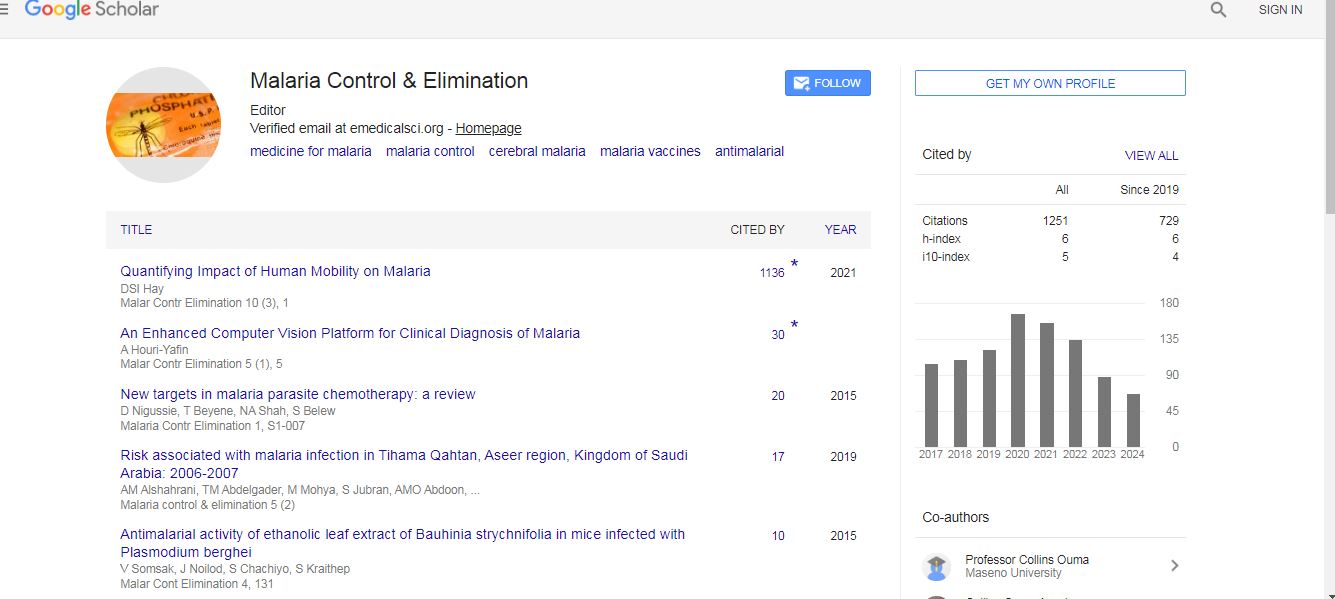
Malaria Control & Elimination received 1187 citations as per Google Scholar report
 Spanish
  Chinese
  Russian
  German
  French
  Japanese
  Portuguese
  Hindi
Hindi 