Emirhan Akyol1, Mehmet Ekrem Zorlu1, Secaattin Gulsen2, Recep Karamert1, Mehmet Birol Ugur1 and Hakan Tutar1
1Gazi University Faculty of Medicine, Turkey 2Gaziantep State Hospital, Turkey
Scientific Tracks Abstracts: J Laser Opt Photonics
Objective: To evaluate the effectiveness of the SmartNav system in detecting tip fold-over (TFO) during cochlear implantation and to compare angular insertion depth measurements obtained via SmartNav and transorbital X-ray imaging. Methods: This retrospective multi-center study included both pediatric and adult patients with normal cochlear anatomy, comprising 163 individuals and 213 ears who underwent cochlear implantation using Nucleus CI522 and CI622 systems between February 2024 and January 2025 at Gazi University Faculty of Medicine and Gaziantep State Hospital. Intraoperative SmartNav measurements included insertion time, angular insertion depth, impedance, and AutoNRT. TFO detection by SmartNav was confirmed with intraoperative X-ray. Postoperative X-ray images were used to verify electrode array position and assess angular insertion depth. Results: Of the 213 cochlear implantations, TFO was detected in 4 implantations (1.88%) intraoperatively with SmartNav, all of which were confirmed by X-ray, withdrawn, and successfully reinserted during the surgery. One case (0.47%) of TFO was not detected by SmartNav and identified postoperatively via X-ray imaging. SmartNav showed a sensitivity of 80%, specificity of 100%, a positive predictive value of 100%, and a negative predictive value of 99.5%. A strong correlation was found between SmartNav and X-ray angular insertion depth measurements (r = 0.711, p < 0.001). Conclusion: SmartNav System is a reliable tool for the intraoperative detection of TFO and the assessment of angular insertion depth in patients with normal cochlear anatomy. By reducing operative time, minimizing the need for intraoperative imaging, and offering real-time insertion feedback, it functions as a practical and efficient adjunct in cochlear implantation. Key words: Cochlear implantation; SmartNav system; Tip fold-over; X-ray Recent Publications 1. Zawawi F, Bukhari AF, Khairy SA, Garrada M. Surgeon-Performed Intraoperative Cochlear Implant Testing Using SmartNav: A Step Toward Streamlining Surgical Workflow. International Journal of Pediatric Otorhinolaryngology. 2025:112432. 2. O'Connell B, Hunter J, Wanna G. The importance of electrode location in cochlear implantation. Laryngoscope Investig Otolaryngol. 2016; 1 (6): 169–74. 3. Kırbaç A, Ulukan MB, İncesulu SA, Kaya E. A New Intraoperative Method for Controlling Electrode Placement in Cochlear Implant Surgeries: Nucleus® SmartNav System and Preliminary Results. 2024. 4. Oh J, Cheon J-E, Park J, Choi YH, Cho YJ, Lee S, et al. Cochlear duct length and cochlear distance on preoperative CT: imaging markers for estimating insertion depth angle of cochlear implant electrode. European Radiology. 2021;31:1260-7. 5. Svrakic M, Friedmann DR, Berman PM, Davis AJ, Roland Jr JT, Svirsky MA. Measurement of cochlear implant electrode position from intraoperative post-insertion skull radiographs: a validation study. Otology & Neurotology. 2015;36(9):1486-91.
Emirhan Akyol graduated from Hacettepe University Faculty of Medicine and is currently a final-year ENT resident at Gazi University. His main interests include otology, neurotology, and facial reanimation. He has been involved in clinical and academic projects related to cochlear implantation, facial nerve surgery, and swallowing disorders.
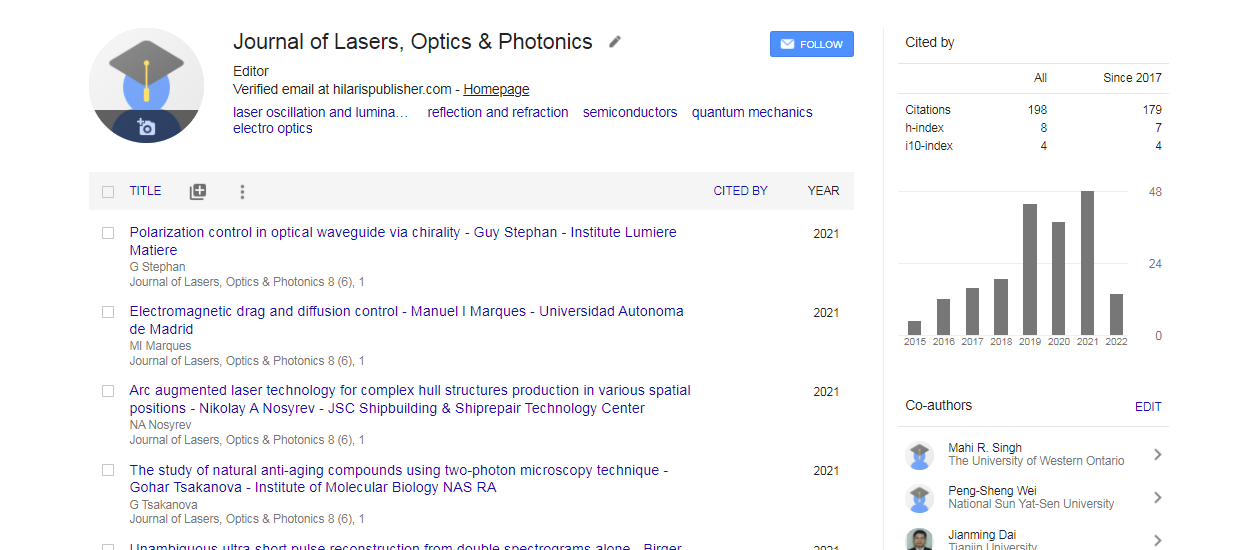
Journal of Lasers, Optics & Photonics received 279 citations as per Google Scholar report

 Spanish
  Chinese
  Russian
  German
  French
  Japanese
  Portuguese
  Hindi
Hindi 