Yoni Evgeni Gutkovich
The Israel Naval Medical Institute, Israel
Scientific Tracks Abstracts: J Laser Opt Photonics
Human passive motion during boat, car or airplane travel may trigger motion sickness. Seasickness is the most provoking manifestation of motion sickness. It imposes major constraints on quality of life and human performance. Based on seasickness susceptibility the population is usually categorized into susceptible (S) and non-susceptible (NS). During repeated exposure some susceptible individuals undergo habituation and obtain symptoms relief, reflecting a third group of habituating (H) individuals. Recently, accumulative evidence suggests that the vestibular time constant (Tc) is associated with motion sickness susceptibility and attenuation of symptoms. These studies demonstrated that repeated passive motion stimuli lead to temporary short-term (days) changes in Tc. whereas sea sickness habituation process lasts 3 to 6 months. Therefore, the goal of the present study was to examine the behavior of Tc during the entire span of the seasickness habituation process between the H, S and NS groups in order to find an objective test for seasickness severity prediction. Design: Tc of 30 subjects was prospectively evaluated pre, 3 and 6 months post exposure to sea environment using a computerized rotatory chair system protocol. Seasickness severity was evaluated by Wiker questionnaire. Results: Significantly shorter Tc was found in the S group compared with the NS and H groups. Further analysis revealed lower maximal Slow Phase Velocity (mSPV) and nystagmus frequency (total number of beats/second) in the S group. Conclusion: Our results suggest that Tc, mSPV and nystagmus frequency might serve as a prediction for seasickness severity. Recent Publications 1. Siag K, Paker M, Gutkovich YE, Mazzawi S. 2025. Buffered Lidocaine for Topical Nasal Anesthesia: a Double-Blind Randomized Controlled Trial. Journal of Voice. 2. Gutkovich YE, Jamison A, Lagami D, Fonar Y, Siag K, Tal D. Video Head Impulse Test and seasickness susceptibility.2025. Exp. Brain Res. 243(5):119. 3. Gutkovich YE, Manheim M, Veler R, Geva A, Tal D. 2025. Hyperbaric oxygen therapy and corticosteroids as combined treatment for Acute Acoustic Trauma. European Archives of Oto-Rhino-Laryngology. 4. Siag K, Paker M, Mazzawi S, Gutkovich YE, Barcan M, Fisher S, Ziv M. 2024. Evaluation of Audiovestibular Involvement in Patients with Psoriasis. Isr Med Assoc J.;26(11):675-681. 5. Gutkovich YE, Shlizerman L, Paker M, Mazzawi S, Siag K, Shupak A. 2023. Barotrauma-Induced Perilymph Fistula: Video Head Impulse Test and High-Resolution Temporal Bones Computed Tomography Role in Evaluation and FollowUp. The journal of international advanced otology 19(4), 350–354.
Yoni Evgeni Gutkovich, M.D., Ph.D., is completing his residency in Otolaryngology–Head and Neck Surgery and will soon begin a clinical fellowship in Australia, focusing on otology and general ENT surgery. He earned his M.D. and Ph.D. (Neurobiology, magna cum laude) from the Technion – Israel Institute of Technology, where his doctoral research examined transcription factor networks and neural patterning in Xenopus development. Having successfully completed all board examinations in Otolaryngology, Dr. Gutkovich has developed advanced expertise in otology, neurotology, and tympanoplasty. He has published in leading journals, including European Archives of Oto-Rhino-Laryngology, Experimental Brain Research, and Journal of Voice. His research has been supported by national grants, and he has presented widely at national and international conferences. His current academic interests focus on surgical innovation in tympanoplasty and translational neuroscience aimed at advancing.
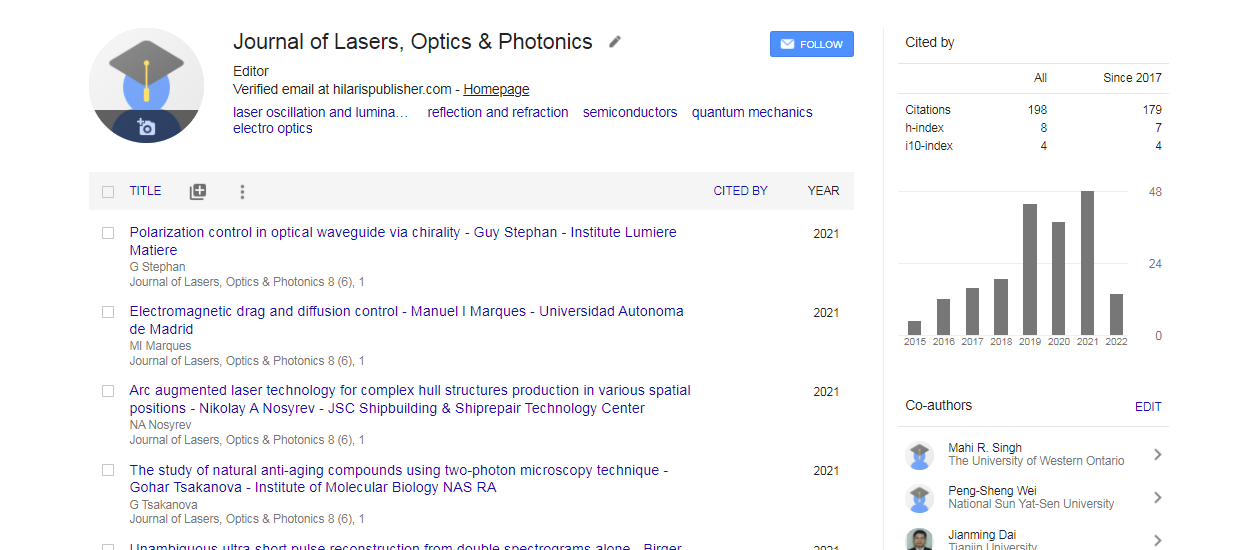
Journal of Lasers, Optics & Photonics received 279 citations as per Google Scholar report

 Spanish
  Chinese
  Russian
  German
  French
  Japanese
  Portuguese
  Hindi
Hindi 