Sofia Sousa Teles1, Ana Claro1, Lília Ferraria1, Mariana Neto1, Rafael Pires1, Ana Miguel Couto1, Joana Dias1, Luis Antunes1, Manuel Pereira2, Eduardo Simoes3 and Rudolfo Peralta3
1Unidade Local de Saude Almada Seixal, Portugal 2University of Lisbon, Portugal 3CEOV (Portuguese Navy), Portugal
Scientific Tracks Abstracts: J Laser Opt Photonics
Innovative 3D models of the temporal bone have been redesigning surgical training, with several 3D temporal bone models described in the literature. While they vary in the presence of different anatomical pointmarks, their fixed ossicular chain and absence of functional tympanic membrane make them less useful for middle ear surgical training. We obtained a micro-CT of a cadaveric temporal bone and segmented the DICOM images, designing a model fit for ossicular mobility. That model was printed in resin (White V4, Formlabs 3+), and the tympanic membrane was printed in transparent Formlabs Elastic 50A. Otoendoscopy was also used to optimize the tympanic membrane. Training was conducted in both the cadaveric bone and in the 3D model. We present our results with both simulation models (cadaver and 3D model), performed by one otologic surgeon, highlighting the realism of the drilling experience and anatomical resemblance of the 3D model to the cadaveric bone. While further research and innovation is still needed, 3D temporal bone models are becoming more and more accurate and represent a promising educational tool for otologic surgical training. Recent Publications 1. 1. Brown MA, Jiang S, Gan RZ. A 3D Printed Human Ear Model for Standardized Testing of Hearing Protection Devices to Blast Exposure. Otol Neurotol Open. 2022;2(2):e010. doi:10.1097/ ono.0000000000000010 2. 2. Lahde S, Hirsi Y, Salmi M, Mäkitie A, Sinkkonen ST. Integration of 3D-printed middle ear models and middle ear prostheses in otosurgical training. BMC Med Educ. 2024;24(1):1-10. doi:10.1186/ s12909-024-05436-9 3. 3. Chien WW, da Cruz MJ, Francis HW. Validation of a 3D-printed human temporal bone model for otology surgical skill training. World J Otorhinolaryngol - Head Neck Surg. 2021;7(2):88-93. doi:10.1016/j.wjorl.2020.12.004 4. 4. Frithioff A, Weiss K, Frendø M, et al. 3D-printing a cost-effective model for mastoidectomy training. 3D Print Med. 2023;9(1):1-8. doi:10.1186/s41205-023-00174-y 5. 5. Iannella G, Pace A, Mucchino A, et al. A new 3D-printed temporal bone: ‘the SAPIENS’—specific anatomical printed-3D-model in education and new surgical simulations. Eur Arch Oto-Rhino- Laryngology. 2024;281(9):4617-4626. doi:10.1007/s00405-024-08645-6 6. 6. Bartling ML, Rohani SA, Ladak HM, Agrawal SK. Micro-CT of the human ossicular chain: Statistical shape modeling and implications for otologic surgery. J Anat. 2021;239(4):771-781. doi:10.1111/ joa.13457
Sofia Sousa Teles is a Portuguese Otolaryngology resident in the Military Health Service, currently working in the Hospital Garcia de Orta (Unidade Local de Saúde Almada-Seixal), with a strong focus on innovation, research, and multidisciplinary collaboration. Her clinical and academic interests span from otoneurology and laryngology to diving and hyperbaric medicine. She is currently involved in projects on immersive virtual reality for vestibular rehabilitation, tailored 3D printing for otologic surgical training, and the integration of technology into patient-specific surgical planning. Her background in the military has shaped her resilience, adaptability, and problem-solving skills—particularly in resourceconstrained environments. Passionate about advancing evidence-based care and surgical education, Sofia is committed to bridging emerging technologies and clinical practice. She has presented nationally and is now expanding her contributions to the international otolaryngology community.
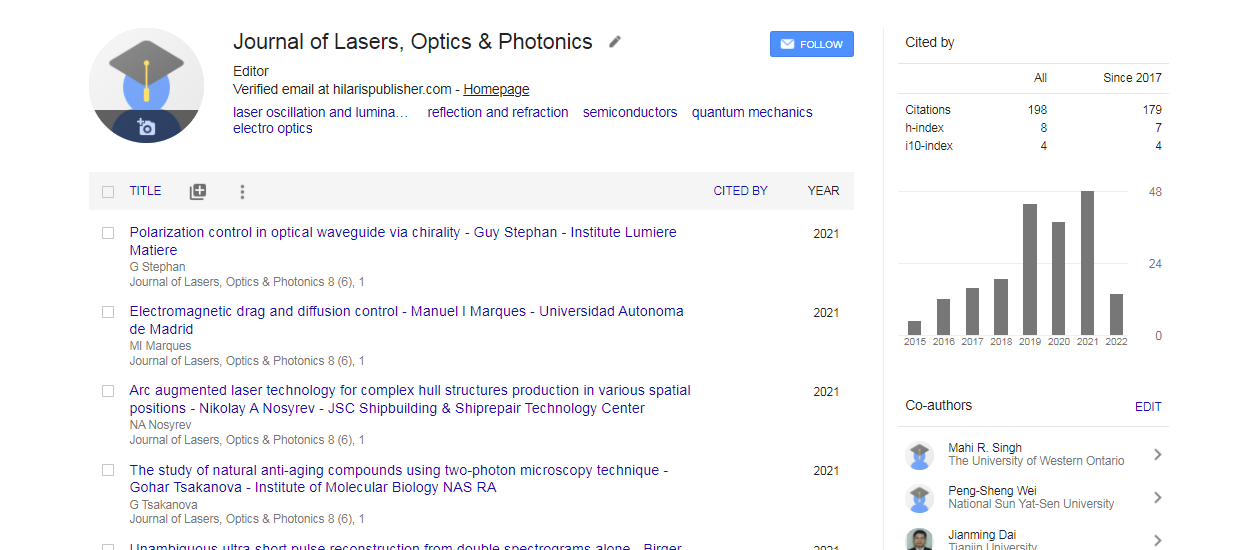
Journal of Lasers, Optics & Photonics received 279 citations as per Google Scholar report

 Spanish
  Chinese
  Russian
  German
  French
  Japanese
  Portuguese
  Hindi
Hindi 