Fahed Aloufi
King Abdulaziz University,Saudi Arabia
Scientific Tracks Abstracts: J Environ Hazard
Environmental Impact Assessment (EIA) is critical to balancing rapid development with environmental protection in Saudi Arabia’s Vision 2030 agenda. This study reviews the Kingdom’s EIA legal, institutional, and procedural framework, evaluates its effectiveness through policy analysis and two contrasting megaproject case studies—the Red Sea Project and NEOM’s “The Line”—and identifies key challenges including limited public participation, fragmented institutional coordination, and weak enforcement. Findings show that successful EIAs rely on comprehensive baseline data, transparent disclosure, and independent verification, while deficiencies stem from inadequate technical capacity and insufficient monitoring. A five-phase reform model is proposed, encompassing regulatory overhaul, digital integration, professional capacity building, strengthened enforcement, and alignment with national and international sustainability goals. The study concludes that adopting this model can shift Saudi Arabia from a compliance-based EIA approach to a proactive, transparent, and sustainability-driven system.
Dr. Fahed Aloufi is a faculty member in the Department of Environmental Science at the Faculty of Meteorology, Environment, and Arid Land Agriculture, King Abdulaziz University, Jeddah, SaudiArabia.
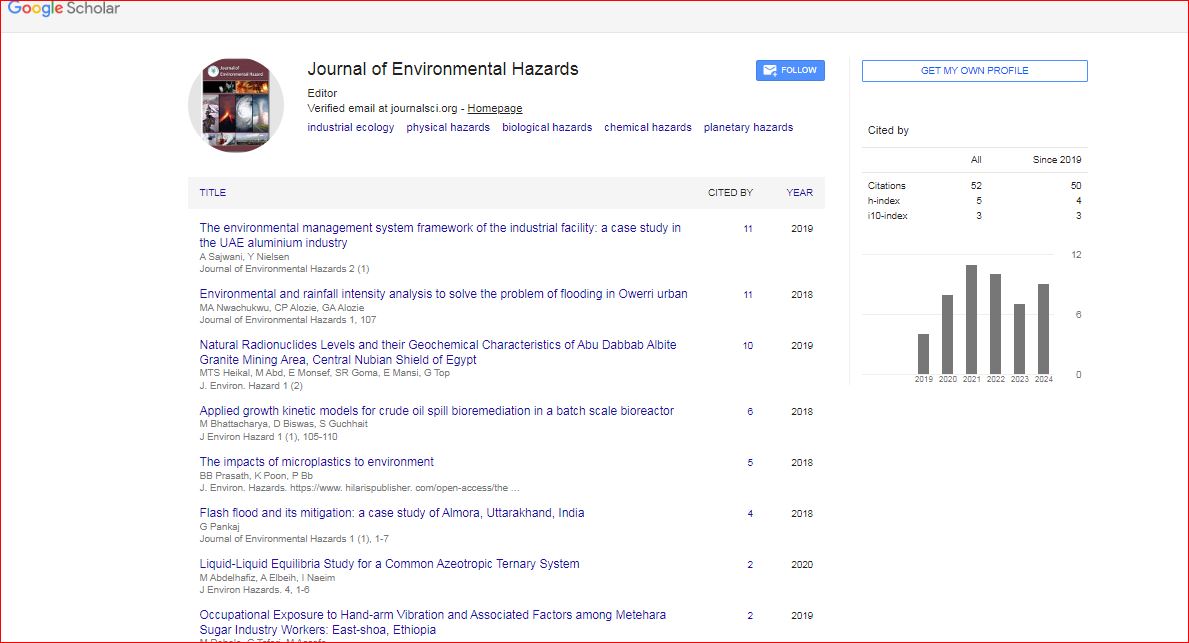
Journal of Environmental Hazards received 51 citations as per Google Scholar report
 Spanish
  Chinese
  Russian
  German
  French
  Japanese
  Portuguese
  Hindi
Hindi 