Celine Iswarya Partha Sarathi
UK
Scientific Tracks Abstracts: J Laser Opt Photonics
To evaluate a novel gated precision-triage “straight-to-radiology” pathway for patients referred under the NHS two-week wait (2WW) suspected cancer scheme with a neck lump at a single district general hospital in England. Design & Setting: Prospective cohort study at Russells Hall Hospital, serving a population of 450,000 with comparatively lower formal-education attainment. Methods: All consecutive 2WW referrals labelled “neck lump” or “unexplained thyroid lump” between 1 November 2023 and 31 December 2024 underwent direct consultant radiologist ultrasound (US), with authority to arrange cross-sectional imaging or biopsy as indicated. Referral details, time intervals (referral– investigation–diagnosis–management) and outcomes were prospectively recorded on a secure NHS database and retrospectively analysed. Minimum follow-up was six months. Results: Of 440 referrals, 417 were included. Over half (55.6%) contained no clinical information beyond the “neck lump” tick box. US was normal in 110 (26.4%) cases; 130 had suspicious lesions requiring biopsy. Malignancy was diagnosed in 53 patients (12.7%), consistent with national benchmarks. After benign/normal initial US, 348 (83.5%) were removed from the cancer pathway; of these, 20% (n=71) sought further review to discuss surgery and 6% (n=21) proceeded to excision. Men were 3.4 times more likely than women to harbour malignancy (RR 3.43, 95% CI 1.99–5.87). Straight-to-biopsy reduced diagnostic interval (15 vs 24 days to biopsy, p<0.001) but treatment start times were unchanged (~73 days, p=0.98). Mean referral-to-management decision time was 20 days (SD 14; range 1–87); mean time to removal from FDS pathway was 16 days (SD 10; range 0–55). Conclusion: This straight-to-radiology pathway safely streamlined neck lump referrals, with high diagnostic accuracy and improved efficiency. Mandatory referral datasets, radiologist-led biopsy and structured benign follow-up could enhance sustainability and optimise resource use, though oncology capacity continues to limit treatment timelines.
Celine Iswarya Partha Sarathi is a Core Surgical Trainee (CT2) in the UK with a strong commitment to advancing equitable care in head and neck oncology. Inspired by the impact of geography and social factors on health outcomes, she has focused her research on uncovering and addressing disparities in diagnosis and management within the NHS. At Russells Hall Hospital serving a population with lower educational attainment Celine is evaluating a novel “straight-to-radiology” pathway for suspected neck lumps to streamline access, shorten diagnostic delays, and reduce inequalities in cancer care. Alongside her surgical training, she is passionate about integrating evidence-based service redesign with frontline clinical practice to improve patient experiences and outcomes. By tackling these local challenges, Celine aims to contribute practical, data-driven solutions to the global dialogue on access and equity in ENT healthcare.
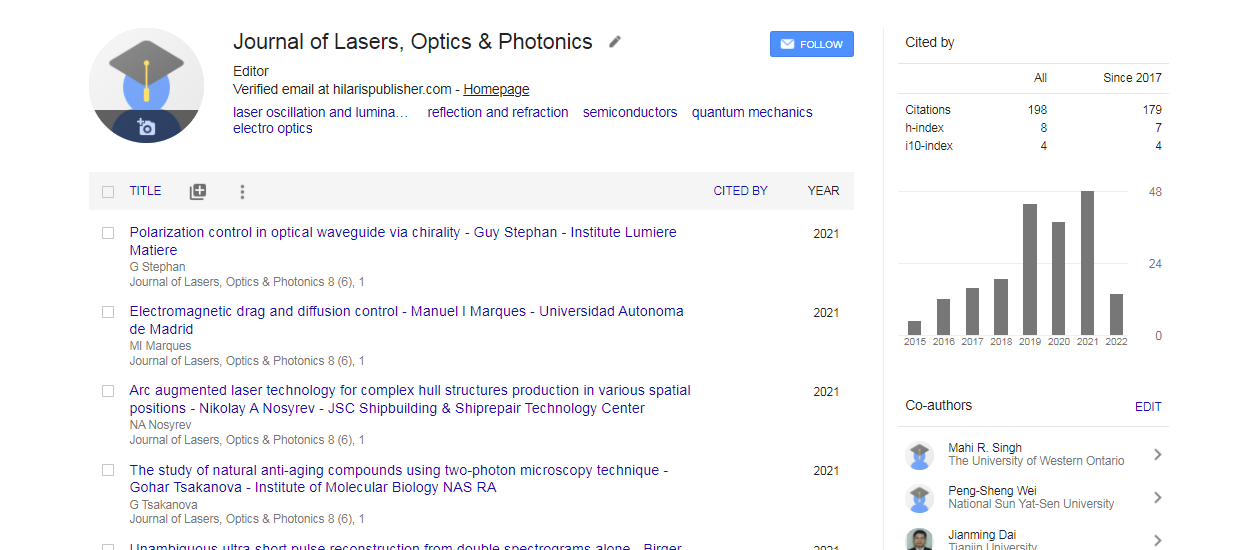
Journal of Lasers, Optics & Photonics received 279 citations as per Google Scholar report
 Spanish
  Chinese
  Russian
  German
  French
  Japanese
  Portuguese
  Hindi
Hindi 