Buh Amos Wung, Nde Fon Peter and Julius Atashili
University of Buea, Cameroon
Posters & Accepted Abstracts: J Med Microb Diagn
Background: Clients have explicit desires or requests for services when visiting hospitals; inadequate discovery of their needs may result in dissatisfaction. Patient satisfaction influences retention in HIV care, adherence to HAART and serves as determinant to HIV suppression. This studyâÂ?Â?s objectives were to quantify clientsâÂ?Â? satisfaction with HIV services in Bamenda and determine relationship between satisfaction and clientsâÂ?Â? socio-demographic/structural characteristics. Methods: A cross-sectional study was conducted on HIV-positive patients followed-up, on treatment and who consulted in the Bamenda Regional Hospital treatment centre between July and August 2014. Participants consent was sought and data collected on clientâÂ?Â?s level of satisfaction to staff-patient-communication, staff attitudes, privacy and confidentiality and staffing and amenities situations in the hospital. Data was collected using a structured questionnaire interviewer-administered by investigator and trained health personnel. Collected data was analyzed using Epi Info version 3.5.4 and clientsâÂ?Â? satisfaction measured using frequencies and percentages. Results: A total of 384 participants took part in this study and their median age was 37 years (IQR: 29-46). 274 (71.4%) participants were females. Overall satisfaction with HIV services was 91.2% and participants reported less satisfaction with overall staffing and amenities situation of the center (3.6%). In the multivariate analysis, only being female, employed and perceiving high number of nurses working at the treatment center remained significant predictors of overall satisfaction with HIV services. Conclusion: A high proportion of participants expressed satisfaction with HIV services. However, some dissatisfaction is masked in this high satisfaction level. This dissatisfaction underscores need to improve staff attitudes, staff-patient-communication, employ more staff and build better patient facilities. Future studies need to focus on assessing long-term progression of satisfaction levels with services and determinants of satisfaction involving larger samples in many treatment centers.
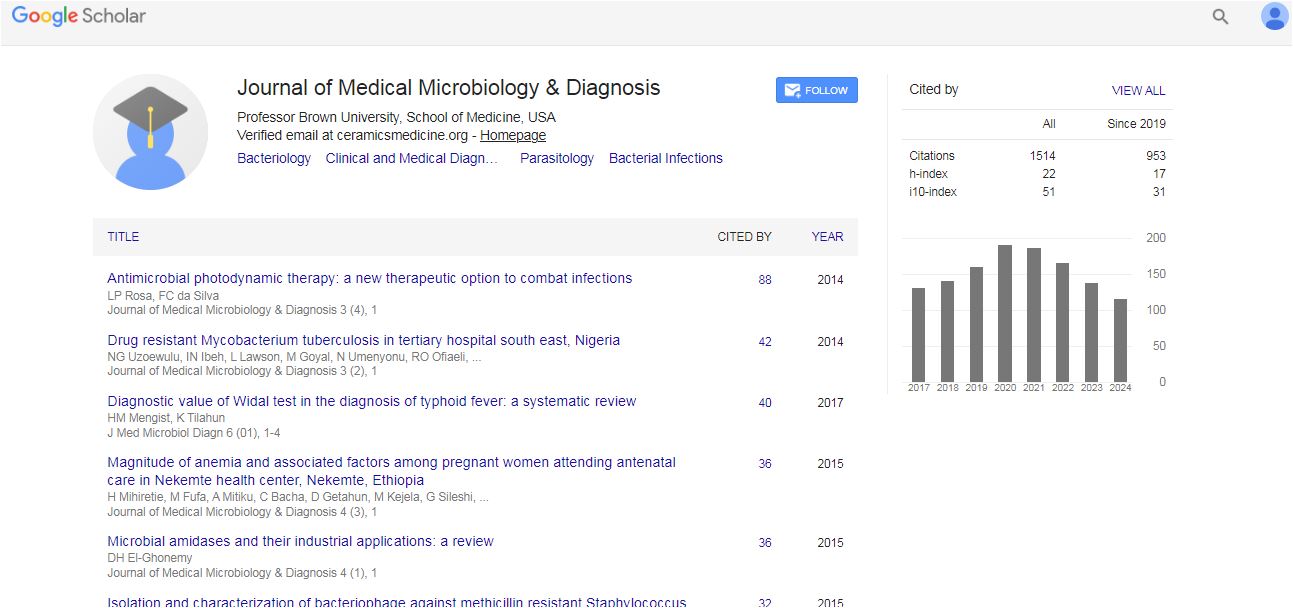
Medical Microbiology & Diagnosis received 14 citations as per Google Scholar report
 Spanish
 Chinese
 Russian
 German
 French
 Japanese
 Portuguese
 Hindi
