Abrham Getachew Alemu
University of Gondar, Ethiopia
Scientific Tracks Abstracts: J Diabetic Complications Med
Diabetes Mellitus (DM), particularly type 2 diabetes is a prevalent non-communicable disease with a significant association with depression. Alongside diabetes, depression is a common comorbidity that significantly impacts patients' quality of life and disease management. The estimated prevalence of depression among diabetic patients in Ethiopia was 39.73%, and its subgroup analysis in Addis Ababa shows it is about52.9% . The main aim of this study is to assess the prevalence and associated factors of depression among insulin and oral hypoglycemic medication users of Diabetes Mellitus patients in public hospitals of Addis Ababa. A comparative cross-sectional study was conducted in three selected public hospitals in Addis Ababa among randomly selected 422 study participants from August 1 2024 to August 30, 2024. Data were collected, entered, and cleaned by Epi info 7 and analyzed using SPSS version 25. Descriptive statistics for categorical variables were presented in frequencies and percentages, and mean and interquartile ranges were used to describe continuous variables. The adequacy of the model was assessed using the Hosmer-Lemeshow test and multicollinearity among independent variables was evaluated using the variance inflation factor (VIF) test. Then, bivariate logistic regression analysis was performed for each independent variable regarding the presence of depression among DM patients. An adjusted odd ratio (AOR) with 95% confidence interval were used to identify associated variables for depression, and p-values < 0.05 were considered to indicate statistical significance. The prevalence of depression among DM patient was 54. 27% (95% CI:49.4%-59.1%), and the prevalence of depression showed variability among DM participants taking oral hypoglycemic agents (44.9%) and insulin users (63.4%)even though the difference in their mean depression scale score (8.54 Vs 9.66) was not significant (P=0.228). From multivariable logistic regression analysis variables such as level of social support(AOR: 6.24; 95% CI:1.91-20.44), type of treatment(AOR: 0.095; 95% CI: 0.009-0.9), family history of depression (AOR:0.47;95% CI:0.29-0.75) and presence of diabetic complication(AOR: 3.22; 95% CI:1.97-5.27) were significantly associated factors at a P-value of<0.05 and a 95% CI. The overall prevalence of depression was unacceptably high and showed that more than half (54.27%) of DM patients stragle to live with depression and its bad qunesqences. According to the output from multivariable logistic regression analysis, poor level of social support and having diabetic complications were found to be risk factors for depression. Conversely, not having family history of depression and taking oral hypoglycemic agents were proven to be protective factors of depression.
Abrham Getachew Alemu is a medical doctor who graduated from the University of Gondar, Ethiopia, in 2020. He has four years of clinical experience working on non-communicable diseases and mental health care as a primary physician. Currently, he is a postgraduate Year 1 student at the University of Pisa, Italy, specializing in Neuroscience.
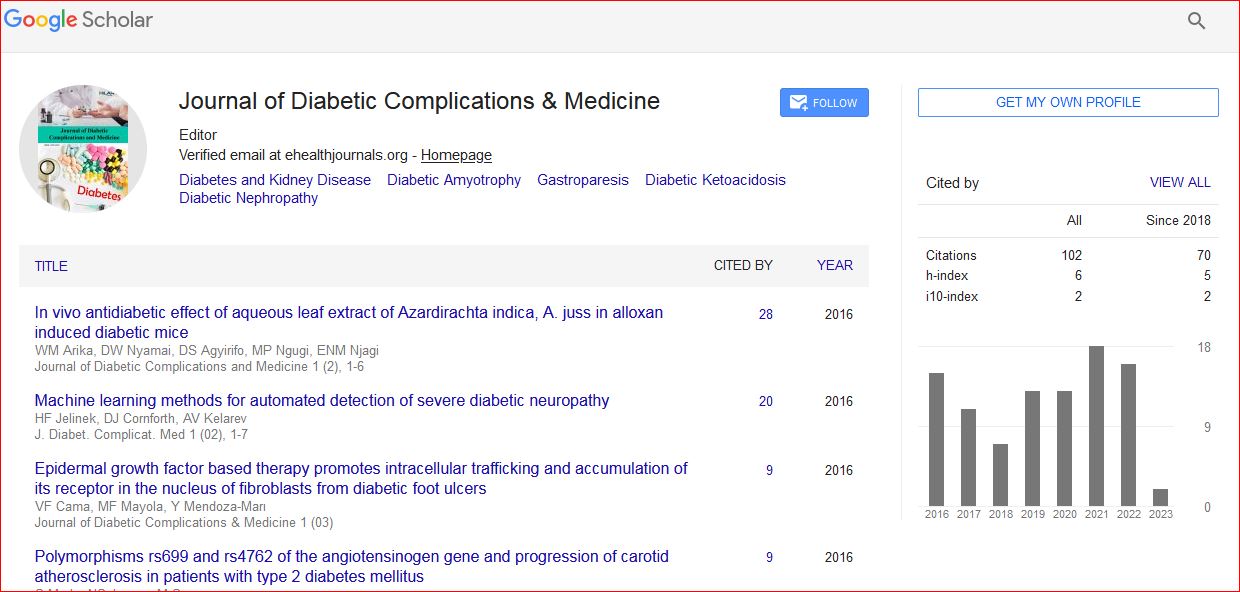
Journal of Diabetic Complications & Medicine received 102 citations as per Google Scholar report
 Spanish
  Chinese
  Russian
  German
  French
  Japanese
  Portuguese
  Hindi
Hindi 