Perspective - (2025) Volume 15, Issue 2
Received: 02-Jun-2025, Manuscript No. bda-25-175523;
Editor assigned: 04-Jun-2025, Pre QC No. P-175523;
Reviewed: 18-Jun-2025, QC No. Q-175523;
Revised: 23-Jun-2025, Manuscript No. R-175523;
Published:
30-Jun-2025
, DOI: 10.37421/2090-5025.2025.15.302
Citation: Khumalo, Thandiwe. ”Zirconia’s Dental Journey: Properties, Advances, Challenges.” Bioceram Dev Appl 15 (2025):302.
Copyright: © 2025 Khumalo T. This is an open-access article distributed under the terms of the Creative Commons Attribution License, which permits unrestricted use, distribution and reproduction in any medium, provided the original author and source are credited.
Zirconia has had a remarkable journey in dentistry, with studies detailing its manufacturing processes, diverse properties, and crucial clinical implications, alongside highlighting future research directions [1].
A thorough understanding of the mechanical properties of zirconia-based biomaterials is fundamental for their successful application in medical implants, with researchers analyzing how composition and processing critically influence performance [2].
Simultaneously, transformation toughening in zirconia ceramics, a crucial mechanism, consistently enhances their fracture toughness and reliability, particularly for dental applications [3].
Significant developments in additive manufacturing for zirconia ceramics are revolutionizing the field, showcasing how 3D printing techniques enable the creation of complex geometries and customized components with high precision [4].
This aligns with the systematic assessment of CAD/CAM manufacturing for zirconia-based dental restorations, underscoring the precision and efficiency that digital workflows bring to modern prosthodontics [9].
A systematic review thoroughly examines the biocompatibility of zirconia ceramic dental implants, confirming excellent integration with oral tissues and minimal adverse reactions, solidifying its status as a reliable material [5].
To further enhance performance, various surface modification techniques for zirconia ceramics are explored, aimed at improving their biological and mechanical interactions, which is essential for advanced biomedical applications [6].
However, critical reviews also delve into low-temperature degradation LTD of zirconia-based ceramics, a phenomenon affecting long-term stability, and offer insights into mitigating strategies, especially relevant in dental contexts [7].
Moreover, the balance between mechanical and optical properties in transparent zirconia ceramics is being actively explored, highlighting their increasing role in aesthetic dental restorations and the compromises involved [10].
Finally, the mechanical properties of zirconia matrix composites are examined, demonstrating how combining zirconia with other materials leads to significantly enhanced performance for various demanding applications [8].
Together, these areas of research paint a comprehensive picture of zirconiaâ??s current standing and future potential in diverse fields.
Zirconiaâ??s journey in dentistry and broader biomedical fields is extensively reviewed, detailing its manufacturing processes, diverse properties, and crucial clinical implications [1]. The fundamental mechanical properties of zirconia-based biomaterials are consistently a focal point of research, as these are critical for their successful integration into various medical implants. Studies analyze how material composition and processing parameters significantly influence overall performance [2].
A significant aspect of zirconiaâ??s utility stems from phenomena like transformation toughening, a crucial mechanism that enhances its fracture toughness and reliability, especially benefiting dental applications [3]. Parallel to this, exciting developments in additive manufacturing are transforming the way zirconia ceramics are produced. What this really means is that 3D printing techniques are enabling the creation of complex geometries and highly customized components with remarkable precision [4].
Regarding patient safety and efficacy, the biocompatibility of zirconia ceramic dental implants has been thoroughly examined in systematic reviews, consistently confirming excellent integration with oral tissues and minimal adverse reactions, establishing it as a highly reliable material [5]. To further refine its biological and mechanical interactions, various surface modification techniques for zirconia ceramics are continually explored. These efforts are essential for developing advanced biomedical applications, ensuring optimal performance and longevity [6].
Here's the thing, despite its advantages, zirconia-based ceramics face challenges like low-temperature degradation LTD, a phenomenon that affects long-term stability. Critical reviews offer insights into mitigating strategies, which are particularly relevant in dental contexts to ensure durability [7]. Concurrently, research investigates the mechanical properties of zirconia matrix composites. This shows how combining zirconia with other materials leads to significantly enhanced performance, opening doors for various demanding applications that require superior material strength and resilience [8].
Modern prosthodontics greatly benefits from advancements in CAD/CAM manufacturing for zirconia-based dental restorations. Systematic reviews consistently underscore the precision and efficiency that digital workflows bring to the fabrication of these crucial components [9]. What this really means is, the evolution of transparent zirconia ceramics addresses aesthetic demands. This involves exploring the intricate balance between achieving optimal mechanical and optical properties, highlighting their increasing role in aesthetic dental restorations and the careful compromises involved in their design and application [10].
Zirconia has a significant journey in dentistry, detailing its manufacturing processes, diverse properties, and crucial clinical implications. Its mechanical properties are fundamental for medical implants, with composition and processing influencing performance. Transformation toughening enhances fracture toughness and reliability, especially in dental applications. Additive manufacturing allows for complex geometries and customized components with high precision. Its biocompatibility is excellent for dental implants, showing integration with oral tissues and minimal adverse reactions. Let's break it down, various surface modification techniques are explored to improve biological and mechanical interactions for advanced biomedical applications. Critical reviews dive into low-temperature degradation LTD of zirconia-based ceramics, a phenomenon affecting long-term stability, and offer insights into mitigating strategies, especially relevant in dental contexts. Reviews examine the mechanical properties of zirconia matrix composites, showing how combining zirconia with other materials leads to significantly enhanced performance for various demanding applications. Systematic reviews assess the current landscape of CAD/CAM manufacturing for zirconia-based dental restorations, underscoring the precision and efficiency that digital workflows bring to modern prosthodontics. The balance between mechanical and optical properties in transparent zirconia ceramics is explored, highlighting their increasing role in aesthetic dental restorations and the compromises involved. What this really means is, ongoing research continues to optimize zirconia's performance, address its challenges, and expand its utility across diverse medical and dental fields.
None
None
V. BGJDA, M. LFPDA, T. BA. "Zirconia: From the Past to the Present, a Comprehensive Review of the Manufacturing Process, Properties, and Clinical Implications".Materials (Basel) 15 (2022):4945.
Indexed at, Google Scholar, Crossref
M. A, H. Q, M. AAA. "Mechanical Properties of Zirconia-Based Biomaterials: A Review".Materials (Basel) 16 (2023):1222.
Indexed at, Google Scholar, Crossref
X. Z, Y. Y, H. Z. "Transformation toughening in zirconia ceramics for dental applications: a review".Dental Materials Journal 40 (2021):1-13.
Indexed at, Google Scholar, Crossref
J. L, P. L, Y. C. "Additive Manufacturing of Zirconia Ceramics: A Review".Materials (Basel) 15 (2022):7578.
Indexed at, Google Scholar, Crossref
C. JK, Y. K, H. YK. "Biocompatibility of Zirconia Ceramic Dental Implants: A Systematic Review".Journal of Prosthodontics 30 (2021):401-411.
Indexed at, Google Scholar, Crossref
Y. C, X. W, H. H. "Surface Modification of Zirconia Ceramics for Biomedical Applications: A Review".Frontiers in Materials 8 (2021):641880.
Indexed at, Google Scholar, Crossref
S. A, R. TLC, J. PdM. "Low-Temperature Degradation (LTD) of Zirconia-Based Ceramics: A Critical Review".Journal of Prosthodontics 29 (2020):569-580.
Indexed at, Google Scholar, Crossref
A. ME, T. AE, S. E. "Mechanical Properties of Zirconia Matrix Composites: A Review".Journal of Composites Science 6 (2022):235.
Indexed at, Google Scholar, Crossref
A. EE, G. AHA, A. E. "CAD/CAM manufacturing of zirconia-based dental restorations: A systematic review".The Journal of the American Dental Association 153 (2022):928-936.e3.
Indexed at, Google Scholar, Crossref
M. KA, M. NM, A. EE. "Mechanical and Optical Properties of Transparent Zirconia Ceramics for Dental Applications: A Review".Journal of Prosthetic Dentistry 126 (2021):457-466.
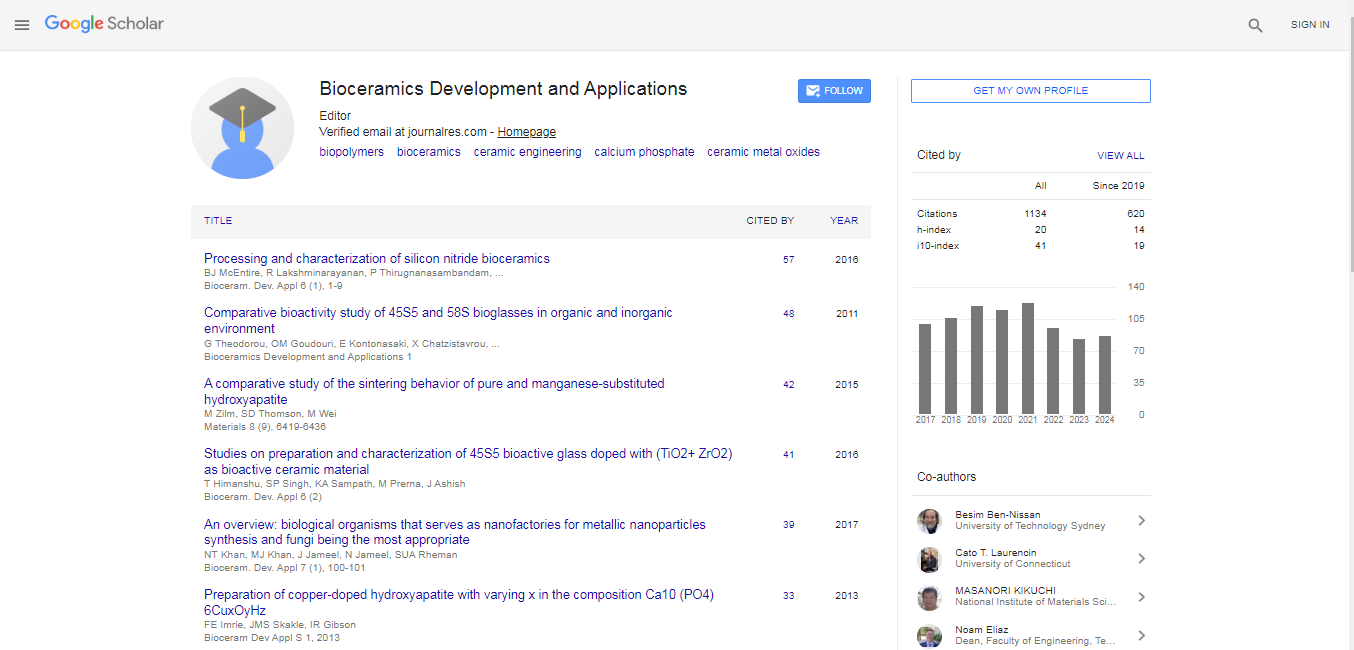
Bioceramics Development and Applications received 1050 citations as per Google Scholar report