Commentary - (2025) Volume 14, Issue 5
Received: 02-Oct-2025, Manuscript No. jsp-26-182279;
Editor assigned: 06-Oct-2025, Pre QC No. P-182279;
Reviewed: 20-Oct-2025, QC No. Q-182279;
Revised: 23-Oct-2025, Manuscript No. R-182279;
Published:
30-Oct-2025
, DOI: 10.37421/2165-7939.2025.14.746
Citation: Dijk, Eric J. van. ”Vertebroplasty And Kyphoplasty: Fractures, Pain, And Outcomes.” J Spine 14 (2025):746.
Copyright: © 2025 Dijk v. J. Eric This is an open-access article distributed under the terms of the Creative Commons Attribution License, which permits unrestricted use, distribution and reproduction in any medium, provided the original author and source are credited.
Vertebroplasty and kyphoplasty represent established minimally invasive procedures widely employed for the treatment of vertebral compression fractures, predominantly those stemming from osteoporosis. These techniques, while generally recognized for their safety and efficacy in mitigating pain and restoring vertebral height, continue to be subjects of ongoing research regarding their long-term benefits and optimal patient selection criteria. Current evidence strongly indicates that these interventions offer substantial pain reduction and functional improvement in appropriately selected individuals, particularly those with severe, debilitating fractures that have not responded to conservative management strategies. Nevertheless, the potential for complications, alongside the inherent risk of developing adjacent level fractures, underscores the critical need for meticulous patient screening and diligent post-operative monitoring to ensure favorable outcomes. The comparative efficacy of vertebroplasty and kyphoplasty has been rigorously examined, with meta-analyses consistently demonstrating their effectiveness in alleviating pain and enhancing function in patients with osteoporotic vertebral compression fractures. While kyphoplasty may exhibit a marginal advantage in restoring vertebral height, the clinical outcome differences are frequently not significant enough to definitively advocate for one procedure over the other. Consequently, the ultimate choice between these two approaches often hinges upon a nuanced consideration of specific fracture characteristics, surgeon expertise, and individual patient factors. A significant concern associated with both vertebroplasty and kyphoplasty is the elevated risk of adjacent vertebral fractures. Research points to factors such as cement leakage, the development of vertebral body deformity, and increased stiffness within the treated spinal segment as potential contributors to this complication. Although strategies for prophylaxis are actively being explored, the meticulous selection of patients and the precise optimization of cement volume remain paramount in effectively mitigating this risk. The long-term efficacy of vertebroplasty and kyphoplasty has been further substantiated by studies demonstrating sustained pain relief and functional improvement in a considerable proportion of patients. However, it is important to acknowledge that a subset of patients may experience recurrent pain or develop new fractures over time. Current research efforts are actively focused on identifying reliable predictors of long-term success and developing proactive strategies to effectively manage these late-emerging complications. While the application of vertebroplasty and kyphoplasty in the management of osteoporotic fractures is well-defined, their role in traumatic vertebral compression fractures remains less clearly delineated. Although these procedures can provide valuable pain relief and contribute to spinal stabilization, the optimal timing, precise indications, and potential risks in traumatic scenarios necessitate further comprehensive investigation. A thorough assessment of fracture stability and the patient's neurological status is therefore of paramount importance in these cases. Advancements in bone cement technology are continually shaping the landscape of vertebral augmentation procedures, with emerging materials such as biodegradable cements and those with enhanced radiopacity holding significant promise for improving both the safety and overall efficacy of vertebroplasty and kyphoplasty. These innovative developments aim to systematically reduce the incidence of complications like cement leakage and simultaneously enhance visualization capabilities during the surgical intervention. The rigorous evaluation of patient-reported outcome measures (PROMs) is indispensable for accurately assessing the success of vertebroplasty and kyphoplasty. Consistent findings from studies employing PROMs highlight significant improvements in patients' pain levels, physical function, and overall quality of life following these interventions, thereby reinforcing their considerable clinical value. The substantial economic impact associated with vertebral compression fractures and their subsequent management through vertebroplasty and kyphoplasty warrants careful consideration. These procedures have demonstrated the potential to significantly reduce hospitalization rates, decrease the dependency on potent pain medications, and ultimately enhance patient productivity, leading to considerable long-term cost savings for healthcare systems. A profound understanding of the biomechanical effects exerted by vertebroplasty and kyphoplasty on the spinal column is fundamentally crucial for refining surgical techniques and accurately predicting patient outcomes. Research endeavors in this domain are primarily concentrated on elucidating how factors such as cement distribution, the volume of cement utilized, and the extent of balloon inflation in kyphoplasty influence vertebral body stiffness and the subsequent transfer of stress to adjacent spinal levels. In instances involving severe or pathological vertebral compression fractures, the management strategy may necessitate the incorporation of adjunctive therapies or the consideration of alternative procedural approaches beyond conventional vertebroplasty and kyphoplasty. For example, in clinical scenarios characterized by significant spinal instability or pronounced neurological compromise, more aggressive surgical interventions might be deemed necessary to achieve optimal patient outcomes.10
Vertebroplasty and kyphoplasty stand as established, minimally invasive interventions for addressing vertebral compression fractures, with a primary focus on those induced by osteoporosis. These procedures have demonstrated considerable success in providing pain relief and restoring vertebral height, though ongoing research continues to refine our understanding of their long-term advantages and the ideal patient profiles for their application. The current body of evidence consistently supports their capacity to deliver significant pain reduction and functional enhancement in carefully selected patients, especially those with severe, painful fractures that prove refractory to conservative treatment modalities. However, the inherent risks of potential complications, including the occurrence of adjacent level fractures, necessitate a rigorous patient selection process and diligent post-operative surveillance. A recent meta-analysis comparing vertebroplasty and kyphoplasty has concluded that both techniques are effective in alleviating pain and improving functional capacity in individuals suffering from osteoporotic vertebral compression fractures. While kyphoplasty may offer a slight edge in terms of vertebral height restoration, the differences observed in clinical outcomes are often not substantial enough to definitively favor one procedure over the other, suggesting that the choice may depend on specific fracture characteristics, surgeon preference, and patient-specific factors. The risk of developing adjacent vertebral fractures remains a significant concern following both vertebroplasty and kyphoplasty. Existing studies suggest that factors such as cement leakage, deformity of the vertebral body, and increased stiffness within the treated spinal segment can contribute to this complication. While prophylactic strategies are under investigation, careful patient selection and the judicious optimization of cement volume are critical for mitigating this potential adverse event. Long-term outcome studies for vertebroplasty and kyphoplasty indicate sustained pain relief and functional improvement for many patients. Nevertheless, a subset of patients may experience recurrent pain or develop new fractures over time, highlighting the ongoing need for research focused on identifying predictors of long-term success and developing strategies to manage these later complications. The utility of vertebroplasty and kyphoplasty in managing traumatic vertebral compression fractures is less extensively defined compared to their use in osteoporotic cases. Although these procedures can offer pain relief and stabilization, further investigation is required to establish optimal timing, indications, and potential risks in traumatic settings, with careful assessment of fracture stability and neurological status being paramount. The development of novel bone cement technologies, including biodegradable cements and those with enhanced radiopacity, presents promising avenues for improving the safety and efficacy of vertebroplasty and kyphoplasty. These technological advancements are designed to reduce complications such as cement leakage and improve visualization during the procedure. Patient-reported outcome measures (PROMs) play a crucial role in evaluating the success of vertebroplasty and kyphoplasty. Studies utilizing PROMs consistently reveal significant improvements in pain, physical function, and quality of life following these interventions, underscoring their clinical value and patient-centered benefits. The economic implications of vertebral compression fractures and their management through vertebroplasty and kyphoplasty are substantial. These procedures can lead to reduced hospitalization rates, a decreased reliance on pain medications, and improved patient productivity, ultimately resulting in significant long-term cost savings. Understanding the biomechanical effects of vertebroplasty and kyphoplasty on the spine is essential for refining surgical techniques and predicting outcomes. Research in this area investigates how cement distribution, volume, and the balloon inflation employed in kyphoplasty influence vertebral body stiffness and the transfer of stress to adjacent spinal levels. For severe or pathological vertebral compression fractures, management may necessitate the integration of adjunctive therapies or alternative approaches to vertebroplasty and kyphoplasty, particularly in cases involving spinal instability or significant neurological compromise where more aggressive surgical interventions might be required.10
Vertebroplasty and kyphoplasty are minimally invasive procedures for vertebral compression fractures, primarily from osteoporosis. They are generally safe and effective for pain relief and improving vertebral height, though long-term benefits and patient selection are still researched. Current evidence shows significant pain reduction and functional improvement in selected patients, especially those with severe fractures unresponsive to conservative treatment. Potential complications like adjacent level fractures require careful screening and monitoring. Meta-analyses confirm effectiveness in pain and function, with kyphoplasty having a slight advantage in height restoration, but clinical outcomes are often similar. The choice between procedures can depend on fracture characteristics, surgeon preference, and patient factors. Adjacent vertebral fractures are a concern, linked to cement leakage and vertebral deformity, necessitating careful patient selection and cement volume optimization. Long-term studies show sustained benefits but acknowledge a subset of patients may experience recurrent pain or new fractures. Research is also exploring new cement technologies to enhance safety and efficacy, and patient-reported outcomes consistently show improvements in pain, function, and quality of life. Economically, these procedures can lead to cost savings by reducing hospitalizations and medication reliance. Biomechanical research aims to understand how these procedures affect spinal stiffness and stress transfer. For complex fractures, alternative or adjunctive therapies may be needed.
None
None
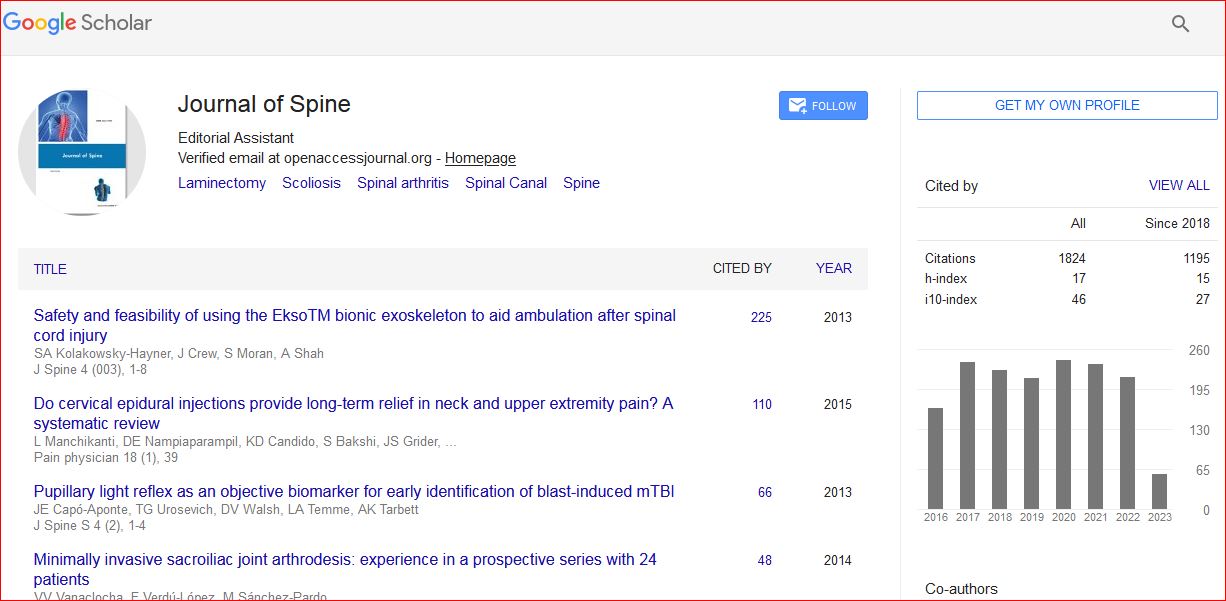
Journal of Spine received 2022 citations as per Google Scholar report