Brief Report - (2025) Volume 9, Issue 1
Received: 01-Jan-2025, Manuscript No. jma-25-172659;
Editor assigned: 03-Jan-2025, Pre QC No. P-172659;
Reviewed: 17-Jan-2025, QC No. Q-172659;
Revised: 22-Jan-2025, Manuscript No. R-172659;
Published:
29-Jan-2025
, DOI: 10.37421/2684-4265.2025.09.360
Citation: Ramirez, Diego F.. ”Vertebrate Anatomy, Development, and Evolutionary Adaptation.” J Morphol Anat 09 (2025):360.
Copyright: © 2025 Ramirez F. Diego This is an open-access article distributed under the terms of the Creative Commons Attribution License, which permits unrestricted use, distribution and reproduction in any medium, provided the original author and source are credited.
Understanding the intricate processes of evolutionary adaptation and developmental change across vertebrate lineages remains a central pursuit in comparative biology. This collection of studies offers a broad perspective on how diverse anatomical structures and sensory systems have evolved, highlighting both conserved patterns and unique specializations. From the robust forelimbs of archosaurs to the nuanced sensory apparatus of fish and mammals, these papers collectively advance our comprehension of the mechanisms driving biological diversity. One significant area of focus involves the evolution of the musculoskeletal system, particularly the limbs. The anatomical variations in the shoulder girdle and forelimb musculature of crocodiles and birds provide critical insights into the distinct locomotor adaptations that emerged in extant archosaurs [1].
Investigating the developmental origins of forelimb muscles in lizards and snakes, this research clarifies homology statements and reconstructs ancestral states for squamate forelimb musculature, shedding light on the evolutionary transformations that led to limblessness in some lineages [2].
Further underscoring the diversity of limb evolution, a detailed study examines the unique skeletal and muscular adaptations of the pectoral girdle and forelimb in caecilians. This research explores how their anatomy specifically supports a highly specialized burrowing lifestyle, thereby contributing to a broader understanding of amphibian limb evolution [6].
Beyond the limbs, the axial skeleton also presents fascinating evolutionary trajectories. A study provides a detailed comparison of axial skeletal elements in various chameleon species. This analysis identifies unique adaptations linked to their arboreal lifestyle and remarkable tongue projection capabilities, offering new perspectives on chameleon phylogeny [3].
Similarly, the evolutionary patterns of muscle architecture in the necks of diverse sauropterygians have been reconstructed through comparative analysis of muscle attachment sites and predicted muscle architecture. This work provides valuable insights into the functional morphology of their long necks, including feeding strategies and locomotion in these extinct marine reptiles [8].
Sensory systems represent another crucial domain of evolutionary innovation. Research examining the brains of different teleost fish species highlights how variations in brain structure and the capacity for adult neurogenesis correlate with specific ecological behaviors and sensory processing. This demonstrates the profound neuroanatomical diversity within this significant aquatic group [4].
The developmental and evolutionary origins of complex structures are also explored in mammals. A comprehensive review synthesizes recent findings on the mammalian middle ear ossicles, tracing their transformation from ancestral jaw elements in synapsids. This discussion includes the significant functional implications for hearing across diverse mammalian clades [5].
Continuing with sensory systems, research delves into the conserved and divergent developmental pathways that shape the olfactory system across various vertebrate lineages. It highlights how fundamental developmental modules are re-patterned to produce a remarkable diversity of olfactory structures tailored to different sensory environments [7].
The comparative developmental biology of taste papillae across different vertebrate groups is also investigated. This paper specifically focuses on the unique features of mammalian papillae and clarifies the molecular and cellular mechanisms underpinning their evolutionary diversification [9].
Finally, a comprehensive study examines the diverse anatomical features of the visual system across a broad range of squamates. This research reveals clear correlations between eye morphology, retinal structure, and ecological niches, ultimately reconstructing the evolutionary trajectory of vision in this highly diverse reptilian group [10].
Collectively, these studies emphasize the power of comparative anatomy and developmental biology in unraveling the complex history of vertebrate life, from musculoskeletal adaptations for locomotion and specialized behaviors to the intricate evolution of sensory perception.
The diverse array of studies presented here collectively paints a detailed picture of vertebrate evolutionary anatomy and development, spanning various taxa and anatomical systems. One core theme revolves around the evolution of the musculoskeletal system, particularly in limbs and girdles. For instance, a study thoroughly details the anatomical variations in the shoulder girdle and forelimb musculature across crocodiles and birds [1]. This research specifically provides insights into the evolutionary changes that supported the distinct locomotor adaptations observed in extant archosaurs. Moving to squamates, another investigation focuses on the developmental origins of forelimb muscles in lizards and snakes [2]. This work is crucial for clarifying homology statements and reconstructing ancestral states for squamate forelimb musculature, ultimately shedding light on the evolutionary transformations that led to limblessness in some lineages. Furthermore, the unique skeletal and muscular adaptations of the pectoral girdle and forelimb in caecilians are explored, demonstrating how their specialized anatomy facilitates a burrowing lifestyle and contributes to the broader understanding of amphibian limb evolution [6]. These studies collectively highlight how fundamental structures are modified to suit diverse environments and modes of locomotion.
Beyond the appendicular skeleton, other skeletal and muscular systems offer rich insights into adaptation. A study provides a detailed comparative osteology of the axial skeletal elements in various chameleon species [3]. This analysis identifies unique adaptations intrinsically linked to their arboreal lifestyle and their remarkable capacity for tongue projection, thereby offering novel perspectives on chameleon phylogeny. Understanding the functional morphology of extinct animals is equally vital; for example, research on sauropterygians conducts a comparative analysis of muscle attachment sites and predicted muscle architecture in their necks [8]. This allows for the reconstruction of the functional morphology of their elongated necks, providing insights into their feeding strategies and locomotion as extinct marine reptiles. These investigations underscore the importance of examining both extant and extinct forms to grasp the full scope of evolutionary changes in skeletal and muscular systems.
Sensory systems represent another significant area of inquiry within this collection, revealing profound adaptations to various ecological niches. Research examining the brains of different teleost fish species, for instance, highlights how variations in brain structure and the capacity for adult neurogenesis correlate with specific ecological behaviors and sensory processing [4]. This work powerfully demonstrates the profound neuroanatomical diversity that exists within this teleost group. Similarly, the developmental and evolutionary origins of the mammalian middle ear ossicles are thoroughly reviewed [5]. This review traces their intricate transformation from ancestral jaw elements in synapsids, discussing the significant functional implications for hearing across diverse mammalian clades. These examples illustrate how complex sensory organs evolve and become refined over evolutionary time.
Further investigations into sensory development and evolution include a comprehensive study on the olfactory system across various vertebrate lineages [7]. This research delves into the conserved and divergent developmental pathways that shape this system, emphasizing how fundamental developmental modules are re-patterned to produce a remarkable diversity of olfactory structures, each tailored to different sensory environments. In a similar vein, the comparative developmental biology of taste papillae across different vertebrate groups is explored [9]. This paper specifically focuses on the unique features of mammalian papillae, unraveling the molecular and cellular mechanisms that underpin their evolutionary diversification. Rounding out the sensory system investigations, a comprehensive study examines the diverse anatomical features of the visual system across a broad range of squamates [10]. This work reveals clear correlations between eye morphology, retinal structure, and ecological niches, ultimately reconstructing the evolutionary trajectory of vision in this highly diverse reptilian group. This body of research collectively emphasizes how vertebrates have evolved highly specialized sensory capabilities to thrive in their respective environments.
This data presents a series of comparative studies illuminating the evolutionary morphology and development across diverse vertebrate groups. Research investigates the shoulder girdle and forelimb musculature in crocodiles and birds, offering insights into distinct locomotor adaptations in extant archosaurs. Similarly, the developmental origins of forelimb muscles in lizards and snakes clarify homology and ancestral states, explaining the evolution of limblessness in squamate lineages. Studies extend to the unique skeletal and muscular adaptations of the pectoral girdle and forelimb in caecilians, revealing how their anatomy supports a specialized burrowing lifestyle and contributes to amphibian limb evolution. Beyond appendicular systems, the data also covers axial skeletal adaptations in chameleons, linking them to arboreal lifestyles and tongue projection, and offering new perspectives on chameleon phylogeny. Investigations into the functional morphology of long necks in extinct marine reptiles like sauropterygians reconstruct feeding strategies and locomotion by analyzing muscle attachment sites. Sensory systems are another key focus. Research on teleost fish brains demonstrates how variations in brain structure and adult neurogenesis correlate with ecological behaviors and sensory processing, showcasing neuroanatomical diversity. The developmental pathways of the olfactory system in various vertebrate lineages are explored, highlighting conserved modules and evolutionary innovations that produce diverse olfactory structures. The evolution of mammalian middle ear ossicles traces their transformation from jaw elements in ancestral synapsids, discussing functional implications for hearing. Further work on taste papillae across vertebrates focuses on unique mammalian features and their molecular underpinnings, while a comprehensive study on squamate visual systems reveals correlations between eye morphology, retinal structure, and ecological niches, reconstructing the evolutionary trajectory of vision. This body of work collectively advances our comprehension of vertebrate anatomy, development, and evolutionary adaptation across a broad spectrum of taxa and physiological systems.
None
None
Indexed at, Google Scholar, Crossref
Indexed at, Google Scholar, Crossref
Indexed at, Google Scholar, Crossref
Indexed at, Google Scholar, Crossref
Indexed at, Google Scholar, Crossref
Indexed at, Google Scholar, Crossref
Indexed at, Google Scholar, Crossref
Indexed at, Google Scholar, Crossref
Indexed at, Google Scholar, Crossref
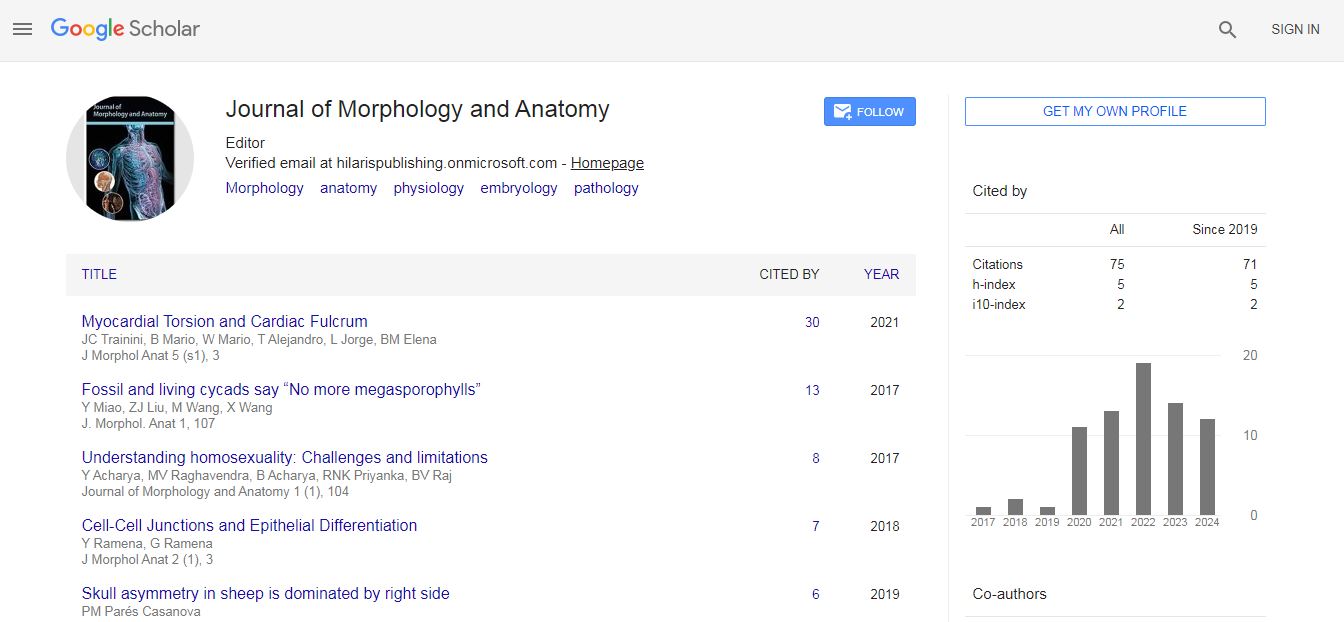
Journal of Morphology and Anatomy received 63 citations as per Google Scholar report