Commentary - (2025) Volume 11, Issue 5
Received: 01-Oct-2025, Manuscript No. JOV-26-186437;
Editor assigned: 03-Oct-2025, Pre QC No. P-186437;
Reviewed: 17-Oct-2025, QC No. Q-186437;
Revised: 22-Oct-2025, Manuscript No. R-186437;
Published:
29-Oct-2025
, DOI: 10.37421/2471-9544.2025.11.323
Citation: Fernandez, Lucia. ”Vascular Tessellations: Biomarkers in Autoimmune Vasculitis.” J Vasc 11 (2025):323.
Copyright: © 2025 Fernandez L. This is an open-access article distributed under the terms of the Creative Commons Attribution License, which permits unrestricted use, distribution and reproduction in any medium, provided the original author and source are credited
The intricate relationship between vascular tessellations and rare autoimmune patterns is a burgeoning area of research, offering novel insights into the pathogenesis and diagnosis of complex conditions. This exploration delves into the significance of specific vascular network abnormalities, which can serve as early indicators of disease severity in less common vasculitic conditions, highlighting the potential of advanced imaging techniques for visualization and early intervention [1].
The diagnostic utility of specific vascular remodeling patterns in patients with unusual autoimmune vasculitic manifestations is being investigated, employing high-resolution ultrasonography to characterize vascular wall changes and microcirculatory alterations, correlating these findings with clinical phenotypes and serological markers [2].
Current knowledge on the pathogenetic role of endothelial dysfunction and vascular remodeling in rare autoimmune vasculitides is being synthesized, examining how aberrant vascular network development might contribute to the disease process and influence treatment responses, emphasizing the need for integrated approaches [3].
Specific microvascular patterns observed in patients with a rare form of autoimmune vasculitis affecting small vessels are the focus of ongoing research, with advanced imaging techniques identifying unique tessellations that correlate with disease activity and the presence of specific autoantibodies, suggesting potential for subtype differentiation and prognosis prediction [4].
The role of aberrant vascular growth and architecture, termed tessellations, in the pathogenesis of rare autoimmune conditions is being examined through case studies, illustrating how these vascular patterns manifest in patients with atypical presentations of vasculitis and proposing that a deeper understanding could unlock new diagnostic and therapeutic strategies [5].
Novel imaging biomarkers for the early detection of vasculitis in rare autoimmune diseases are being investigated, specifically analyzing changes in vascular network density and tortuosity (tessellations) in affected tissues, with findings suggesting that subtle alterations can precede overt clinical symptoms, offering a promising avenue for preemptive diagnosis and intervention [6].
The histological and imaging correlates of vascular abnormalities in patients with unclassified autoimmune vasculitis are being examined, focusing on the concept of vascular tessellations to describe characteristic patterns of small vessel branching and remodeling, aiming to contribute to a better understanding of vasculitis heterogeneity and identify potential diagnostic clues from vascular morphology [7].
The importance of recognizing subtle vascular changes in rare autoimmune vasculitic syndromes is being highlighted, introducing the term 'vascular tessellations' to describe specific geometric arrangements of small blood vessels that may be indicative of underlying inflammatory processes, emphasizing the value of advanced imaging modalities in visualizing these patterns and their potential role in diagnosis and monitoring [8].
The application of computational fluid dynamics to model blood flow within anomalous vascular networks (tessellations) found in certain rare autoimmune vasculitides is being explored, aiming to understand how these vascular patterns might contribute to tissue damage and inflammation by simulating flow dynamics in complex geometries, offering insights into disease pathogenesis [9].
The genetic underpinnings of vascular dysmorphia, termed tessellations, in patients with rare autoimmune connective tissue diseases that can manifest with vasculitic features are being investigated through genomic data analysis, seeking to identify susceptibility genes that influence vascular development and may predispose individuals to these conditions, paving the way for personalized medicine approaches [10].
The intricate relationship between vascular tessellations and rare autoimmune patterns is being explored, with a focus on novel insights from institutions like the Department of Rheumatology and Vasculitis at the University of Buenos Aires. This research highlights how specific vascular network abnormalities can serve as early diagnostic markers or indicators of disease severity in less common vasculitic conditions. The potential for advanced imaging techniques to visualize these tessellations, leading to earlier intervention and improved patient outcomes in challenging autoimmune cases, is a key emphasis [1].
Further investigation into the diagnostic utility of specific vascular remodeling patterns in patients presenting with unusual autoimmune vasculitic manifestations is underway. Researchers are employing high-resolution ultrasonography to characterize vascular wall changes and microcirculatory alterations, correlating these findings with clinical phenotypes and serological markers. The work suggests that distinct vascular tessellations may predispose individuals to or reflect the underlying inflammatory process in certain rare autoimmune diseases, offering a new avenue for diagnostic refinement [2].
A comprehensive review synthesizes current knowledge on the pathogenetic role of endothelial dysfunction and vascular remodeling in rare autoimmune vasculitides. It delves into how aberrant vascular network development, or tessellations, might contribute to the disease process and influence treatment responses. The authors emphasize the need for integrated approaches, combining clinical assessment with advanced vascular imaging, to better understand and manage these complex conditions [3].
Specific microvascular patterns observed in patients with a rare form of autoimmune vasculitis affecting small vessels are being investigated. Using advanced imaging techniques, the study identifies unique tessellations that correlate with disease activity and the presence of specific autoantibodies. The findings suggest that these vascular signatures could aid in differentiating subtypes of vasculitis and predicting prognoses [4].
The role of aberrant vascular growth and architecture, termed tessellations, in the pathogenesis of rare autoimmune conditions is being examined through case studies. These studies illustrate how these vascular patterns manifest in patients with atypical presentations of vasculitis, and the authors propose that a deeper understanding of these architectural changes could unlock new diagnostic and therapeutic strategies for these often challenging diseases [5].
Novel imaging biomarkers for early detection of vasculitis in rare autoimmune diseases are being studied, specifically analyzing changes in vascular network density and tortuosity (tessellations) in affected tissues. The findings suggest that subtle alterations in vascular architecture can precede overt clinical symptoms, offering a promising avenue for preemptive diagnosis and intervention [6].
The histological and imaging correlates of vascular abnormalities in patients with unclassified autoimmune vasculitis are being explored. This research focuses on the concept of vascular tessellations, describing characteristic patterns of small vessel branching and remodeling that are observed. The study aims to contribute to a better understanding of the heterogeneous nature of vasculitis and to identify potential diagnostic clues from vascular morphology [7].
The importance of recognizing subtle vascular changes in rare autoimmune vasculitic syndromes is being underscored. The term 'vascular tessellations' is introduced to describe specific geometric arrangements of small blood vessels that may be indicative of underlying inflammatory processes. The research emphasizes the value of advanced imaging modalities in visualizing these patterns and their potential role in diagnosis and monitoring [8].
The application of computational fluid dynamics to model blood flow within the anomalous vascular networks (tessellations) found in certain rare autoimmune vasculitides is being investigated. By simulating flow dynamics in these complex geometries, researchers aim to understand how these vascular patterns might contribute to tissue damage and inflammation, offering insights into disease pathogenesis [9].
The genetic underpinnings of vascular dysmorphia, termed tessellations, in patients with rare autoimmune connective tissue diseases that can manifest with vasculitic features are being explored. By analyzing genomic data, the study seeks to identify susceptibility genes that influence vascular development and may predispose individuals to these conditions, paving the way for personalized medicine approaches [10].
Research is increasingly focusing on vascular tessellations, or specific patterns of small blood vessel architecture, as potential biomarkers in rare autoimmune vasculitides. Studies highlight how these vascular abnormalities can aid in early diagnosis, disease severity assessment, and subtype differentiation. Advanced imaging techniques are crucial for visualizing these tessellations, and their presence is linked to endothelial dysfunction and aberrant vascular growth, potentially predisposing individuals to or reflecting the underlying inflammatory process. Research also explores the role of computational fluid dynamics and genetic analysis to further understand the pathogenesis and develop targeted therapies for these complex conditions.
None
None
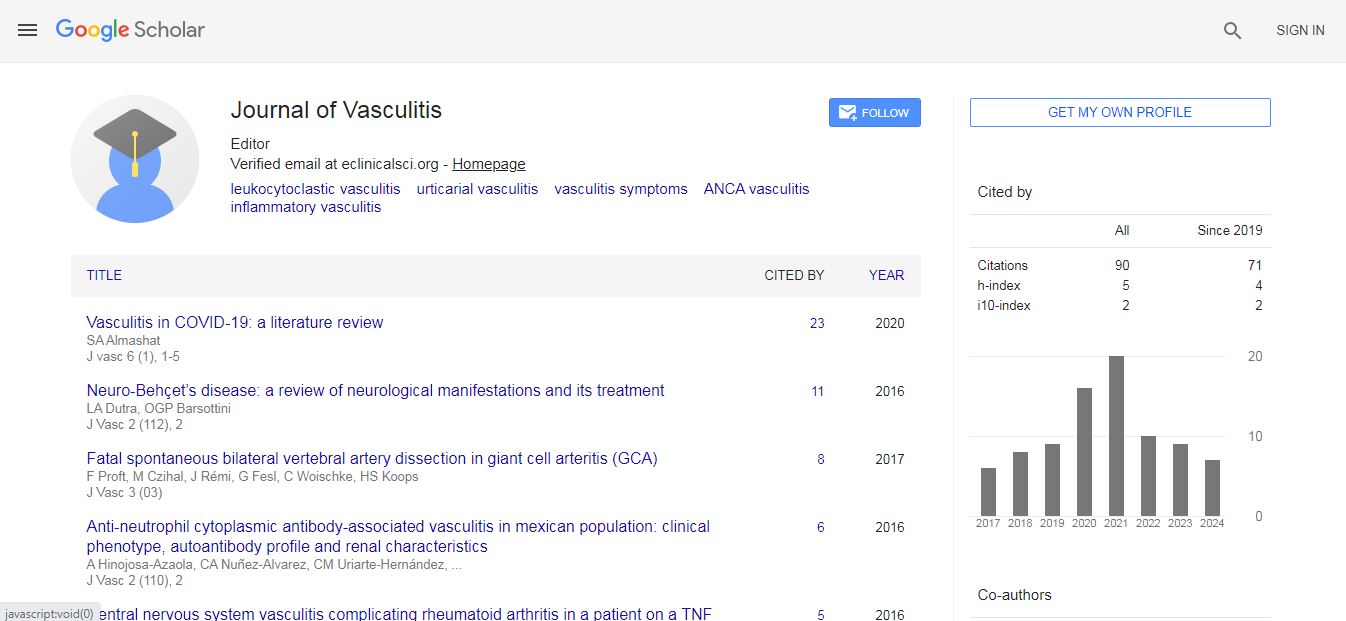
Journal of Vasculitis received 83 citations as per Google Scholar report