Brief Report - (2025) Volume 8, Issue 2
Received: 01-Apr-2025, Manuscript No. pollution-25-176611;
Editor assigned: 03-Apr-2025, Pre QC No. P-176611;
Reviewed: 17-Apr-2025, QC No. Q-176611;
Revised: 22-Apr-2025, Manuscript No. R-176611;
Published:
29-Apr-2025
, DOI: 10.37421/2684-4958.2025.8.370
Citation: Carter, Emily. âUrgent Global Environmental Challenges Demand Integrated Action.â Pollution 08 (2025):370.
Copyright: © 2025 Carter E. This is an open-access article distributed under the terms of the Creative Commons Attribution License, which permits unrestricted use, distribution
and reproduction in any medium, provided the original author and source are credited.
The significant issue of plastic waste in marine environments, detailing its diverse sources, mechanisms of degradation, and profound ecological impacts, is a critical global concern. This pervasive pollution disrupts marine ecosystems, affecting wildlife through ingestion and entanglement, and also introduces microplastic concerns for human health. Integrated management strategies, including waste reduction, improved recycling, and biodegradable alternatives, are essential to mitigate this environmental threat [1].
The complex policy landscape surrounding desertification and land degradation, identifying key challenges and opportunities for achieving sustainable development goals, warrants immediate attention. Effective solutions demand integrated governance, cross-sectoral collaboration, and robust policy implementation to reverse land degradation trends. The importance of local knowledge, participatory approaches, and strong monitoring systems in developing resilient land management strategies cannot be overstated [2].
A global review comprehensively assesses the observed and projected impacts of climate change on terrestrial ecosystems. It details how rising temperatures, altered precipitation patterns, and increased carbon dioxide levels are driving significant shifts in vegetation distribution, phenology, and productivity, ultimately leading to biodiversity loss and ecosystem destabilization. There is an urgent need for adaptation and mitigation strategies to protect vital ecological services [3].
Understanding the profound health impacts of air pollution is crucial, as various pollutants contribute to a wide range of diseases, from respiratory and cardiovascular conditions to neurological disorders and cancer, affecting populations globally. Implementing robust public health interventions and policy changes is paramount to mitigate air quality degradation and safeguard human well-being [4].
Biodiversity loss and its direct impact on essential ecosystem services represent a significant global challenge. Habitat destruction, climate change, pollution, overexploitation, and invasive species rapidly erode natural capital, diminishing provisioning, regulating, cultural, and supporting services. Urgent, integrated conservation efforts and policy frameworks are needed to reverse these trends and protect ecological resilience [5].
Emerging contaminants in water bodies, providing a detailed analysis of their prevalence, pathways, and the ecological risks they pose, are increasingly problematic. This broad spectrum of pollutants, including pharmaceuticals, personal care products, and industrial chemicals, highlights their persistence and potential to disrupt aquatic ecosystems and affect human health. Advanced detection technologies and effective treatment strategies are urgently required to ensure water quality [6].
A global assessment identifies and analyzes the key drivers behind deforestation and forest degradation in tropical regions, linking these processes to agricultural expansion, infrastructure development, and unsustainable resource extraction. The severe consequences for biodiversity, climate regulation, and indigenous communities demand attention. Effective conservation requires addressing underlying economic and governance issues, promoting sustainable land use, and strengthening protected areas [7].
An exhaustive analysis of soil degradation, addressing its multifaceted causes, extensive impacts, and proposing sustainable management strategies, reveals a critical threat to global sustainability. Processes like erosion, salinization, compaction, and nutrient depletion undermine agricultural productivity, food security, and ecosystem health. Soil conservation practices, sustainable land use, and policy interventions are vital for restoring soil vitality and mitigating environmental degradation [8].
Pervasive anthropogenic impacts on marine ecosystems, identifying a range of stressors from climate change and pollution to overfishing and habitat destruction, highlight the vulnerability of these vital environments. Evaluating the current state of marine biodiversity and ecosystem function, along with factors influencing resilience, is essential. Comprehensive, integrated ocean management strategies are urgently needed to reverse degradation and foster sustainable marine environments [9].
Finally, the ecological impacts of noise pollution on wildlife, highlighting how anthropogenic sounds disrupt animal behavior, physiology, and population dynamics across diverse taxa, are a growing concern. These effects on communication, foraging, reproduction, and stress responses contribute to habitat degradation and biodiversity loss. Greater recognition of noise as a significant environmental pollutant and robust mitigation strategies are essential to protect wildlife [10].
Our planet faces a myriad of interconnected environmental challenges, profoundly affecting ecosystems and human well-being. A significant issue is the pervasive presence of plastic waste in marine environments, originating from diverse sources and undergoing complex degradation processes. This pollution severely impacts marine life through ingestion and entanglement, while also raising microplastic concerns for human health. Mitigating this threat necessitates integrated strategies, including waste reduction, enhanced recycling efforts, and the development of biodegradable alternatives [1]. Complementing this, emerging contaminants, such as pharmaceuticals and industrial chemicals, are increasingly prevalent in water bodies globally. These persistent pollutants pose considerable ecological risks, disrupting aquatic ecosystems and potentially impacting human health, highlighting an urgent need for advanced detection and treatment technologies to safeguard water quality [6]. Furthermore, marine ecosystems are under constant assault from a range of anthropogenic stressors, including climate change, pollution, overfishing, and habitat destruction. A comprehensive understanding of the state of marine biodiversity and ecosystem function, along with factors influencing resilience, is crucial for developing integrated ocean management strategies to reverse degradation and foster sustainable marine environments [9].
Land degradation represents another critical global issue with far-reaching consequences. Desertification and land degradation present complex policy challenges, requiring integrated governance and cross-sectoral collaboration to achieve sustainable development goals. Effective policy implementation, alongside the incorporation of local knowledge and participatory approaches, is vital for developing resilient land management strategies and reversing degradation trends [2]. Simultaneously, tropical regions are experiencing widespread deforestation and forest degradation, primarily driven by agricultural expansion, infrastructure development, and unsustainable resource extraction. These activities lead to severe consequences for biodiversity, climate regulation, and indigenous communities, emphasizing the need to address underlying economic and governance issues and promote sustainable land use practices [7]. Soil degradation, encompassing processes like erosion, salinization, compaction, and nutrient depletion, further exacerbates these problems. This undermines agricultural productivity, threatens food security, and harms overall ecosystem health. Sustainable soil conservation practices, responsible land use, and policy interventions are imperative for restoring soil vitality and mitigating widespread environmental degradation [8].
Climate change stands as a fundamental driver of ecological shifts, particularly impacting terrestrial ecosystems. Rising temperatures, altered precipitation patterns, and increased atmospheric CO2 levels are instigating significant changes in vegetation distribution, phenology, and productivity. This leads directly to biodiversity loss and broad ecosystem destabilization, underscoring the urgent global requirement for comprehensive adaptation and mitigation strategies to protect essential ecological services [3]. This directly links to the broader issue of biodiversity loss, which erodes crucial ecosystem services worldwide. Habitat destruction, climate change, pollution, overexploitation, and invasive species are rapidly diminishing natural capital, affecting provisioning, regulating, cultural, and supporting services. Urgent, integrated conservation efforts and robust policy frameworks are therefore essential to reverse these trends and bolster ecological resilience [5].
Beyond these widespread environmental alterations, specific forms of pollution continue to threaten both human and ecological health. Air pollution, for instance, has profound and diverse health impacts globally, contributing to a wide spectrum of diseases from respiratory and cardiovascular conditions to neurological disorders and cancer. Implementing strong public health interventions and policy changes is critical to mitigate air quality degradation and protect human well-being [4]. Adding to the complexity, noise pollution, stemming from various anthropogenic sources, significantly impacts wildlife. It disrupts animal behavior, physiology, and population dynamics across diverse species, affecting communication, foraging, reproduction, and inducing stress responses. This contributes to habitat degradation and biodiversity loss, making it imperative to recognize noise as a serious environmental pollutant and implement effective mitigation strategies to safeguard wildlife populations [10]. The collective data emphasizes that addressing these multifaceted environmental challenges requires an integrated and coordinated global response.
The collected research highlights a pressing array of global environmental challenges, each demanding urgent attention and integrated solutions. Marine environments are significantly impacted by plastic waste, leading to ecological disruption and human health concerns, necessitating strategies like waste reduction and improved recycling. Simultaneously, land degradation, including desertification and soil erosion, threatens agricultural productivity and food security, calling for sustainable land management and policy interventions. Tropical forests face severe deforestation due to agricultural expansion, affecting biodiversity and climate regulation. Climate change emerges as a pervasive force, driving shifts in terrestrial ecosystems, phenology, and productivity, culminating in significant biodiversity loss. This broader biodiversity decline, fueled by habitat destruction, pollution, and overexploitation, compromises essential ecosystem services globally. Beyond these large-scale shifts, specific pollutants pose immediate threats: air pollution causes widespread health issues, while emerging contaminants in water bodies disrupt aquatic ecosystems. Even noise pollution significantly impacts wildlife behavior and population dynamics. Collectively, these studies underscore the interconnected nature of environmental problems and the critical need for comprehensive conservation efforts, robust policy frameworks, and adaptive management strategies to protect both natural systems and human well-being.
None
None
Indexed at, Google Scholar, Crossref
Indexed at, Google Scholar, Crossref
Indexed at, Google Scholar, Crossref
Indexed at, Google Scholar, Crossref
Indexed at, Google Scholar, Crossref
Indexed at, Google Scholar, Crossref
Indexed at, Google Scholar, Crossref
Indexed at, Google Scholar, Crossref
Indexed at, Google Scholar, Crossref
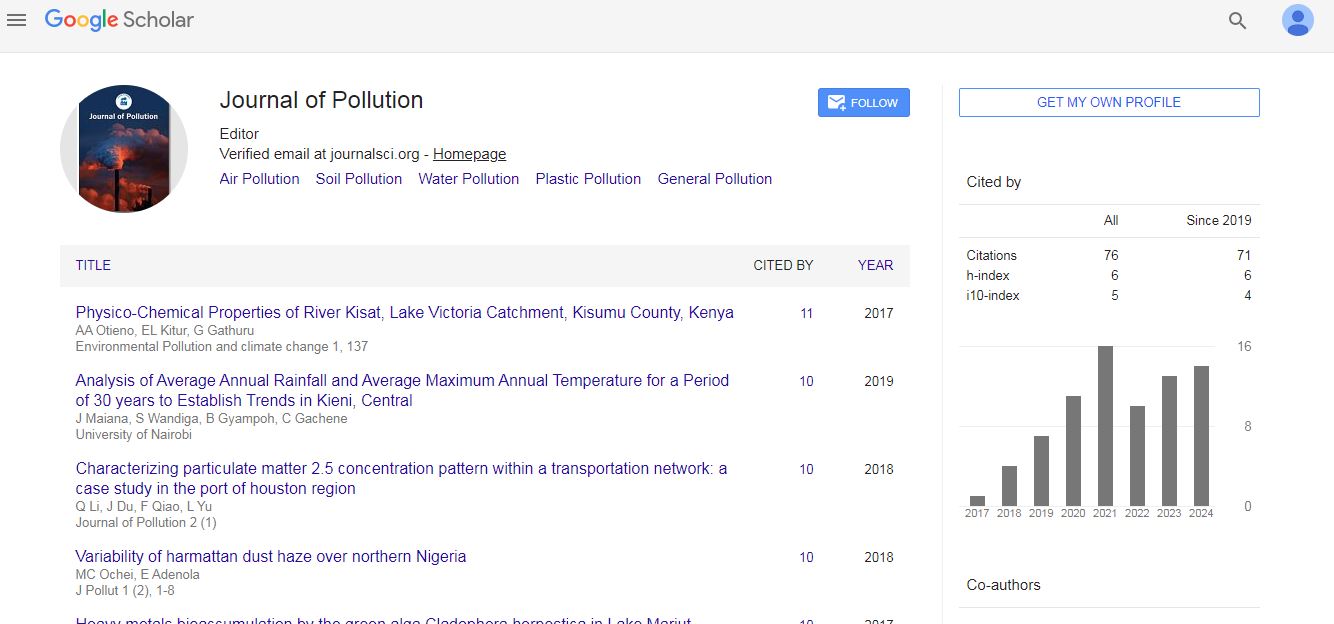
Journal of Pollution received 64 citations as per Google Scholar report