Brief Report - (2025) Volume 12, Issue 4
Received: 01-Jul-2025, Manuscript No. jlop-26-179045;
Editor assigned: 03-Jul-2025, Pre QC No. P-179045;
Reviewed: 17-Jul-2025, QC No. Q-179045;
Revised: 22-Jul-2025, Manuscript No. R-179045;
Published:
29-Jul-2025
, DOI: 10.37421/2469-410X. 2025.12.210
Citation: Zahra, Fatima. ”Ultracold Quantum Gases: Laser Cooling Advances and Applications.” J Laser Opt Photonics 12 (2025):210.
Copyright: © 2025 Zahra F. This is an open-access article distributed under the terms of the Creative Commons Attribution License, which permits unrestricted use, distribution and reproduction in any medium, provided the original author and source are credited.
Recent advancements in laser cooling and trapping of atoms have significantly expanded the frontiers of quantum science, enabling researchers to achieve ultra-low temperatures and high phase-space densities. These sophisticated techniques are foundational to numerous cutting-edge fields, including quantum simulation, precision measurements, and quantum computing. The fundamental principles of Doppler cooling, Sisyphus cooling, and evaporative cooling are instrumental in achieving these remarkable states of matter. Furthermore, the continuous development of more efficient and versatile atomic manipulation schemes promises to unlock even greater possibilities in the future of quantum technologies [1].
Complementing these atom-centric approaches, the creation and manipulation of ultracold quantum gases using advanced laser cooling techniques are crucial for exploring novel condensed matter physics. The precise experimental setups required for achieving Bose-Einstein condensation and fermionic superfluids often rely on the careful interplay of optical lattices and Feshbach resonances. This control over atomic interactions is essential for designing and executing complex quantum experiments that were previously inaccessible [2].
The pursuit of extremely low temperatures extends beyond neutral atoms to atomic ions, which are critical for quantum information processing. Sympathetic cooling, a technique where laser-cooled atomic ions are used to cool other ion species not directly amenable to laser cooling, has proven to be a key aspect. This method facilitates high-fidelity quantum gates and significantly reduces decoherence rates, thereby improving the reliability of quantum computations [3].
In parallel, novel approaches to optical trapping of neutral atoms are being developed to support the advancement of quantum technologies. The stability and scalability of various optical trap geometries, such as optical tweezers and optical lattices, are paramount for assembling large arrays of individually addressable atoms. These advancements are crucial for the construction of scalable quantum computers and simulators capable of tackling complex problems [4].
The achievement of quantum degeneracy in optical lattices using fermionic atoms represents another significant milestone. Experimental progress in this area highlights the critical role of evaporative cooling and precise laser control in reaching these highly quantum regimes. This enables the in-depth study of quantum many-body physics and the simulation of complex models like the Hubbard model [5].
The application of laser-cooled atoms has also revolutionized the field of high-precision atomic clocks. Advanced cooling and trapping techniques effectively minimize Doppler and recoil shifts, leading to substantial improvements in clock stability and accuracy. This development is crucial for the creation of next-generation atomic clocks essential for fundamental physics tests and sophisticated navigation systems [6].
Beyond atoms, innovative methods are emerging for cooling molecular ensembles. Bichromatic atom cooling techniques, for instance, offer a novel pathway to achieving ultracold temperatures for molecules, which are inherently more challenging to cool than individual atoms. This breakthrough opens up new avenues for molecular spectroscopy and advanced quantum chemistry research [7].
Atom interferometry, a highly sensitive probe that leverages laser-cooled atoms, continues to push the boundaries of precision measurements. The fundamental principles governing the beam splitting and recombination of atomic wave packets are now being applied to measure fundamental constants, gravity, and inertial forces with unprecedented accuracy, underscoring the power of these techniques [8].
Furthermore, the implementation of Rydberg atoms in quantum simulation and quantum computing is gaining considerable traction. Laser excitation to highly excited Rydberg states, coupled with sophisticated trapping techniques, enables strong and tunable interactions between atoms. This is a critical requirement for building robust quantum gates and exploring intricate quantum phenomena [9].
Finally, sympathetic cooling of neutral atoms using laser-cooled ion crystals represents a significant advancement in hybrid quantum systems. This technique efficiently transfers motional energy from ions to neutral atoms, allowing for the creation of ultracold neutral atom ensembles that are difficult to cool directly, thus enabling new possibilities in quantum information processing [10].
The field of laser cooling and trapping of atoms has witnessed remarkable progress, enabling unprecedented control over atomic systems and unlocking new frontiers in scientific research. Techniques such as Doppler cooling, Sisyphus cooling, and evaporative cooling are fundamental to achieving the ultracold temperatures and high phase-space densities required for advanced quantum applications like quantum simulation, precision measurements, and quantum computing. The continuous refinement of these methods and the development of novel atomic manipulation schemes are crucial for future advancements in these areas [1].
Ultracold quantum gases, including Bose-Einstein condensates and fermionic superfluids, are central to exploring fundamental aspects of condensed matter physics. Advanced laser cooling techniques are indispensable for their creation and manipulation. Experimental setups that utilize optical lattices and Feshbach resonances, in conjunction with precise laser control, allow for exquisite control over atomic interactions, paving the way for novel physics experiments [2].
In the realm of quantum information processing, sympathetic cooling of atomic ions plays a vital role in achieving the extremely low temperatures necessary for high-fidelity quantum operations. By using laser-cooled ions to cool other species, researchers can implement complex quantum gates and mitigate decoherence, thereby enhancing the reliability and scalability of quantum computers [3].
Optical trapping of neutral atoms is another cornerstone for the development of quantum technologies. Research into the stability and scalability of various optical trap geometries, such as optical tweezers and optical lattices, is essential for assembling large, individually addressable atom arrays. These capabilities are critical for building large-scale quantum computers and simulators [4].
The achievement of quantum degeneracy in optical lattices using fermionic atoms is a significant experimental accomplishment. This state is reached through a combination of evaporative cooling and precise laser control, enabling the study of complex quantum many-body phenomena and the simulation of fundamental models like the Hubbard model [5].
Laser cooling and trapping techniques are also integral to the advancement of atomic clocks, which are essential for precise timekeeping and fundamental physics measurements. By reducing Doppler and recoil shifts, these methods significantly improve clock stability and accuracy, leading to the development of next-generation atomic clocks for various applications [6].
Beyond atomic systems, research is extending to the cooling of molecular ensembles. Novel techniques like bichromatic atom cooling offer new possibilities for reaching ultracold temperatures in molecules, which present unique challenges compared to atoms. This opens up new avenues for research in molecular spectroscopy and quantum chemistry [7].
Atom interferometry, a technique that harnesses laser-cooled atoms, is a powerful tool for precision measurements. By exploiting the wave-like nature of atoms, atom interferometers can be used to measure fundamental constants, gravity, and inertial forces with unparalleled precision, demonstrating the sensitivity of these controlled atomic systems [8].
The application of Rydberg atoms in quantum simulation and computing is an active area of research. Laser excitation to Rydberg states, combined with advanced trapping, allows for strong, tunable interactions between atoms, which is crucial for constructing quantum gates and investigating complex quantum phenomena [9].
Finally, hybrid quantum systems benefit from sympathetic cooling of neutral atoms using laser-cooled ion crystals. This technique facilitates the creation of ultracold neutral atom ensembles by transferring energy from ions to atoms, offering a versatile approach for quantum information processing [10].
This collection of research highlights significant advancements in the field of atomic and molecular physics, primarily focusing on laser cooling and trapping techniques. These methods are crucial for achieving ultracold temperatures, which are essential for a wide range of applications. Key areas explored include quantum simulation, precision measurements, quantum computing, and advanced atomic clocks. The research details the manipulation of ultracold quantum gases, sympathetic cooling of ions and neutral atoms, optical trapping, and the use of Rydberg atoms. Developments in cooling molecules and the application of atom interferometry for high-precision measurements are also discussed, underscoring the broad impact of laser cooling technologies across various scientific disciplines.
None
None
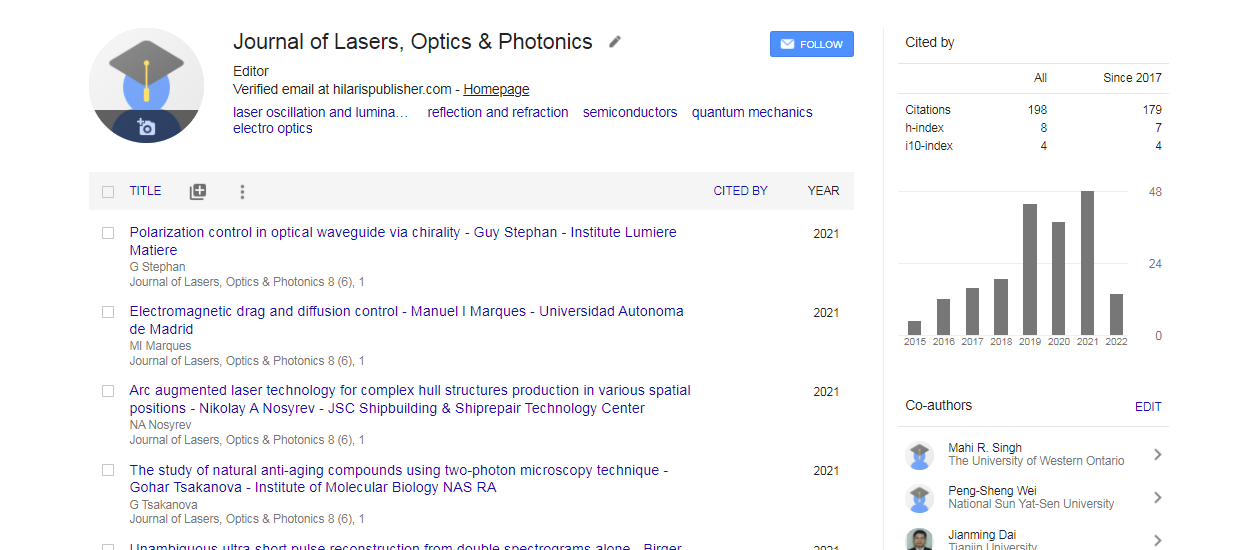
Journal of Lasers, Optics & Photonics received 279 citations as per Google Scholar report