Commentary - (2025) Volume 14, Issue 4
Received: 01-Jul-2025, Manuscript No. jtm-26-186016;
Editor assigned: 03-Jul-2025, Pre QC No. P-186016;
Reviewed: 17-Jul-2025, QC No. Q-186016;
Revised: 22-Jul-2025, Manuscript No. R-186016;
Published:
29-Jul-2025
, DOI: 10.37421/2167-1222.2025.14.689
Citation: Johnson, Sarah. ”Trauma-Induced Coagulopathy: Early Recognition and Balanced Resuscitation.” J Trauma Treat 14 (2025):689.
Copyright: © 2025 Johnson S. This is an open-access article distributed under the terms of the Creative Commons Attribution License, which permits unrestricted use, distribution and reproduction in any medium, provided the original author and source are credited.
Trauma-induced coagulopathy (TIC) is a critical and life-threatening condition that develops rapidly following severe injuries, marked by impaired blood clotting and significant bleeding [1].
The underlying mechanisms are multifaceted, involving a complex interplay of hyperfibrinolysis, compromised clot formation, and platelet dysfunction, often exacerbated by physiological stressors such as shock, hypothermia, and acidosis [1].
Effective management hinges on early recognition and prompt resuscitation, emphasizing the use of balanced blood product ratios and addressing underlying metabolic disturbances [1].
Recent research has shifted towards personalized treatment strategies, leveraging viscoelastic hemostatic assays (VHA) to guide the administration of specific blood components like fibrinogen, prothrombin complex concentrate, and platelets [1].
The understanding of TIC has evolved, moving beyond a simple deficiency of procoagulant factors to incorporate the significant roles of hyperfibrinolysis and endothelial dysfunction [2].
This evolving perspective underscores the importance of rapid resuscitation with balanced blood products and highlights the increasing utility of point-of-care diagnostics, such as thromboelastography (TEG) and rotational thromboelastometry (ROTEM), in tailoring therapeutic interventions, particularly regarding fibrinogen and platelet transfusions [2].
Early coagulopathic responses in trauma patients are of significant interest, with baseline activated partial thromboplastin time (aPTT) and international normalized ratio (INR) demonstrating predictive value for blood product requirements and mortality risk [3].
Investigations into the roles of tissue factor pathway inhibitor and thrombin-activatable fibrinolysis inhibitor are also revealing potential therapeutic targets beyond conventional coagulation factor replacement [3].
The impact of different resuscitation strategies on TIC is a critical area of study, with balanced blood product resuscitation demonstrating superiority over traditional crystalloid-heavy approaches [4].
Early and aggressive administration of plasma and platelets, guided by viscoelastic assays, has been shown to mitigate coagulopathy, reduce overall transfusion needs, and improve outcomes in severely injured patients [4].
The role of hyperfibrinolysis in TIC is a key focus, with tranexamic acid (TXA) emerging as a crucial antifibrinolytic agent [5].
The benefits of early TXA administration in reducing mortality from exsanguination, especially in the initial hours post-injury, are well-established, prompting a discussion on its optimal utilization in trauma care [5].
A complex bidirectional relationship exists between inflammation and coagulopathy in trauma patients, where systemic inflammation triggered by injury can activate coagulation pathways, potentially leading to disseminated intravascular coagulation (DIC) and exacerbating fibrinolytic states [6].
This intricate interaction highlights the need to consider inflammatory responses when managing coagulopathic trauma patients [6].
The diagnostic capabilities of VHAs, including TEG and ROTEM, in guiding the management of TIC are continually being evaluated [7].
Prospective studies suggest that VHA-guided therapy facilitates more appropriate and timely blood product administration, potentially leading to better patient outcomes compared to reliance on standard laboratory tests alone [7].
Specific challenges are present in managing coagulopathy in pediatric trauma, with distinct coagulation profiles and treatment responses observed in children compared to adults [8].
This necessitates the development of age-specific protocols and careful adjustments in blood product administration, particularly for red blood cells, plasma, and platelets [8].
The 'deadly triad' of hypothermia, acidosis, and coagulopathy significantly impacts trauma patients, with these metabolic derangements impairing enzymatic functions, platelet aggregation, and fibrinolysis, thereby worsening the coagulopathic state and requiring aggressive correction alongside resuscitation efforts [9].
Novel hemostatic agents and adjunctive therapies are being developed and applied to address TIC, expanding treatment options beyond standard blood products [10].
Research into agents like recombinant activated factor VII (rFVIIa) and prothrombin complex concentrate (PCC) explores their potential roles within evolving management paradigms for trauma-induced coagulopathy [10].
Trauma-induced coagulopathy (TIC) is a complex and life-threatening complication following severe injury, characterized by a rapid onset of coagulopathy and bleeding [1].
The pathophysiology involves a combination of hyperfibrinolysis, impaired clot formation, and platelet dysfunction, often exacerbated by shock, hypothermia, and acidosis [1].
Early recognition and management are critical, focusing on resuscitation with balanced ratios of blood products, alongside strategies to address underlying metabolic derangements [1].
Recent advancements emphasize individualized treatment approaches based on viscoelastic hemostatic assays (VHA) to guide the administration of specific components like fibrinogen, prothrombin complex concentrate, and platelet concentrates [1].
This review delves into the evolving understanding of trauma-induced coagulopathy (TIC), highlighting the shift from a solely procoagulant factor deficiency model to one incorporating hyperfibrinolysis and endothelial dysfunction [2].
It underscores the importance of rapid resuscitation with balanced blood products and the growing role of point-of-care diagnostics like thromboelastography (TEG) and rotational thromboelastometry (ROTEM) in tailoring therapy, especially the administration of fibrinogen and platelet transfusions [2].
Investigating the early coagulopathic response in trauma patients, this study emphasizes the predictive value of baseline activated partial thromboplastin time (aPTT) and international normalized ratio (INR) for blood product requirements and mortality [3].
It also explores the role of tissue factor pathway inhibitor and thrombin-activatable fibrinolysis inhibitor in the development of coagulopathy, suggesting potential therapeutic targets beyond traditional coagulation factor replacement [3].
This paper examines the impact of different resuscitation strategies on trauma-induced coagulopathy (TIC), comparing balanced blood product resuscitation with more traditional crystalloid-heavy approaches [4].
It highlights how early and aggressive administration of plasma and platelets, guided by viscoelastic assays, can mitigate coagulopathy, reduce transfusion requirements, and improve outcomes in severely injured patients [4].
The role of hyperfibrinolysis in trauma-induced coagulopathy is further elucidated here, with a focus on the antifibrinolytic agent tranexamic acid (TXA) [5].
The study reaffirms the benefits of early TXA administration in reducing mortality from exsanguination, particularly in the initial hours after injury, and discusses strategies for its optimal use in trauma patients [5].
This research investigates the complex interplay between inflammation and coagulopathy in trauma patients [6].
It explores how systemic inflammation, triggered by the injury, can activate coagulation pathways and contribute to the development of disseminated intravascular coagulation (DIC) and fibrinolysis, thereby worsening coagulopathic states [6].
The diagnostic utility of viscoelastic hemostatic assays (VHAs) like TEG and ROTEM in guiding the management of trauma-induced coagulopathy is evaluated in this prospective study [7].
Findings suggest that VHA-guided therapy leads to more appropriate and timely administration of blood products, potentially improving patient outcomes compared to standard laboratory tests alone [7].
This article addresses the specific challenges of managing coagulopathy in pediatric trauma [8].
It highlights the differences in coagulation profiles and responses to treatment between children and adults, emphasizing the need for age-specific protocols and adjustments in blood product administration, particularly concerning red blood cells, plasma, and platelets [8].
The metabolic derangements commonly associated with severe trauma, such as hypothermia, acidosis, and hypocalcemia, are explored for their profound impact on coagulation [9].
This review details how these factors can impair enzyme function, platelet aggregation, and fibrinolysis, exacerbating trauma-induced coagulopathy and necessitating aggressive correction alongside resuscitation [9].
This article discusses the development and application of novel hemostatic agents and adjunctive therapies for trauma-induced coagulopathy [10].
It reviews the potential of procoagulant agents beyond standard blood products, such as recombinant activated factor VII (rFVIIa) and prothrombin complex concentrate (PCC), and their place in the evolving management paradigms [10].
Trauma-induced coagulopathy (TIC) is a severe complication characterized by rapid bleeding due to impaired clotting. Its pathophysiology involves hyperfibrinolysis, poor clot formation, and platelet dysfunction, often worsened by shock, hypothermia, and acidosis. Early recognition and resuscitation with balanced blood products, alongside metabolic correction, are crucial. Advances include individualized treatment guided by viscoelastic hemostatic assays (VHA) for specific component administration. The understanding of TIC has expanded to include hyperfibrinolysis and endothelial dysfunction, emphasizing rapid, balanced resuscitation and point-of-care diagnostics like TEG and ROTEM. Baseline coagulation tests like aPTT and INR can predict outcomes, and inhibitors of coagulation are being investigated as therapeutic targets. Balanced blood product resuscitation, with early plasma and platelet administration guided by VHAs, improves outcomes compared to crystalloid-heavy approaches. Tranexamic acid (TXA) is vital for reducing exsanguination mortality. Inflammation plays a bidirectional role with coagulopathy. VHAs like TEG and ROTEM aid in guiding therapy more effectively than standard tests. Pediatric trauma presents unique management challenges requiring age-specific protocols. Metabolic derangements like hypothermia and acidosis significantly exacerbate TIC. Novel hemostatic agents and adjunctive therapies beyond standard blood products are under development.
None
None
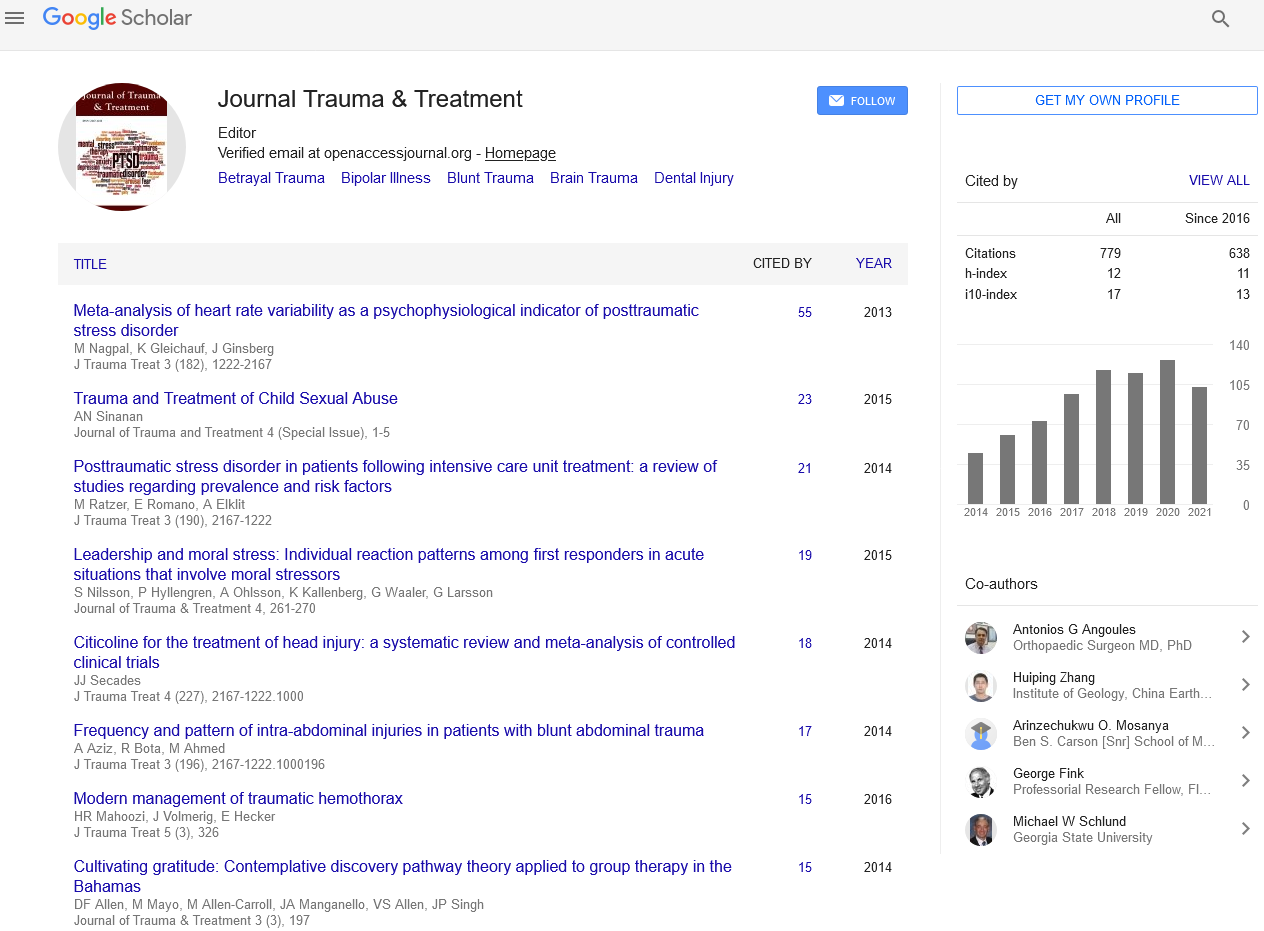
Journal of Trauma & Treatment received 1048 citations as per Google Scholar report