Perspective - (2025) Volume 14, Issue 2
Received: 01-Mar-2025, Manuscript No. jtm-25-172837;
Editor assigned: 03-Mar-2025, Pre QC No. P-172837;
Reviewed: 17-Mar-2025, QC No. Q-172837;
Revised: 24-Mar-2025, Manuscript No. R-172837;
Published:
31-Mar-2025
, DOI: 10.37421/2167-1222.2025.14.673
Citation: Mansour, Yara. ”Trauma Scores: Evaluating Mortality Prediction Across Groups.” J Trauma Treat 14 (2025):673.
Copyright: © 2025 Mansour Y. This is an open-access article distributed under the terms of the Creative Commons Attribution License, which permits unrestricted use, distribution and reproduction in any medium, provided the original author and source are credited.
Trauma scoring systems serve as essential tools in emergency medicine, offering critical insights into patient prognosis and guiding clinical decision-making. Their application spans various trauma contexts, aiming to standardize assessment and improve outcomes. A comprehensive systematic review and meta-analysis specifically evaluated the predictive power of these diverse trauma scoring systems for mortality in adult blunt trauma patients, highlighting both their utility and inherent limitations in clinical decision-making and prognosis [1].
Focusing on vulnerable populations, research has thoroughly investigated the efficacy of various trauma scoring systems in predicting mortality specifically within the geriatric trauma population. Such studies aim to identify which systems perform optimally for this particular group, recognizing the unique physiological responses and comorbidities often present in older individuals [2].
Further expanding on this crucial area, another systematic review and meta-analysis extensively evaluated the effectiveness of various trauma scoring systems, specifically in predicting mortality among older trauma patients. This work meticulously identified age-related challenges and pinpointed optimal scoring methodologies tailored to the elderly [6].
Complementing this, an additional research effort drew a comparison among the Injury Severity Score (ISS), the New Injury Severity Score (NISS), and the Revised Trauma Score (RTS) when predicting outcomes for geriatric trauma, thereby illuminating their comparative advantages and informing best practices for this demographic [8].
Beyond specific patient demographics, the predictive capabilities of individual and combined scoring systems have been a subject of rigorous examination. A retrospective study diligently evaluated the performance of the Injury Severity Score (ISS) and Revised Trauma Score (RTS) in predicting mortality among trauma patients, offering insights into their utility within a single-center setting [3].
In an effort to refine predictive models, one study explored the prognostic value of combining the Shock Index with the Revised Trauma Score to predict mortality in trauma patients. This research notably suggested an improved predictive model for early risk stratification, indicating the potential for enhanced early intervention strategies [5].
The prehospital phase of trauma care is equally vital, where rapid and accurate assessment significantly impacts subsequent management. A systematic review and meta-analysis assessed the predictive accuracy of various prehospital trauma scores for in-hospital mortality. This provided crucial data invaluable for prehospital triage and informed resource allocation, emphasizing the early impact of accurate scoring [4].
Similarly, another systematic review synthesized evidence on the predictive utility of different prehospital trauma scores for mortality, offering a comprehensive overview of their strengths and weaknesses in initial assessment and guiding prehospital care protocols [10].
Novel approaches to trauma scoring are also under development to address complex injury scenarios. One significant study focused on the development and validation of a novel trauma scoring system specifically designed to predict mortality in polytrauma patients. The aim here was to achieve improved accuracy in managing such complex injury scenarios, where multiple severe injuries often complicate prognosis [7].
Furthermore, specific injury patterns, like hip fractures from low-energy trauma, present unique challenges. Research has therefore evaluated and compared various trauma scoring systems' ability to predict in-hospital mortality in patients who sustain hip fractures due to low-energy trauma. This provided specific insights for this distinct patient subgroup, helping to tailor care effectively [9].
Collectively, this body of research underscores the continuous effort to refine and validate trauma scoring systems. The objective is to enhance their accuracy, broaden their applicability across diverse patient populations and injury patterns, and ultimately improve the prediction of mortality and the subsequent clinical management of trauma patients. The ongoing investigation into these scoring systems reflects a commitment to evidence-based practice in trauma care, ensuring that clinicians have the most reliable tools at their disposal for assessing patient severity and guiding timely, life-saving interventions.
Trauma scoring systems are fundamental tools utilized in emergency medicine and critical care to assess injury severity, predict outcomes, and guide patient management. Research consistently explores the effectiveness and limitations of these systems across diverse patient populations and clinical settings. For instance, a systematic review and meta-analysis provides a comprehensive evaluation of the predictive power of various trauma scoring systems for mortality in adult blunt trauma patients [1]. This review is pivotal in understanding the overall utility and limitations of these tools in complex clinical decision-making and prognosis. Similarly, in the prehospital environment, where rapid assessment is paramount, studies critically assess the predictive accuracy of various prehospital trauma scores for in-hospital mortality. This offers essential data for prehospital triage and resource allocation, emphasizing the critical role of early, accurate assessment [4]. Another systematic review further synthesizes evidence on the predictive utility of different prehospital trauma scores for mortality, providing a thorough overview of their strengths and weaknesses during initial patient assessment [10].
A significant focus within trauma research is the geriatric population, known for its unique physiological responses and increased vulnerability to trauma. Multiple studies specifically address the performance of trauma scoring systems in older patients. For example, one study meticulously compares the efficacy of various trauma scoring systems in predicting mortality specifically within the geriatric trauma population, identifying which systems perform best for this vulnerable group [2]. Building on this, another systematic review and meta-analysis extensively evaluates the effectiveness of various trauma scoring systems solely for predicting mortality in older trauma patients, identifying age-related challenges and optimal scoring methods tailored for this demographic [6]. Furthermore, a detailed research effort directly compared the Injury Severity Score (ISS), the New Injury Severity Score (NISS), and the Revised Trauma Score (RTS) in predicting outcomes for geriatric trauma patients, clearly highlighting their comparative advantages and offering insights into their specific utility [8]. This collective body of work underscores the ongoing commitment to refine care for the aging trauma population.
Beyond broad population studies, researchers also delve into the predictive value of specific scoring systems, both individually and in combination. A retrospective study, conducted in a single-center setting, provides valuable insights into the performance of the Injury Severity Score (ISS) and Revised Trauma Score (RTS) in predicting mortality among trauma patients [3]. This type of localized evaluation helps to understand the practical application of these established scores. In an effort to enhance predictive accuracy, one study explored the prognostic value of combining the Shock Index with the Revised Trauma Score to predict mortality in trauma patients. The findings suggested an improved predictive model for early risk stratification, indicating that combining physiological parameters can offer a more robust assessment than single scores alone [5].
Innovations in trauma scoring also extend to the development of novel systems and their application in specialized contexts. One particularly relevant study focuses on the development and validation of a new trauma scoring system specifically designed to predict mortality in polytrauma patients. The goal here is to achieve improved accuracy in highly complex injury scenarios where multiple severe injuries are present, demanding a more nuanced predictive tool [7]. Moreover, specific injury patterns, such as hip fractures resulting from low-energy trauma, have their own unique prognostic considerations. Research has specifically evaluated and compared various trauma scoring systems' ability to predict in-hospital mortality in patients with hip fractures due to low-energy trauma, offering specific insights for this patient subgroup and aiding in tailored management strategies [9].
Ultimately, the continuous investigation into trauma scoring systems across different settings, patient groups, and injury types reflects a sustained effort within trauma care to improve patient outcomes. By rigorously evaluating existing tools and developing new ones, clinicians aim to achieve more accurate prognoses, facilitate more effective triage, and optimize resource allocation. These efforts collectively contribute to an evidence-based approach that supports timely and appropriate interventions, which is critical for reducing morbidity and mortality in trauma patients. The insights gained from these studies are instrumental in refining clinical protocols and advancing the science of trauma care worldwide.
This collection of research offers a comprehensive evaluation of trauma scoring systems and their predictive power for mortality across various patient populations and clinical scenarios. Systematic reviews and meta-analyses extensively assess these systems in adult blunt trauma patients, highlighting their utility and limitations in clinical decision-making and prognosis. Similar reviews also concentrate on older trauma patients, identifying specific age-related challenges and optimal scoring methods for this vulnerable demographic. Several studies delve into the effectiveness of trauma scores specifically for geriatric trauma populations. Researchers compare existing systems like the Injury Severity Score (ISS), New Injury Severity Score (NISS), and Revised Trauma Score (RTS) to determine their comparative advantages and predictive performance for outcomes in this group. The critical role of prehospital assessment is also thoroughly investigated, with systematic reviews and meta-analyses evaluating the predictive accuracy of various prehospital trauma scores for in-hospital mortality. This provides crucial data for enhancing early triage and efficient resource allocation. Beyond broad applications, the research explores the prognostic value of combining different physiological parameters, such as the Shock Index with the Revised Trauma Score, suggesting improved predictive models for early risk stratification in trauma patients. Individual scores, like ISS and RTS, are also evaluated for their performance in single-center retrospective studies, offering localized insights into their utility. Furthermore, the field sees the development and validation of novel trauma scoring systems specifically designed to predict mortality in complex polytrauma patients, aiming for enhanced accuracy in these challenging scenarios. Comparisons of trauma scores are also conducted for specific injury patterns, such as hip fractures resulting from low-energy trauma, providing tailored insights for particular patient subgroups. Collectively, these investigations underscore a continuous effort to refine existing tools, develop new ones, and ultimately improve early risk stratification, clinical decision-making, and patient prognosis within trauma care.
None
None
Indexed at, Google Scholar, Crossref
Indexed at, Google Scholar, Crossref
Indexed at, Google Scholar, Crossref
Indexed at, Google Scholar, Crossref
Indexed at, Google Scholar, Crossref
Indexed at, Google Scholar, Crossref
Indexed at, Google Scholar, Crossref
Indexed at, Google Scholar, Crossref
Indexed at, Google Scholar, Crossref
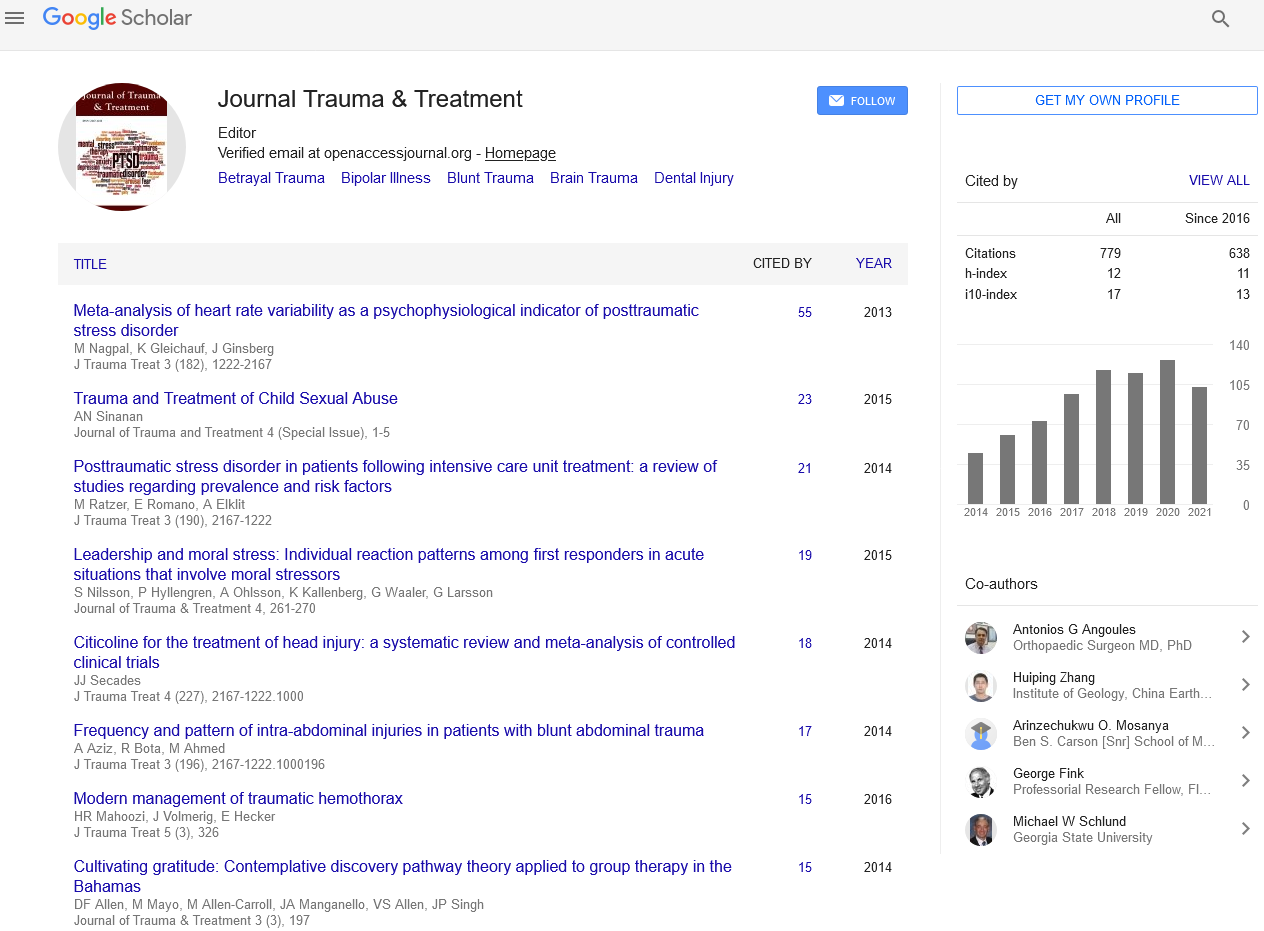
Journal of Trauma & Treatment received 1048 citations as per Google Scholar report