Brief Report - (127) Volume 14, Issue 6
Received: 03-Nov-2025, Manuscript No. jtm-26-186035;
Editor assigned: 05-Nov-2025, Pre QC No. P-186035;
Reviewed: 19-Nov-2025, QC No. Q-186035;
Revised: 24-Nov-2025, Manuscript No. R-186035;
Published:
29-Nov-2025
, DOI: 10.37421/2167-1222.2025.14.707
Citation: Tan, Ming Jie. ”Trauma and Emergency Surgery: Optimizing Patient Outcomes.” J Trauma Treat 14 (2025):707.
Copyright: © 2025 Tan J. Ming This is an open-access article distributed under the terms of the Creative Commons Attribution License, which permits unrestricted use, distribution and reproduction in any medium, provided the original author and source are credited.
The critical evaluation and application of research findings are paramount in advancing trauma and emergency surgery, aiming to refine patient care and surgical practices. This involves a strong emphasis on evidence-based medicine, necessitating rigorous study designs and robust data analysis to inform clinical decisions and healthcare policies. The ultimate goal is to identify optimal approaches, streamline treatment pathways, and enhance survival rates and long-term recovery for individuals suffering from traumatic injuries [1].
Surgical interventions play a pivotal role in the functional recovery of patients experiencing severe trauma. Research in this area meticulously examines various surgical techniques and their direct correlation with patient outcomes, focusing on key metrics such as restored mobility, effective pain management, and the ability to resume daily activities. The importance of prompt and appropriate surgical management in minimizing long-term disability and improving the overall quality of life cannot be overstated [2].
Minimally invasive surgical techniques are increasingly being explored for their efficacy in managing emergency surgical conditions. These approaches are often compared against traditional open surgery to assess benefits like reduced complication rates, shorter hospital stays, and accelerated recovery periods. This ongoing evolution underscores the dynamic nature of emergency surgery, driven by continuous technological advancements [3].
Effective resuscitation strategies are vital for patients presenting with hemorrhagic shock due to trauma. Studies in this domain analyze outcomes related to survival, organ function preservation, and the necessity for blood transfusions, with the aim of establishing optimal protocols for managing severe bleeding in emergency settings. These efforts are crucial for refining both pre-hospital and in-hospital resuscitation protocols [4].
The long-term neurological consequences following traumatic brain injury (TBI) are a significant concern, particularly in relation to surgical management. Research in this field evaluates the effectiveness of diverse surgical approaches in mitigating secondary brain injury and promoting functional recovery. The insights gained are indispensable for developing improved post-injury care pathways and comprehensive rehabilitation strategies [5].
Damage control surgery is a critical strategy for managing critically injured patients, and its effectiveness is continuously under review. Analyses focus on outcomes such as survival rates, complication profiles, and the frequency of re-operation, comparing various protocols and intervention timings. This research endeavors to refine the fundamental principles of damage control surgery to optimize outcomes for the most severely injured individuals [6].
The surgical management of abdominal trauma involves a detailed examination of its outcomes. This research evaluates different surgical approaches for injuries to solid organs and perforations of hollow viscera, assessing the factors that significantly influence patient morbidity and mortality. The findings contribute directly to the development of evidence-based guidelines for the surgical management of abdominal trauma [7].
Surgical fixation of complex extremity fractures in trauma patients presents unique challenges, and outcome studies are essential. These investigations compare various fixation methods, evaluating their impact on functional recovery, the incidence of complications, and the need for subsequent revision surgeries. The conclusions drawn are fundamental to optimizing the surgical treatment of severe limb injuries [8].
The timing of surgical intervention in emergency surgery is a critical determinant of patient outcomes. Research in this area explores the effects of early versus delayed surgical management in specific emergency scenarios, analyzing factors like infection rates, organ dysfunction, and overall survival. The objective is to identify optimal surgical timing to minimize morbidity and enhance patient prognosis [9].
Multidisciplinary teams play an increasingly recognized role in enhancing outcomes for trauma patients undergoing complex surgical procedures. This involves assessing how coordinated care, from initial resuscitation through post-operative rehabilitation, influences patient recovery, complication rates, and resource utilization. Such research highlights the profound benefits of integrated care models in managing severe trauma [10].
The process of rigorously evaluating research outcomes in trauma and emergency surgery is fundamental to enhancing patient care and refining surgical methodologies. This pursuit is deeply rooted in the principles of evidence-based medicine, demanding that study designs be meticulous and data analysis be thorough to effectively guide clinical decision-making and shape healthcare policy. The overarching aim is to delineate best practices, optimize treatment trajectories, and ultimately elevate survival rates and foster robust long-term recovery for trauma patients [1].
Investigating the impact of surgical interventions on the functional recovery of individuals suffering from severe trauma is a core area of research. This involves a detailed examination of diverse surgical techniques and their observed correlation with patient outcomes, with a particular emphasis on restored mobility, effective pain control, and the successful return to daily life activities. The critical importance of timely and appropriate surgical management in minimizing enduring disability and augmenting overall life quality is a consistent theme [2].
The application of minimally invasive surgical techniques in the context of emergency surgical conditions is a rapidly evolving field. Comparative studies contrast the outcomes of these advanced approaches with those of conventional open surgery, meticulously assessing advantages such as diminished complication rates, reduced hospital stays, and quicker recovery trajectories. This research highlights the transformative influence of technological progress on the landscape of emergency surgery [3].
Examining the effectiveness of various resuscitation strategies for patients experiencing hemorrhagic shock secondary to trauma is of paramount importance. Such studies undertake a comprehensive analysis of outcomes, including survival rates, the maintenance of organ function, and the volume of blood transfusions required, with the express goal of identifying the most effective protocols for managing severe hemorrhage in emergency situations. These findings are crucial for refining resuscitation efforts across both pre-hospital and hospital settings [4].
Research into the long-term neurological sequelae following traumatic brain injury (TBI) places significant emphasis on the role of surgical management. This body of work assesses the efficacy of different surgical interventions in curtailing secondary brain injury and promoting improved functional recovery. The insights derived from these studies are invaluable for the formulation of enhanced post-injury care protocols and sophisticated rehabilitation programs [5].
The principles and outcomes of damage control surgery in the management of critically injured patients are subject to ongoing scrutiny. This involves a detailed analysis of survival rates, the spectrum of complications encountered, and the propensity for re-operation, often comparing different surgical protocols and the timing of interventions. The objective is to further refine the foundational tenets of damage control surgery to achieve superior outcomes for the most severely compromised patients [6].
Investigating the surgical management of abdominal trauma and its resultant outcomes provides critical insights into patient care. This research typically evaluates a range of surgical approaches for injuries to solid organs and cases of hollow viscus perforation, while meticulously assessing the specific factors that contribute to patient morbidity and mortality. Such studies are instrumental in advancing evidence-based guidelines for the surgical treatment of abdominal trauma [7].
Studies focusing on the surgical fixation of complex extremity fractures in trauma patients are essential for optimizing limb salvage and functional restoration. These investigations often compare the success rates of various fixation techniques, examining their influence on functional recovery, the incidence of complications, and the requirement for secondary surgical procedures. The findings are vital for enhancing the surgical management of severe injuries to the limbs [8].
The temporal aspect of surgical intervention in emergency settings significantly influences patient outcomes. This area of research systematically explores the consequences of initiating surgical treatment either early or after a delay in specific emergency surgical contexts. By analyzing factors such as infection rates, organ dysfunction, and overall patient survival, the aim is to ascertain the optimal timing for surgical management, thereby reducing morbidity and improving prognosis [9].
The integration of multidisciplinary teams is increasingly recognized as a key strategy for improving outcomes among trauma patients who undergo complex surgical procedures. This involves evaluating how a coordinated approach to care, encompassing everything from initial resuscitation to long-term post-operative rehabilitation, impacts patient recovery, the occurrence of complications, and the efficient use of healthcare resources. The research underscores the substantial advantages of employing integrated care models in the comprehensive management of severe trauma [10].
This collection of research explores the multifaceted aspects of trauma and emergency surgery, emphasizing outcomes-based analysis. Key themes include the evaluation and utilization of research in improving patient care, the impact of surgical interventions on functional recovery, and the role of minimally invasive techniques. Studies also delve into resuscitation strategies for hemorrhagic shock, long-term neurological outcomes after TBI, damage control surgery principles, abdominal trauma management, surgical fixation of complex fractures, the timing of emergency surgical interventions, and the benefits of multidisciplinary team approaches. The collective research aims to refine surgical practices, optimize treatment pathways, and enhance survival and quality of life for trauma patients.
None
None
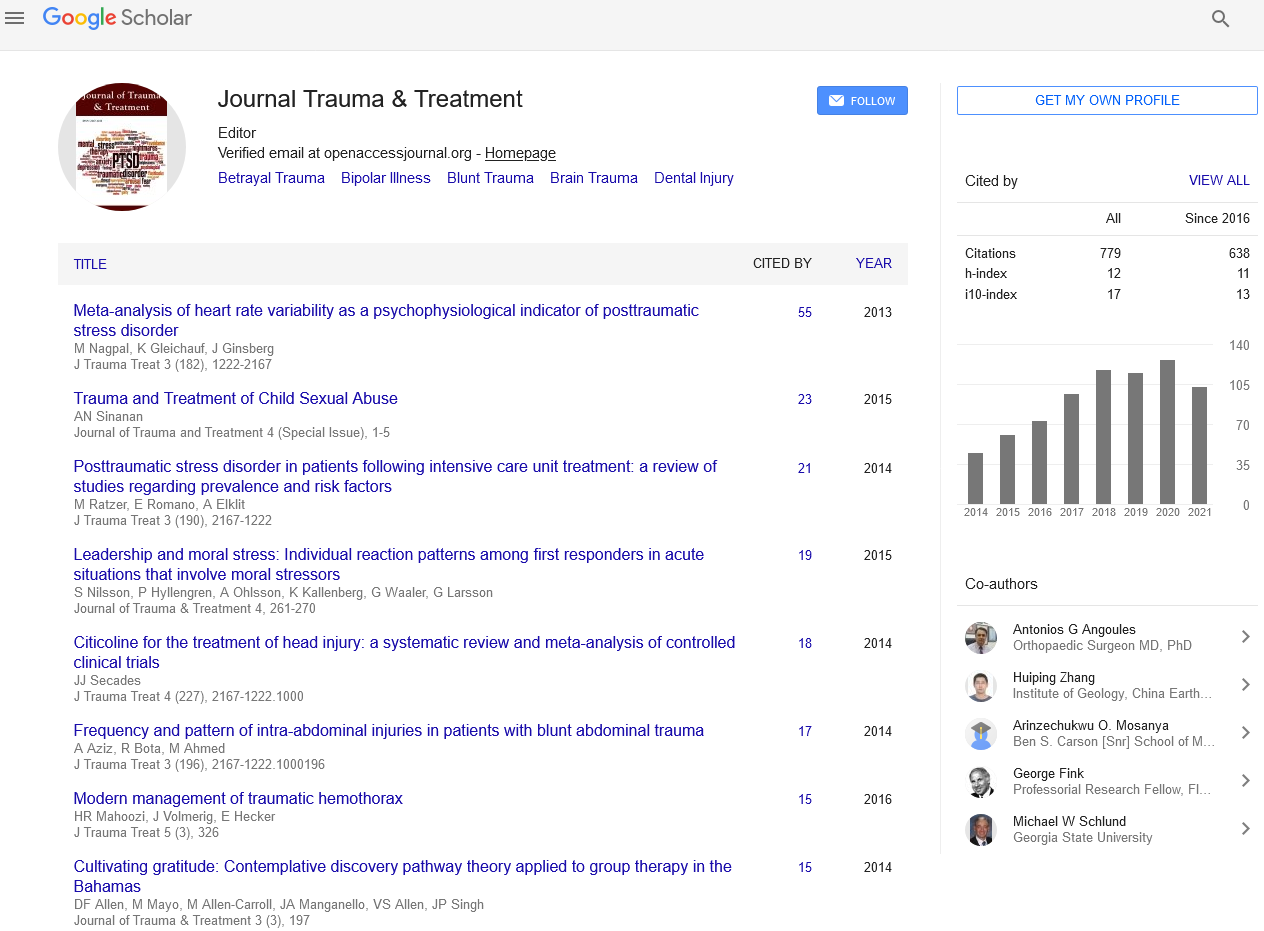
Journal of Trauma & Treatment received 1048 citations as per Google Scholar report