Perspective - (2025) Volume 14, Issue 5
Received: 02-Sep-2025, Manuscript No. pbt-25-173777;
Editor assigned: 04-Sep-2025, Pre QC No. P-173777;
Reviewed: 18-Sep-2025, QC No. Q-173777;
Revised: 23-Sep-2025, Manuscript No. R-173777;
Published:
30-Sep-2025
, DOI: 10.37421/2167-7689.2025.14.506
Citation: Svensson, Ingrid. ”Transforming Pharma Quality Control: Tech & QbD.” Pharmaceut Reg Affairs 14 (2025):506.
Copyright: © 2025 Svensson I. This is an open-access article distributed under the terms of the Creative Commons Attribution License, which permits unrestricted use,
distribution and reproduction in any medium, provided the original author and source are credited.
Implementing Quality by Design (QbD) is a game-changer for pharmaceutical quality control. What this really means is moving from a reactive, 'test-for-quality' approach to a proactive, 'build-quality-in' strategy from the get-go. This paper breaks down how QbD isn't just theory; it's a practical roadmap for developing robust processes, ensuring products consistently meet their critical quality attributes right from the design phase, which ultimately elevates patient safety and product efficacy[1].
Here's the thing about pharmaceutical quality control: reliable analytical methods are the backbone. This review highlights why method validation isn't just a regulatory checkbox; it's fundamental to ensuring drug product quality. It covers the essential parameters, like accuracy, precision, and specificity, showing how rigorous validation guarantees that our tests accurately measure what they're supposed to, leading to safer and more effective medications[2].
The pharmaceutical industry is really starting to embrace Industry 4.0, and what that means for quality control is a massive shift. This review dives into how technologies like AI, IoT, and big data are transforming everything from real-time monitoring to predictive maintenance. It's about moving towards smarter, more connected quality systems that can flag issues faster and prevent deviations before they even happen, ultimately improving overall product consistency and safety[3].
For pharmaceutical manufacturing, getting rapid microbial results is crucial, and this paper highlights just how important new methods are. It discusses how traditional microbial testing can be a bottleneck, and why embracing rapid microbiological methods (RMMs) isn't just about speed, but about getting critical data faster to make informed decisions, reducing inventory hold times, and ultimately getting products to patients more efficiently while maintaining safety[4].
Artificial intelligence and machine learning are fundamentally changing how pharmaceuticals are manufactured, especially in quality control. This comprehensive review makes it clear that these technologies aren't just buzzwords; they offer real potential for predictive quality, process optimization, and anomaly detection. It means moving beyond traditional control charts to systems that can anticipate problems before they occur, leading to more consistent product quality and reduced waste throughout the production line[5].
Data integrity is non-negotiable in pharmaceutical quality control; it's the bedrock of trust in our industry. This paper really gets into the current landscape, highlighting the evolving regulatory expectations and the practical challenges companies face in maintaining complete, consistent, and accurate data throughout the entire product lifecycle. It emphasizes that ensuring data integrity isn't just about avoiding non-compliance; it's about making sure every decision made about a drug product is based on truthful and reliable information[6].
When it comes to real-time quality control in pharma, techniques like Near-Infrared (NIR) Spectroscopy are proving incredibly valuable. This paper makes a good case for how NIR is being used directly on the production line, allowing manufacturers to monitor critical process parameters instantly. It's about moving away from time-consuming offline tests to get immediate feedback, which means quicker adjustments, less waste, and ultimately, a more efficient and compliant manufacturing process for drug products[7].
Continuous manufacturing is a big step forward for pharma, and Process Analytical Technology (PAT) is what makes it work in terms of quality control. This review really spells out the latest advancements, showing how PAT tools enable real-time monitoring and control during continuous production. It means companies can catch and fix issues much faster, ensuring consistent product quality from start to finish, which is a major upgrade from traditional batch processes and helps reduce the risk of variability[8].
A modern approach to pharmaceutical quality control centers around risk-based quality management. This article makes it clear that rather than treating all aspects equally, companies need to strategically identify, assess, and mitigate risks that could impact product quality and patient safety. It delves into the regulatory expectations and the hurdles companies face, showing how this focused approach allows resources to be directed where they matter most, leading to more effective and efficient quality systems[9].
Quality control for biologics and biosimilars is a complex field, and this paper provides a great overview of the analytical technologies making it possible. What this really means is that because these products are so intricate, standard methods often fall short. The article details advanced techniques, like mass spectrometry and various chromatographic methods, that are essential for characterizing these complex molecules, ensuring their identity, purity, and potency, which is absolutely critical for patient safety and therapeutic efficacy[10].
Implementing Quality by Design (QbD) transforms pharmaceutical quality control from a reactive to a proactive 'build-quality-in' strategy. This ensures products consistently meet critical quality attributes from the design phase, enhancing patient safety and product efficacy [1]. Reliable analytical methods are the backbone of pharmaceutical quality control; rigorous method validation, covering parameters like accuracy, precision, and specificity, is fundamental to ensuring drug product quality and leading to safer medications [2].
The pharmaceutical industry is rapidly embracing Industry 4.0, which brings a significant shift to quality control. Technologies like Artificial Intelligence (AI), the Internet of Things (IoT), and big data are transforming monitoring and maintenance, creating smarter quality systems that prevent deviations and improve consistency [3]. Artificial intelligence and machine learning are fundamentally changing pharmaceutical manufacturing and quality control. These technologies offer potential for predictive quality, process optimization, and anomaly detection, moving beyond traditional control charts to anticipate problems and reduce waste [5].
Rapid Microbiological Methods (RMMs) are crucial for pharmaceutical manufacturing, addressing traditional testing bottlenecks. RMMs provide faster critical data, enabling informed decisions, reducing inventory hold times, and delivering products more efficiently while maintaining safety [4]. Real-time quality control in pharma benefits immensely from techniques like Near-Infrared (NIR) Spectroscopy. Used directly on the production line, NIR allows instant monitoring of critical process parameters, leading to quicker adjustments, less waste, and more efficient manufacturing [7]. Continuous manufacturing is advanced by Process Analytical Technology (PAT) in quality control. PAT tools enable real-time monitoring and control during continuous production, allowing faster issue resolution, ensuring consistent product quality, and reducing variability from traditional batch processes [8].
Data integrity is non-negotiable in pharmaceutical quality control, forming the bedrock of trust. Evolving regulatory expectations and practical challenges highlight the need for complete, consistent, and accurate data throughout the product lifecycle, ensuring decisions are based on reliable information [6]. A modern approach focuses on risk-based quality management, where companies strategically identify, assess, and mitigate risks impacting product quality and patient safety. This focused strategy directs resources effectively, leading to more efficient and robust quality systems [9].
Quality control for biologics and biosimilars is complex, requiring advanced analytical technologies as standard methods often fall short for these intricate products. Techniques like mass spectrometry and various chromatographic methods are essential for characterizing these molecules, ensuring their identity, purity, and potency, which is critical for patient safety and therapeutic efficacy [10].
The pharmaceutical industry is actively transforming its quality control practices, moving from traditional reactive methods to proactive, technology-driven strategies. A core shift involves embracing Quality by Design (QbD), which integrates quality into the product from the initial design phase, prioritizing patient safety and product efficacy. This means not just testing for quality, but building it in from the get-go. Crucially, reliable analytical methods are foundational, demanding rigorous validation to ensure test accuracy and drug product quality. Modern approaches are incorporating Industry 4.0 technologies like Artificial Intelligence (AI), the Internet of Things (IoT), and big data for real-time monitoring and predictive maintenance. This allows for quicker issue flagging and deviation prevention, improving consistency. Rapid Microbiological Methods (RMMs) are becoming vital, offering faster results to streamline manufacturing and reduce hold times. Other innovations include Near-Infrared (NIR) Spectroscopy for in-line process monitoring and Process Analytical Technology (PAT) for continuous manufacturing, enabling real-time control and reducing variability. Data integrity remains paramount, with evolving regulatory expectations emphasizing complete and accurate information throughout the product lifecycle. Risk-based quality management is also key, directing resources to mitigate critical risks effectively. For complex products like biologics and biosimilars, advanced analytical technologies such as mass spectrometry and chromatography are essential to characterize their identity, purity, and potency, ensuring overall patient safety.
None
None
1. Archana V, Pradeep KS, Anil KP. "Quality by Design: Implementation of an Innovative Approach to Pharmaceutical Process Development and Quality Control".Curr Drug Deliv 18 (2021):86-98.
Indexed at, Google Scholar, Crossref
2. Abhishek R, Amrita M, Soumyajit M. "A Comprehensive Review on Analytical Method Validation in Pharmaceutical Quality Control".Res J Pharm Technol 13 (2020):4972-4978.
Indexed at, Google Scholar, Crossref
3. Mohamed G, Nourhan H, Mayar G. "Industry 4.0 in the Pharmaceutical Sector: A Review of its Impact on Quality Control and Assurance".Pharmaceutics 14 (2022):2800.
Indexed at, Google Scholar, Crossref
4. Weihong M, Jianan H, Yan S. "Current Trends and Perspectives of Rapid Microbiological Methods in Pharmaceutical Manufacturing".Microorganisms 11 (2023):2901.
Indexed at, Google Scholar, Crossref
5. Sachin K, Vimal K, Naresh K. "Artificial intelligence and machine learning in pharmaceutical product manufacturing: A comprehensive review".Int J Pharmaceutics 637 (2023):122902.
Indexed at, Google Scholar, Crossref
6. Harshit S, Rahul K, Sanjeev K. "Data integrity in pharmaceutical industry: Current trends and challenges".J Drug Deliv Ther 10 (2020):215-220.
Indexed at, Google Scholar, Crossref
7. Nyaoke N, Anne M, Peter N. "Near-Infrared Spectroscopy in Pharmaceutical Quality Control and Manufacturing".J Pharm Innov 16 (2021):844-857.
Indexed at, Google Scholar, Crossref
8. Indranil N, M. RB, A. K. "Process Analytical Technology for Continuous Manufacturing of Pharmaceuticals: A Review of Recent Advances".Indian J Pharm Educ Res 57 (2023):S43-S52.
Indexed at, Google Scholar, Crossref
9. Ritu Y, Pradeep KS, Harpreet K. "Risk-based quality management in pharmaceutical industries: Regulatory landscape and challenges".Int J Pharmaceutics 603 (2021):120690.
Indexed at, Google Scholar, Crossref
10. Anoop S, Jaimini G, Suresh G. "Analytical Technologies for Quality Control of Biologics and Biosimilars".Front Bioeng Biotechnol 10 (2022):908126.
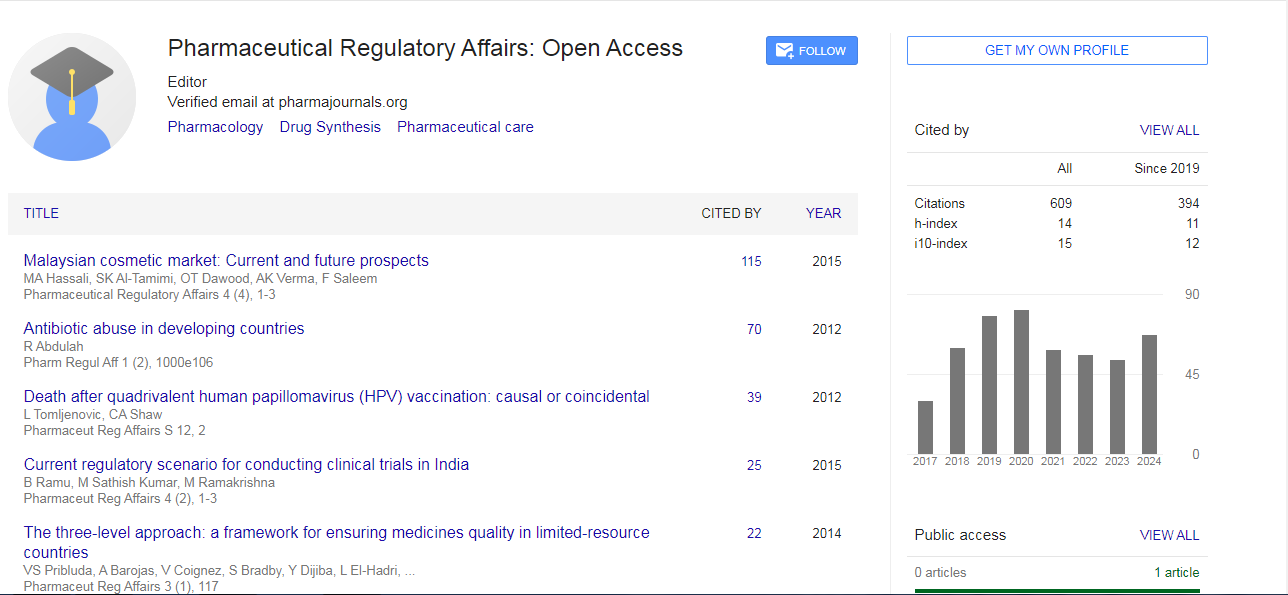
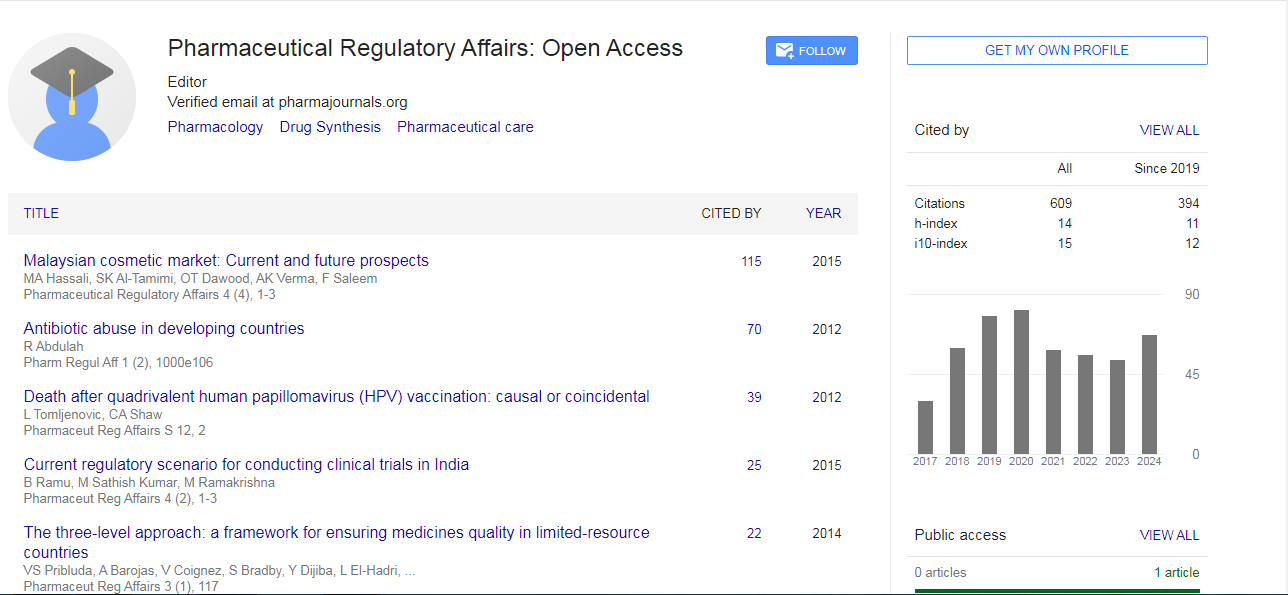
Pharmaceutical Regulatory Affairs: Open Access received 533 citations as per Google Scholar report