Perspective - (2026) Volume 7, Issue 5
Received: 13-Sep-2024, Manuscript No. JSPD-24-147895;
Editor assigned: 16-Sep-2024, Pre QC No. JSPD-24-147895 (PQ);
Reviewed: 01-Oct-2024, QC No. JSPD-24-147895;
Revised: 14-Oct-2025, Manuscript No. JSPD-24-147895 (R);
Published:
21-Oct-2025
, DOI: 10.37421/2684-4575.2025.7.167
Citation: Sebastien, Benoist. "The Evolution of Telepathology: From Concept to Clinical Practice." J Surg Path Diag 7 (2025): 167.
Copyright: © 2025 Sebastien B. This is an open-access article distributed under the terms of the creative commons attribution license which permits unrestricted use, distribution and reproduction in any medium, provided the original author and source are credited.
The COVID-19 pandemic, telepathology, a rapidly advancing field within digital pathology, has revolutionized how pathologists diagnose and collaborate across distances. This technological evolution is reshaping the landscape of medical diagnostics, improving accessibility, and enhancing the quality of patient care. This article explores the journey of telepathology from its conceptual roots to its current clinical applications and future potential.
Telepathology emerged in the late 20th century, driven by the increasing need for remote diagnostic capabilities and efficient consultation among pathologists. The initial concept involved using telecommunications technology to transmit pathology images from one location to another, facilitating remote diagnosis and consultation. Early systems were rudimentary, relying on analog transmission methods and limited image resolution.
The pivotal breakthrough came with the development of digital imaging and computer technology. Digital pathology systems allowed for high-resolution imaging and the storage of vast amounts of data, setting the stage for the modern telepathology landscape. In the 1990’s, the first-generation telepathology systems began to appear. These systems used video microscopy to capture and transmit live images of tissue samples, enabling pathologists to provide real-time consultations. Although these early systems demonstrated the feasibility of telepathology, they faced challenges related to image quality, bandwidth limitations, and the lack of standardized protocols.
The 2000’s saw significant advancements with the advent of Whole- Slide Imaging (WSI) technology. WSI involves scanning entire glass slides and converting them into high-resolution digital images that can be viewed and analyzed on computer screens. This innovation overcame many of the limitations of earlier systems, providing pathologists with more detailed and accurate images for remote diagnosis. The integration of telepathology into clinical practice has been gradual but impactful. Initially, telepathology was primarily used for remote consultations and second opinions. Pathologists in rural or underserved areas could now access the expertise of specialists from major medical centers without the need for physical transfer of specimens.
Seamless integration with EHR systems is essential for maintaining comprehensive patient records and ensuring that telepathology data is easily accessible to all members of the healthcare team. Looking ahead, telepathology is poised for further transformation with the integration of Artificial Intelligence (AI) and machine learning. AI algorithms can assist pathologists in analyzing complex images, identifying patterns, and making more accurate diagnoses. Additionally, advancements in telecommunication infrastructure and cloud-based solutions are expected to enhance the capabilities and accessibility of telepathology. The future of telepathology holds promise for even greater integration into routine clinical practice, potentially leading to more personalized and efficient patient care. As technology continues to advance, the role of telepathology in the healthcare system will likely expand, offering new opportunities for improving diagnostic accuracy and patient outcomes.
Telepathology has come a long way from its early conceptual stages, evolving into a critical component of modern medical practice. Its journey from rudimentary systems to sophisticated digital platforms highlights the ongoing innovation in medical technology and its potential to enhance patient care. As telepathology continues to evolve, its impact on the field of pathology and the broader healthcare system will undoubtedly grow, shaping the future of diagnostics and medical collaboration.
Telepathology, a rapidly advancing field within digital pathology, has revolutionized how pathologists diagnose and collaborate across distances. This technological evolution is reshaping the landscape of medical diagnostics, improving accessibility, and enhancing the quality of patient care. This article explores the journey of telepathology from its conceptual roots to its current clinical applications and future potential. Telepathology emerged in the late 20th century, driven by the increasing need for remote diagnostic capabilities and efficient consultation among pathologists. The initial concept involved using telecommunications technology to transmit pathology images from one location to another, facilitating remote diagnosis and consultation. Early systems were rudimentary, relying on analog transmission methods and limited image resolution.
In the 1990’s, the first-generation telepathology systems began to appear. These systems used video microscopy to capture and transmit live images of tissue samples, enabling pathologists to provide real-time consultations. Although these early systems demonstrated the feasibility of telepathology, they faced challenges related to image quality, bandwidth limitations, and the lack of standardized protocols. The 2000’s saw significant advancements with the advent of Whole-Slide Imaging (WSI) technology. WSI involves scanning entire glass slides and converting them into highresolution digital images that can be viewed and analyzed on computer screens. This innovation overcame many of the limitations of earlier systems, providing pathologists with more detailed and accurate images for remote diagnosis.
The integration of telepathology into clinical practice has been gradual but impactful. Initially, telepathology was primarily used for remote consultations and second opinions. Pathologists in rural or underserved areas could now access the expertise of specialists from major medical centers without the need for physical transfer of specimens.
Looking ahead, telepathology is poised for further transformation with the integration of Artificial Intelligence (AI) and machine learning. AI algorithms can assist pathologists in analyzing complex images, identifying patterns, and making more accurate diagnoses. Additionally, advancements in telecommunication infrastructure and cloud-based solutions are expected to enhance the capabilities and accessibility of telepathology.
The future of telepathology holds promise for even greater integration into routine clinical practice, potentially leading to more personalized and efficient patient care. As technology continues to advance, the role of telepathology in the healthcare system will likely expand, offering new opportunities for improving diagnostic accuracy and patient outcomes. Telepathology is not only transforming healthcare in high-resource settings but is also making significant strides in low- and middle-income countries. In regions where access to trained pathologists is limited, telepathology offers a lifeline by connecting local healthcare providers with global experts. This global perspective highlights the potential of telepathology to address disparities in healthcare access and improve diagnostic capabilities worldwide.
Telepathology has come a long way from its early conceptual stages, evolving into a critical component of modern medical practice. Its journey from rudimentary systems to sophisticated digital platforms highlights the ongoing innovation in medical technology and its potential to enhance patient care. As telepathology continues to evolve, its impact on the field of pathology and the broader healthcare system will undoubtedly grow, shaping the future of diagnostics and medical collaboration. With ongoing advancements in technology and increased global adoption, telepathology stands at the forefront of a new era in medical diagnostics, promising to transform how we approach patient care and collaborative medicine.
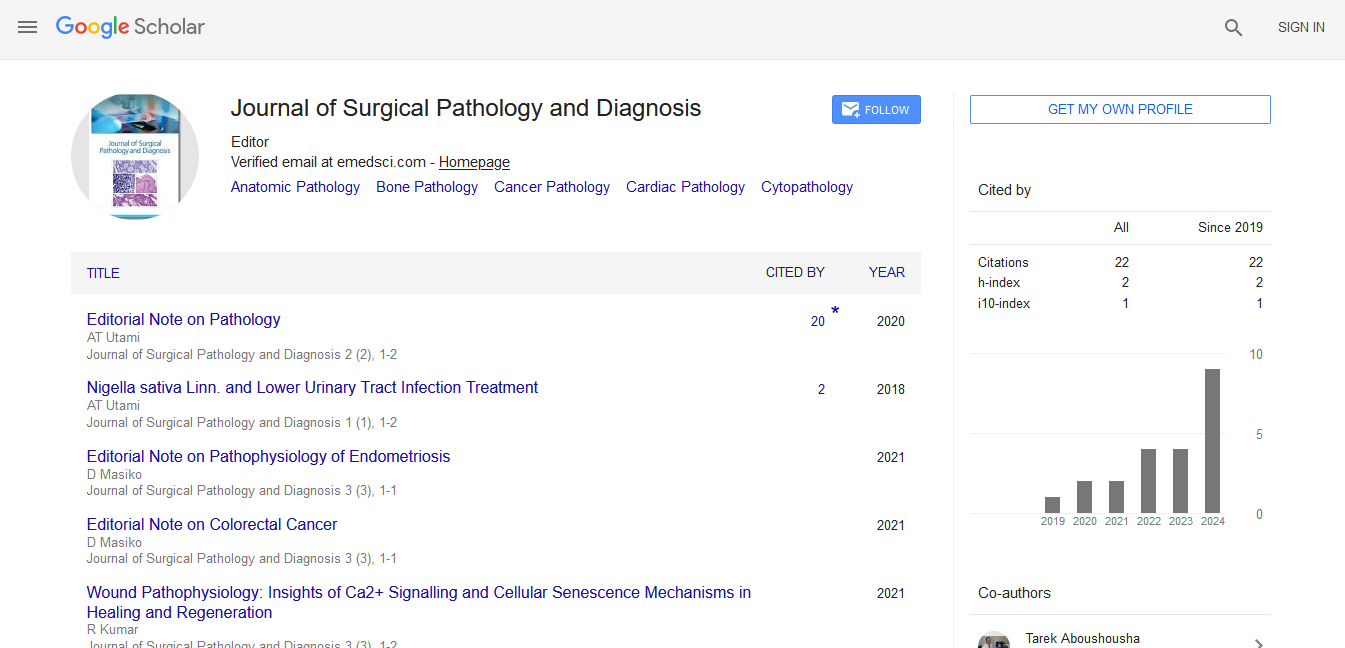
Journal of Surgical Pathology and Diagnosis received 15 citations as per Google Scholar report