Short Communication - (2025) Volume 12, Issue 3
Received: 02-Jun-2025, Manuscript No. ijn-26-183983;
Editor assigned: 04-Jun-2025, Pre QC No. P-183983;
Reviewed: 18-Jun-2025, QC No. Q-183983;
Revised: 23-Jun-2025, Manuscript No. R-183983;
Published:
30-Jun-2025
, DOI: 10.37421/2376-0281.2025.12.638
Citation: El-Sayed, Ahmed. ”Tele-rehabilitation: Improving Neurological Care Access and Outcomes.” Int J Neurorehabilitation Eng 12 (2025):638.
Copyright: © 2025 El-Sayed A. This is an open-access article distributed under the terms of the Creative Commons Attribution License, which permits unrestricted use, distribution and reproduction in any medium, provided the original author and source are credited.
Tele-rehabilitation is emerging as a transformative approach in delivering neurological care, particularly addressing the persistent challenges of accessibility and geographical limitations. This innovative modality leverages technology to extend therapeutic services beyond traditional clinical settings, making specialized neurological treatment more attainable for a wider patient population. The primary goal is to bridge the gap between patients requiring specialized care and the availability of such services, especially in remote or underserved areas. This facilitates increased patient engagement, potentially leading to better adherence to prescribed treatment regimens and ultimately contributing to improved health outcomes. Furthermore, the adoption of tele-rehabilitation can offer significant cost savings for both patients and healthcare systems by reducing travel expenses and the need for prolonged hospital stays. However, the widespread implementation of tele-rehabilitation is not without its obstacles, including the need for robust technological infrastructure, evolving reimbursement policies, and ensuring equitable access across diverse socioeconomic and demographic groups. Ongoing research and development are crucial to overcome these barriers and fully realize the potential of tele-rehabilitation in neurological care. [1] The integration of telestroke services represents a significant advancement in the management of acute ischemic stroke, especially within rural and remote regions where immediate access to specialized neurological expertise can be limited. These telemedicine platforms are designed to enable real-time consultations between neurologists located elsewhere and local medical teams, thereby facilitating rapid diagnosis and prompt initiation of life-saving treatments. Such timely intervention is absolutely critical for maximizing functional recovery and minimizing long-term disability in stroke survivors. The focus of current and future research is increasingly shifting towards expanding these services to encompass remote rehabilitation programs, thereby ensuring a seamless continuum of care for patients even after their discharge from acute care facilities. This comprehensive approach aims to support sustained recovery and improve overall quality of life. [2] Virtual reality (VR) and augmented reality (AR) technologies are poised to revolutionize neurorehabilitation, offering novel and highly engaging therapeutic interventions for a variety of neurological conditions. These immersive technologies have the capacity to transform standard rehabilitation exercises into motivating and interactive experiences, thereby enhancing patient participation and adherence. Conditions such as stroke, traumatic brain injury, and Parkinson's disease, which often require extensive and sustained rehabilitation efforts, can particularly benefit from these advanced tools. The ability of remote VR/AR-based rehabilitation to provide personalized training protocols and objective outcome tracking presents a significant opportunity to deliver more effective and accessible care, adapting to individual patient needs and progress. This personalized approach has the potential to accelerate recovery and improve functional independence. [3] Wearable sensors are playing an increasingly vital role in tele-rehabilitation, providing clinicians with objective, real-time data on patient movement and functional performance. These sophisticated devices are capable of accurately monitoring critical aspects of patient mobility, including gait patterns, balance stability, and upper limb function. The continuous stream of data generated by these sensors offers invaluable insights that allow therapists to remotely adjust and optimize treatment plans in response to a patient's evolving needs and progress. This data-driven approach is fundamental to enhancing the personalization of care and enabling the early detection of subtle functional declines, which is crucial for the effective management of chronic neurological conditions. Such proactive intervention can prevent further deterioration and improve long-term prognoses. [4] Remote monitoring of individuals diagnosed with Parkinson's disease, facilitated through sophisticated tele-rehabilitation platforms, has demonstrated highly promising results in the comprehensive management of both motor and non-motor symptoms associated with the condition. These platforms commonly integrate various technological tools, including video consultations, dedicated mobile applications, and advanced sensor-based devices, to meticulously assess key indicators such as tremor severity, rigidity, gait abnormalities, and mood disturbances. The consistent and proactive engagement offered by these interventions has the potential to significantly improve the overall quality of life for patients and simultaneously reduce the considerable burden placed upon both caregivers and the broader healthcare systems. [5] The application of tele-rehabilitation strategies has proven to be particularly beneficial in addressing the unique challenges faced by individuals living with multiple sclerosis (MS), a progressive neurological disease. Common symptoms such as significant mobility impairments and debilitating fatigue can be effectively managed through remote delivery of tailored physiotherapy and occupational therapy services. These services can be flexibly scheduled and delivered within the patient's home environment, promoting greater adherence to exercise regimens and leading to demonstrably improved functional independence and a reduction in the exacerbation of disease symptoms. Furthermore, studies consistently report high levels of patient satisfaction with these accessible and convenient remote rehabilitation options. [6] For individuals undergoing recovery after a stroke, the implementation of home-based tele-rehabilitation programs, under the guidance of trained therapists, has been shown to significantly enhance motor recovery processes and markedly reduce the risk of developing secondary complications. These comprehensive programs typically integrate a variety of components, including carefully designed exercise protocols, essential educational materials, and regular, constructive feedback mechanisms to ensure consistent patient adherence and track progress effectively. The inherent convenience and enhanced accessibility offered by tele-rehabilitation are pivotal factors contributing to better long-term functional outcomes and a greater return to independence. [7] The expanding role of teleneurology in providing essential, specialized care for children diagnosed with neurodevelopmental disorders is a critical development, especially in regions where access to pediatric neurologists is severely limited. Teleconsultations and sophisticated remote monitoring capabilities allow for the earlier identification of potential developmental issues and facilitate timely intervention, which is crucial for improving developmental trajectories. Early and appropriate interventions can lead to better long-term outcomes, promoting more effective integration into educational and social environments for these children. This accessibility ensures that children receive the specialized care they need to thrive. [8] Successful implementation of tele-rehabilitation initiatives hinges on the establishment of robust technological infrastructure and the development of clear, comprehensive ethical guidelines. Paramount importance must be placed on ensuring the privacy and security of sensitive patient data, in addition to proactively addressing existing gaps in digital literacy among both patients and healthcare providers. Achieving widespread adoption and maximizing the benefits of tele-rehabilitation in neurological care necessitates close and collaborative efforts among technology developers, dedicated clinicians, and influential policymakers. These partnerships are essential for navigating implementation challenges and fostering innovation. [9] The future trajectory of tele-rehabilitation within the field of neurology is strongly oriented towards a personalized and deeply integrated approach, increasingly leveraging the power of artificial intelligence (AI) and advanced big data analytics. AI algorithms are becoming instrumental in analyzing vast amounts of patient data, derived from sources such as wearable devices and remote assessments, to more accurately predict treatment outcomes, optimize intricate treatment plans, and proactively identify individuals who may be at an increased risk of experiencing clinical deterioration. This significant shift towards predictive and precision-based neurorehabilitation promises to further elevate the quality and effectiveness of care delivery, particularly in settings where access to specialized neurological services is a persistent challenge. [10]
Tele-rehabilitation has emerged as a critical solution for overcoming the persistent barriers to accessing specialized neurological care, particularly for individuals residing in remote or underserved geographic areas. This innovative approach utilizes advanced technological platforms to deliver essential therapeutic services directly to patients, thereby eliminating the necessity for extensive travel and reducing associated logistical burdens. Key advantages of this model include a marked increase in patient engagement with their treatment plans, improved adherence to prescribed therapeutic regimens, and the potential for substantial cost savings for both healthcare providers and patients. However, the successful and widespread adoption of tele-rehabilitation is contingent upon addressing several significant challenges, including the need for greater technological literacy among users, the establishment of clear and supportive reimbursement policies, and the imperative to ensure equitable access across diverse populations with varying socioeconomic and technological capabilities. Continuous innovation and policy development are essential to maximize its reach. [1] The implementation of telestroke services has profoundly enhanced the capacity to manage acute ischemic stroke effectively, especially in regions that are typically underserved by specialized medical facilities. These sophisticated telemedicine platforms facilitate the crucial real-time consultation process between experienced neurologists and local healthcare teams, enabling swift diagnosis and the immediate initiation of critical treatment protocols. This promptness in intervention is absolutely vital for optimizing functional recovery outcomes and minimizing the long-term disability experienced by stroke survivors. Current research efforts are actively directed towards the expansion of these services to incorporate remote rehabilitation components, thereby ensuring a consistent and comprehensive care pathway for patients throughout their recovery journey post-discharge. This integrated approach is key to sustained well-being. [2] Virtual reality (VR) and augmented reality (AR) technologies are demonstrating immense potential to significantly enhance the field of neurorehabilitation by providing immersive and highly engaging therapeutic experiences. These cutting-edge technologies can transform standard therapeutic exercises into motivating and interactive activities, thereby fostering greater patient adherence and participation for individuals with conditions such as stroke, traumatic brain injury, and Parkinson's disease. The advent of remote VR/AR-based rehabilitation allows for the development and implementation of highly personalized training protocols tailored to individual patient needs, coupled with objective outcome tracking capabilities. This facilitates a more effective and accessible approach to neurological rehabilitation. [3] The integration of wearable sensors into tele-rehabilitation practices is proving to be invaluable for obtaining objective, real-time data concerning patient movement and functional performance. These advanced devices are capable of meticulously monitoring crucial metrics such as gait parameters, postural stability, and upper limb functionality. The continuous stream of data provides therapists with critical insights that enable them to remotely adjust and refine treatment plans, ensuring that care remains highly personalized and responsive to the patient's progress. This data-driven methodology is fundamental to enhancing the precision of care delivery and facilitating the early identification of potential functional declines, which is essential for the effective management of chronic neurological disorders. [4] Remote monitoring of patients diagnosed with Parkinson's disease, facilitated through advanced tele-rehabilitation platforms, has yielded encouraging outcomes in the management of both motor and non-motor symptoms characteristic of the condition. These platforms commonly employ a combination of tools, including secure video consultations, intuitive mobile applications, and sophisticated sensor-based devices, to systematically assess key indicators such as tremor intensity, rigidity, gait disturbances, and emotional well-being. The consistent and convenient application of these remote interventions has the potential to significantly improve the overall quality of life for affected individuals and concurrently alleviate the substantial burden on their caregivers and the wider healthcare infrastructure. [5] The application of tele-rehabilitation models in the comprehensive management of multiple sclerosis (MS) effectively addresses the significant challenges associated with mobility impairments and chronic fatigue, which are hallmark symptoms of this progressive neurological condition. The remote delivery of specialized physiotherapy and occupational therapy services offers unparalleled flexibility in scheduling and allows patients to engage in home-based exercises, leading to notable improvements in functional independence and a reduction in the severity of symptom exacerbations. Patient feedback consistently indicates high levels of satisfaction with the convenience and efficacy of these remote services. [6] For individuals navigating the recovery process following a stroke, the implementation of structured home-based tele-rehabilitation programs, supported by qualified therapists, has demonstrated a remarkable ability to enhance motor recovery and significantly mitigate the risk of secondary complications. These meticulously designed programs often incorporate tailored exercise protocols, comprehensive educational resources, and consistent feedback mechanisms to ensure optimal patient adherence and monitor progress effectively. The inherent convenience and enhanced accessibility offered by tele-rehabilitation are crucial factors that contribute to improved long-term functional outcomes and a more successful return to daily activities. [7] The role of teleneurology in extending specialized care to children with neurodevelopmental disorders is experiencing significant expansion, particularly in geographical areas where access to pediatric neurologists is notably limited. Through the use of teleconsultations and advanced remote monitoring capabilities, it becomes possible to achieve earlier identification of developmental delays or disorders and to implement timely interventions. Such early and appropriate support is essential for fostering improved developmental trajectories and facilitating better integration into educational and social settings for these children, ensuring they receive the critical care needed for optimal development. [8] The successful implementation of tele-rehabilitation programs necessitates the establishment of a robust and reliable technological infrastructure, alongside the development and adherence to clear, comprehensive ethical guidelines. Paramount importance must be placed on safeguarding the privacy and security of sensitive patient health information, while simultaneously addressing any existing disparities in digital literacy among both patients and healthcare professionals. To surmount these implementation hurdles and fully harness the benefits of tele-rehabilitation in neurological care, collaborative efforts involving technology developers, clinical practitioners, and policymakers are indispensable. [9] The future evolution of tele-rehabilitation in the field of neurology is anticipated to be characterized by a highly personalized and integrated approach, increasingly powered by advancements in artificial intelligence (AI) and sophisticated big data analytics. AI will play a crucial role in analyzing complex patient data derived from various sources, including wearable devices and remote assessments, to enable more accurate outcome predictions, optimize intricate treatment plans, and proactively identify individuals at heightened risk of clinical deterioration. This transformative shift towards predictive and precision-oriented neurorehabilitation holds the promise of further enhancing the efficacy and accessibility of care, especially for those in remote or underserved regions. [10]
Tele-rehabilitation offers a promising solution to improve access to neurological care, particularly in remote areas. It utilizes technology to deliver therapy, increasing patient engagement and adherence while potentially reducing costs. Key technologies include telemedicine for stroke management, virtual and augmented reality for engaging exercises, and wearable sensors for objective data collection. Remote monitoring is effective for conditions like Parkinson's disease and multiple sclerosis, enhancing functional independence and quality of life. Teleneurology is also crucial for pediatric neurodevelopmental disorders. Challenges remain in technological infrastructure, data security, digital literacy, and reimbursement. Future advancements involve AI and big data for personalized and predictive neurorehabilitation.
None
None
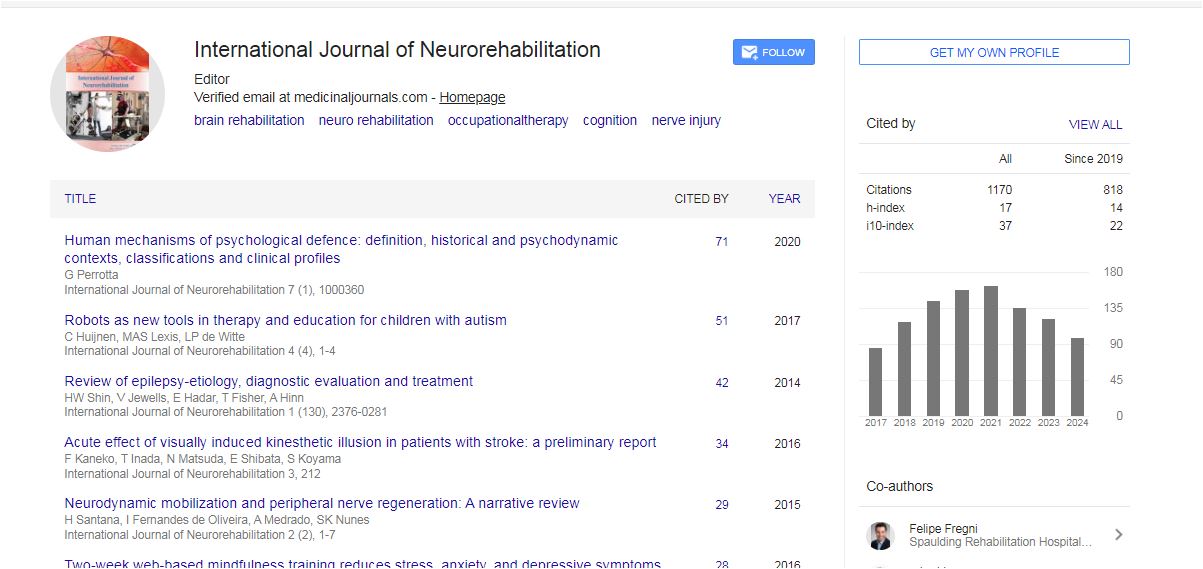
International Journal of Neurorehabilitation received 1078 citations as per Google Scholar report