Perspective - (2025) Volume 16, Issue 3
Received: 29-May-2025, Manuscript No. gjto-25-175444;;
Editor assigned: 02-Jun-2025, Pre QC No. P-175444;
Reviewed: 16-Jun-2025, QC No. QC-175444;
Revised: 23-Jun-2025, Manuscript No. R-175444;
Published:
30-Jun-2025
, DOI: 10.37421/2229-8711.2025.16.449
Citation: Valverde, Diego. ”Technological Innovation: Scope, Impact, and Hurdles.” Global J Technol Optim 16 (2025):449.
Copyright: © 2025 Valverde D. This is an open-access article distributed under the terms of the Creative Commons Attribution License, which permits unrestricted use,
distribution and reproduction in any medium, provided the original author and source are credited.
This review explores how Artificial Intelligence serves as a crucial tool for achieving sustainability goals. It systematically analyzes diverse AI applications across various sectors, identifying key opportunities like optimized resource management, predictive environmental monitoring, and smart urban planning. The article also discusses associated challenges such as data privacy, ethical considerations, and the need for robust AI governance frameworks[1]. This comprehensive review examines the significant advancements in Robotic Process Automation (RPA), detailing its evolution, current state, and future directions. It highlights how RPA optimizes business processes, improves efficiency, and reduces operational costs across various industries. The article also addresses critical challenges, including implementation complexities, workforce implications, and the need for effective governance frameworks[2]. This review provides a comprehensive overview of blockchain technology's application in supply chain management, highlighting its potential to enhance transparency, traceability, and efficiency. It systematically categorizes existing research, identifies key benefits such as fraud reduction and improved data integrity, and outlines a future research agenda focusing on scalability, interoperability, and regulatory challenges[3].
This review offers an insightful look into quantum machine learning, surveying its most recent applications and the inherent challenges it faces. It covers various quantum algorithms designed for machine learning tasks, such as classification and optimization, highlighting their potential to outperform classical methods for specific problems. The discussion also addresses key hurdles like quantum hardware limitations, error correction, and the development of accessible quantum programming tools[4]. This systematic review explores the recent applications of virtual reality (VR) in education, focusing on how VR technology facilitates immersive learning experiences. It identifies various educational contexts where VR is effectively employed, from medical training simulations to virtual field trips. The article discusses the pedagogical benefits, such as increased engagement and improved knowledge retention, while also addressing technical limitations and the need for standardized development practices[5].
This review comprehensively explores the transformative impact of Big Data Analytics within the healthcare sector, detailing both its opportunities and inherent challenges. It identifies key areas where big data drives innovation, such as personalized medicine, predictive diagnostics, and public health surveillance. The article also addresses significant hurdles, including data privacy concerns, integration complexities, and the need for skilled analytical professionals[6]. This comprehensive review scrutinizes the multifaceted challenges and innovative solutions in cybersecurity within the context of Industry 4.0. It highlights the increased vulnerabilities posed by interconnected systems, Internet of Things (IoT) devices, and cloud computing in industrial environments. The article details various mitigation strategies, including advanced encryption, anomaly detection systems, and robust authentication protocols, emphasizing the critical need for a proactive and holistic security approach[7].
This review highlights the most recent advancements in solar photovoltaic technology, discussing breakthroughs in efficiency, material science, and manufacturing processes. It covers developments in crystalline silicon, thin-film technologies, and emerging perovskite solar cells. The article emphasizes the ongoing efforts to reduce costs, improve stability, and integrate solar energy more effectively into diverse applications, contributing significantly to sustainable energy goals[8]. This systematic review focuses on the current applications of Augmented Reality (AR) in manufacturing, detailing its role in enhancing various industrial processes. It highlights AR's utility in tasks like assembly assistance, quality control, maintenance, and training, leading to improved efficiency and reduced errors. The article also addresses significant challenges such as hardware limitations, data integration complexities, and the need for user-friendly interfaces, outlining future research directions[9]. This comprehensive review delves into the foundational technologies, diverse applications, and inherent challenges associated with the development of smart cities. It explores how interconnected systems, Internet of Things (IoT) devices, Big Data Analytics, and AI are leveraged to enhance urban living, optimize resource management, and improve public services. The article also addresses critical issues like data privacy, cybersecurity, and the need for inclusive governance models to ensure sustainable and equitable urban development[10].
Artificial Intelligence (AI) serves as a crucial tool for achieving sustainability goals, systematically analyzing diverse AI applications for optimized resource management, predictive environmental monitoring, and smart urban planning. However, this field also contends with challenges like data privacy, ethical considerations, and the necessity for robust AI governance frameworks [1]. Similarly, quantum machine learning presents intriguing potential with algorithms designed for tasks such as classification and optimization, capable of outperforming classical methods for specific problems. Yet, it faces hurdles in quantum hardware limitations, error correction, and the development of accessible programming tools [4]. Complementing these, Big Data Analytics significantly impacts the healthcare sector by enabling personalized medicine, predictive diagnostics, and public health surveillance. Its widespread adoption confronts significant obstacles related to data privacy concerns, integration complexities, and the demand for skilled analytical professionals [6].
In the realm of operational efficiency, Robotic Process Automation (RPA) demonstrates remarkable advancements, optimizing business processes, improving efficiency, and reducing operational costs across diverse industries. Implementing RPA, however, involves complexities, workforce implications, and the need for effective governance [2]. Concurrently, blockchain technology offers profound enhancements to supply chain management by fostering transparency, traceability, and efficiency. It aids in fraud reduction and ensures improved data integrity, though future research must address scalability, interoperability, and regulatory challenges [3]. These technologies collectively underscore a shift towards more automated and secure operational paradigms.
Modern industrial environments and urban infrastructures are also undergoing significant transformation. Cybersecurity in Industry 4.0 presents a complex landscape of challenges and solutions, primarily due to increased vulnerabilities from interconnected systems, Internet of Things (IoT) devices, and cloud computing. Mitigation strategies, including advanced encryption and anomaly detection, are critical for a proactive security approach [7]. Furthermore, the development of smart cities relies heavily on interconnected systems, IoT devices, Big Data Analytics, and AI to enhance urban living and optimize resource management. This ambitious endeavor grapples with critical issues such as data privacy, cybersecurity, and the need for inclusive governance models to ensure sustainable and equitable urban development [10]. These advancements highlight the dual nature of progress: immense potential paired with complex security and ethical considerations.
Beyond industrial and urban applications, other technological innovations enhance specific sectors. Recent advancements in solar photovoltaic technology, including breakthroughs in efficiency and material science, demonstrate ongoing efforts to reduce costs, improve stability, and integrate solar energy more effectively, contributing to sustainable energy goals [8]. In education, virtual reality (VR) facilitates immersive learning experiences, from medical training to virtual field trips, significantly boosting engagement and knowledge retention. Nevertheless, technical limitations and the need for standardized development practices persist [5]. Meanwhile, Augmented Reality (AR) in manufacturing streamlines various industrial processes, improving assembly assistance, quality control, maintenance, and training. This technology also faces hardware limitations and data integration complexities [9]. These diverse applications showcase how technology is reshaping how we learn, produce, and generate energy, each with its unique set of opportunities and challenges.
The provided data reviews advancements and applications of diverse technologies across multiple sectors. Artificial Intelligence (AI) plays a crucial role in achieving sustainability through optimized resource management and predictive monitoring. Robotic Process Automation (RPA) is streamlining business processes, enhancing efficiency, and cutting operational costs. Blockchain technology offers transparency and traceability in supply chain management, combating fraud and ensuring data integrity. Quantum Machine Learning presents algorithms that could surpass classical methods, despite hardware and error correction challenges. Virtual Reality (VR) is transforming education by providing immersive learning experiences and improving knowledge retention. Big Data Analytics revolutionizes healthcare through personalized medicine and predictive diagnostics, though data privacy remains a concern. Cybersecurity solutions are vital for protecting interconnected systems in Industry 4.0 environments. Breakthroughs in solar photovoltaic technology aim to reduce costs and improve energy integration. Augmented Reality (AR) enhances manufacturing processes, improving assembly, quality control, and training. Finally, smart cities leverage IoT, Big Data, and AI to improve urban living and resource management, facing privacy and governance hurdles. Overall, these reviews highlight significant opportunities for technological innovation alongside common challenges like data privacy, ethical considerations, and implementation complexities across various fields.
None
None
Tahar BH, Hamza EB, Carlo AG. "The Role of Artificial Intelligence in Enhancing Sustainability: A Systematic Review".Sustainable Cities and Society 97 (2023):104719.
Indexed at, Google Scholar, Crossref
Mary CL, Salman FK, Leslie PW. "Advancements in Robotic Process Automation: A Comprehensive Review".J Strat Info Syst 31 (2022):101783.
Indexed at, Google Scholar, Crossref
Sachin SK, Angappa G, Sachin AG. "Blockchain technology in supply chain management: A comprehensive review and future research agenda".Comput Ind 115 (2020):103123.
Indexed at, Google Scholar, Crossref
Kavinder B, Neha C, Neeraj K. "Quantum machine learning: A review of recent applications and challenges".Expert Syst Appl 185 (2021):115462.
Indexed at, Google Scholar, Crossref
Jasmina R, Eko S, Yuni W. "Virtual reality in education: A systematic review of recent applications and immersive learning experiences".Comput Educ 153 (2020):104000.
Indexed at, Google Scholar, Crossref
Yogesh KD, Laurie H, Heikki K. "Big Data Analytics in Healthcare: A Review of Opportunities and Challenges".Int J Inf Manage 56 (2021):102197.
Indexed at, Google Scholar, Crossref
Lutz MK, Robert S, Tilo W. "Cybersecurity in Industry 4.0: A comprehensive review of challenges and solutions".J Bus Res 140 (2022):35-47.
Indexed at, Google Scholar, Crossref
Martin AG, Anita WYH, Henry JS. "Recent advances in solar photovoltaic technology: A review".Nat Energy 5 (2020):559-571.
Indexed at, Google Scholar, Crossref
Xiangyu W, Yunjiao W, Zhe M. "Augmented reality in manufacturing: A systematic review of current applications, challenges, and future trends".J Manuf Syst 69 (2023):102435.
Indexed at, Google Scholar, Crossref
Farshad A, Ali A, Fasil K. "Smart cities: A comprehensive review of key technologies, applications, and challenges".Sustainable Cities and Society 74 (2021):103000.
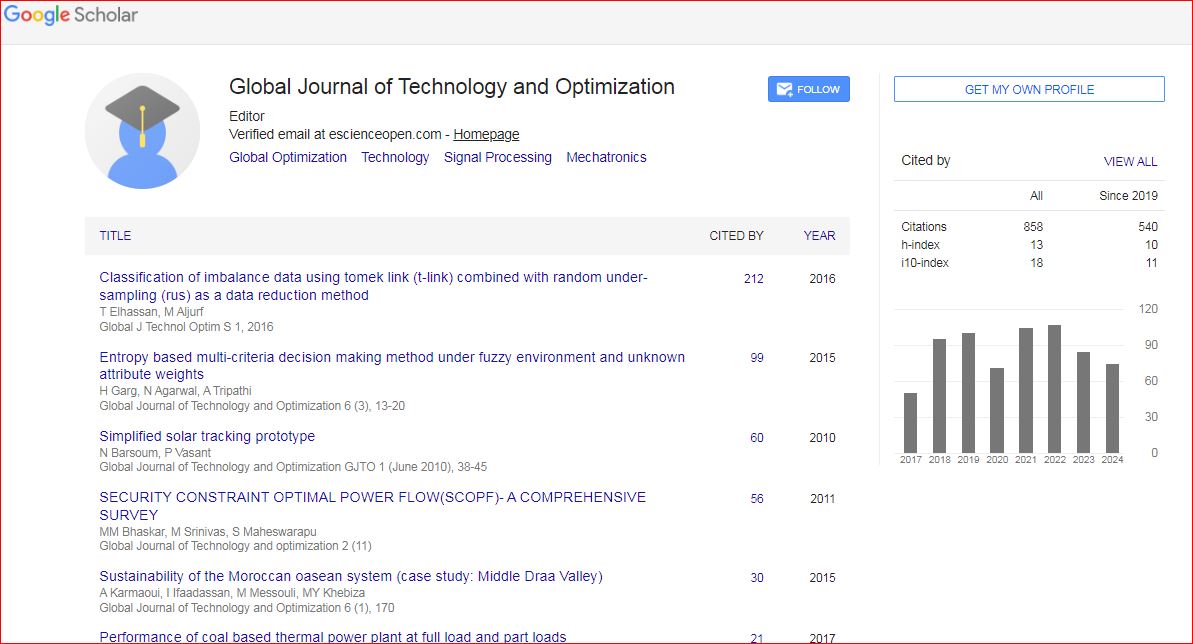
Global Journal of Technology and Optimization received 847 citations as per Google Scholar report