Short Communication - (2025) Volume 12, Issue 6
Received: 01-Dec-2025, Manuscript No. ijn-26-184030;
Editor assigned: 03-Dec-2025, Pre QC No. P-184030;
Reviewed: 17-Dec-2025, QC No. Q-184030;
Revised: 22-Dec-2025, Manuscript No. R-184030;
Published:
29-Dec-2025
, DOI: 10.37421/2376-0281.2025.12.667
Citation: Pavlov, Viktor. ”Task-Specific Training Drives Neuroplasticity For Recovery.” Int J Neurorehabilitation Eng 12 (2025):667.
Copyright: © 2025 Pavlov V. This is an open-access article distributed under the terms of the Creative Commons Attribution License, which permits unrestricted use, distribution and reproduction in any medium, provided the original author and source are credited.
Task-specific training is a fundamental element in neurorehabilitation, demonstrably promoting adaptive neuroplasticity. Through repetitive engagement in goal-oriented activities, the brain actively reorganizes its neural pathways to enhance motor control and facilitate functional recovery following neurological injury. This customized strategy optimizes the learning process and ensures long-term retention of acquired skills, underscoring the critical importance of individualized rehabilitation programs in addressing neurological deficits [1].
The principle of specificity in training is of paramount importance for eliciting significant neuroplastic changes within the central nervous system. When individuals consistently perform movements directly related to a desired functional outcome, such as ambulation or object manipulation, the corresponding neural circuits are progressively strengthened and refined. This targeted practice directly contributes to improved motor learning, ultimately leading to more efficient and effective rehabilitation outcomes [2].
Neuroplasticity, when induced by task-specific training, can be effectively modulated by several key factors, including the intensity of the training, the frequency of repetition, and the quality of feedback provided. Higher training intensity and a greater number of repetitions of a specific task generally result in more pronounced neural adaptations. Moreover, the delivery of timely and accurate feedback plays a vital role in guiding the learning process, thereby accelerating functional improvements and promoting robust skill acquisition [3].
The efficacy of task-specific training has been observed to extend across a broad spectrum of neurological conditions, including but not limited to stroke and spinal cord injury. By tailoring rehabilitation exercises to closely mimic essential functional activities, such as dressing oneself or reaching for common objects, this approach promotes the relearning of compromised motor patterns and significantly enhances an individual's participation in daily life. This strategy fosters a more comprehensive and holistic recovery process [4].
Understanding the intricate neural mechanisms that underpin the effectiveness of task-specific training necessitates a detailed examination of the structural and functional changes occurring within the brain. Advanced neuroimaging techniques, such as functional magnetic resonance imaging (fMRI) and electroencephalography (EEG), have been instrumental in revealing alterations in cortical activation patterns and inter-regional connectivity. These findings collectively highlight how targeted practice actively reshapes neural networks, leading to demonstrable improvements in motor performance and cognitive engagement [5].
The widely recognized principle of 'use it or lose it' is central to understanding adaptive neuroplasticity. Task-specific training ensures that neural pathways essential for performing desired functions are continuously and actively engaged, thereby preventing their potential degeneration or disuse. This principle emphasizes the proactive and crucial role that rehabilitation plays in both maintaining existing neurological capabilities and fostering improvements in functional recovery [6].
Personalized approaches within task-specific training are absolutely vital for maximizing patient outcomes and ensuring the effectiveness of rehabilitation interventions. By carefully considering individual differences, including the specific location and severity of the neurological lesion, as well as the patient's personal goals, it becomes possible to develop highly tailored rehabilitation programs. This level of personalization ensures that the training is optimally matched to the individual's unique neural substrate and specific functional needs [7].
The duration and precise timing of task-specific training can exert a significant influence on the extent and nature of neuroplastic changes observed. Early and consistent engagement in rehabilitation exercises is frequently associated with better overall recovery trajectories. However, determining the optimal duration of training required to achieve sustained plasticity and long-term skill retention remains an active and important area of ongoing research within the field [8].
Extrinsic factors, such as a patient's intrinsic motivation and overall engagement in the rehabilitation process, play a crucial role in driving both the adherence to task-specific training and the subsequent neuroplastic adaptations. When patients are highly motivated and actively involved in their rehabilitation journey, they are demonstrably more likely to follow training protocols consistently, which in turn leads to enhanced neural adaptations and improved functional outcomes [9].
The ultimate goal of task-specific training in neurorehabilitation is the successful transfer of learned skills from the controlled training environment to real-world, everyday activities. Effective training protocols are designed with the specific aim of generalizing learned skills, thereby enabling individuals to apply their newly acquired motor capabilities in a wide variety of diverse situations. This successful generalization is a direct reflection of successful and enduring neuroplastic adaptations that have occurred [10].
Task-specific training represents a cornerstone of modern neurorehabilitation, with its effectiveness rooted in its ability to drive adaptive neuroplasticity. By engaging individuals in repetitive, goal-directed activities, the brain is encouraged to reorganize its neural pathways. This reorganization is crucial for improving motor control and facilitating functional recovery after experiencing neurological injury. The tailored nature of this approach is key to optimizing the learning process and ensuring the long-term retention of newly acquired skills, highlighting the indispensable role of individualized rehabilitation programs in patient care [1].
Central to the success of inducing meaningful neuroplastic changes is the fundamental principle of specificity in training. When individuals repeatedly practice movements that are directly relevant to a desired outcome, such as the act of walking or grasping an object, the neural circuits associated with these specific actions are systematically strengthened and honed. This precise, targeted practice enhances the efficiency of motor learning, ultimately leading to rehabilitation that is both more effective and more efficient in its outcomes [2].
Furthermore, the extent of neuroplasticity induced by task-specific training can be significantly influenced by several critical factors, including the intensity of the intervention, the number of repetitions performed, and the nature of the feedback provided to the patient. Training regimens characterized by higher intensity and a greater frequency of repetition for a specific task tend to yield more substantial and measurable neural adaptations. Additionally, the provision of feedback that is both timely and accurate serves to effectively guide the learning process, thereby accelerating functional improvements and promoting the acquisition of new skills [3].
The demonstrable efficacy of task-specific training is not confined to a narrow range of neurological conditions; it extends broadly to various conditions, including stroke and spinal cord injuries. By carefully designing rehabilitation exercises that closely mimic real-life functional activities, such as the process of dressing or reaching for objects, this approach actively promotes the relearning of motor patterns that may have been disrupted. This, in turn, enhances an individual's ability to participate more fully in their daily life, fostering a more comprehensive and holistic recovery [4].
Investigating the neural underpinnings of task-specific training involves a detailed examination of the changes that occur in both brain structure and function. Neuroimaging techniques, such as functional magnetic resonance imaging (fMRI) and electroencephalography (EEG), have provided invaluable insights by revealing alterations in patterns of cortical activation and the connectivity between different brain regions. These findings collectively underscore the profound impact that targeted practice has on reshaping neural networks, leading to tangible improvements in motor performance and cognitive engagement [5].
The widely accepted principle of 'use it or lose it' is a foundational concept in understanding adaptive neuroplasticity. Task-specific training directly addresses this principle by ensuring that the neural pathways essential for performing specific functions are actively engaged and thereby strengthened, preventing their potential degeneration due to disuse. This principle highlights the proactive role that rehabilitation interventions play in not only maintaining but also improving the neurological capabilities of individuals [6].
In the realm of task-specific training, personalized approaches are considered vital for maximizing the positive outcomes experienced by patients. The process of tailoring rehabilitation interventions involves carefully considering a range of individual differences, such as the specific location and severity of the neurological lesion, as well as the unique goals of each patient. This meticulous consideration allows for the development of highly individualized rehabilitation programs that are optimally matched to the patient's neural substrate and specific functional requirements [7].
The duration of the rehabilitation process and the timing of the initiation of task-specific training can significantly influence the degree of neuroplastic changes that occur. Research suggests that early initiation and consistent engagement in rehabilitation exercises are often associated with more favorable recovery trajectories. However, the precise optimal duration of training needed to achieve sustained plasticity and ensure long-term skill retention remains an active and important area of ongoing scientific investigation [8].
Beyond the physical aspects of training, extrinsic factors such as a patient's motivation and their overall level of engagement in the rehabilitation process are recognized as playing a crucial role in driving task-specific training and the subsequent neuroplastic adaptations. When patients exhibit high levels of motivation and actively participate in their rehabilitation journey, they are more likely to adhere to the prescribed training protocols, which ultimately leads to enhanced neural adaptations and a greater likelihood of improved functional outcomes [9].
A primary objective of task-specific training in neurorehabilitation is to ensure the successful transfer of learned skills from the controlled environment of therapy to the diverse activities of real-world life. Effective training protocols are therefore designed to promote the generalization of learned motor skills, enabling individuals to apply their newly acquired capabilities in a wide array of everyday situations. This successful generalization serves as a key indicator of robust and enduring neuroplastic adaptations [10].
Task-specific training is a crucial component of neurorehabilitation that drives neuroplasticity by engaging individuals in repetitive, goal-oriented activities. This process reorganizes neural pathways, improving motor control and functional recovery after neurological injury. The principle of specificity ensures that targeted practice strengthens relevant neural circuits, enhancing motor learning. Factors like training intensity, repetition, and feedback modulate neuroplasticity. This training approach is effective across various neurological conditions, including stroke and spinal cord injury, by mimicking functional activities. Neuroimaging studies reveal how targeted practice reshapes neural networks. The 'use it or lose it' principle underscores the importance of active engagement. Personalized training programs, considering individual differences, are vital for maximizing outcomes. Early and consistent training, along with patient motivation and engagement, are associated with better recovery. The ultimate goal is the transfer of learned skills to real-world activities, reflecting successful neuroplastic adaptations.
None
None
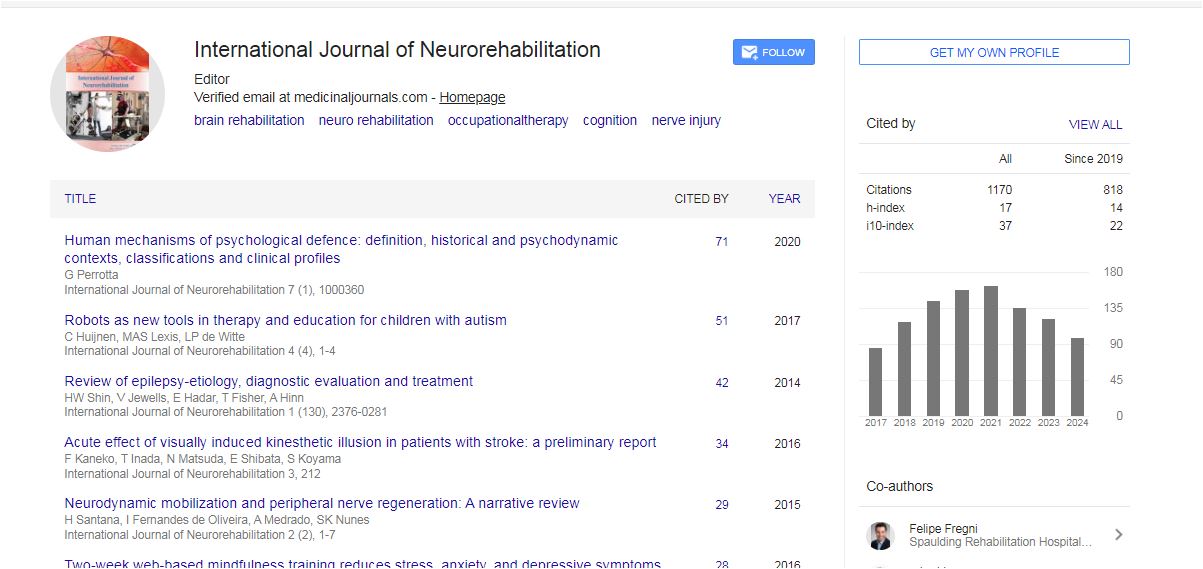
International Journal of Neurorehabilitation received 1078 citations as per Google Scholar report