Perspective - (2025) Volume 8, Issue 4
Received: 28-Nov-2025, Manuscript No. pollution-25-176628;
Editor assigned: 01-Dec-2025, Pre QC No. P-176628;
Reviewed: 15-Dec-2025, QC No. Q-176628;
Revised: 22-Dec-2025, Manuscript No. R-176628;
Published:
29-Dec-2025
, DOI: 10.37421/2684-4958.2025.8.397
Citation: Haruka, Sato,. Synthetic Fibers: Benefits, Challenges, and Sustainability. Pollution 08 (2025):397.
Copyright: © 2025 Haruka S. This is an open-access article distributed under the terms of the Creative Commons Attribution License, which permits unrestricted use,
distribution and reproduction in any medium, provided the original author and source are credited.
This review delves into how synthetic textile fibers contribute significantly to microplastic pollution in freshwater ecosystems. It outlines the sources, transport mechanisms, and ecological impacts of these fibers, highlighting their pervasive presence and the urgent need for mitigation strategies to protect aquatic biodiversity and human health. Understanding their sources, transport, and ecological impacts is crucial for developing effective mitigation strategies to protect aquatic biodiversity[1].
This article offers a thorough review of advanced functional synthetic fibers, emphasizing their growing importance in biomedical fields. It covers various applications, from tissue engineering scaffolds to drug delivery systems, illustrating how tailored properties of these fibers enable innovative solutions for medical challenges. Tailored properties enable innovative solutions for medical challenges, from tissue engineering to drug delivery, highlighting their growing importance[2].
This review explores the critical challenge of synthetic textile waste by examining current recycling technologies and future prospects. It highlights various methods, from mechanical to chemical recycling, crucial for reducing environmental impact and promoting a circular economy within the textile industry. Various recycling methods, including mechanical and chemical, are vital for reducing environmental impact and promoting a circular economy within the textile industry[3].
This article reviews the latest breakthroughs in high-performance synthetic fibers, showcasing their enhanced properties and diverse applications across industries. It discusses how innovations in material science are pushing the boundaries of strength, durability, and functionality for these advanced fibrous materials. Innovations in material science continue to push the boundaries of strength, durability, and functionality, leading to diverse applications across industries[4].
This review provides an overview of advanced smart textile fibers, many of which are synthetic, and their wide-ranging applications. It explores how these fibers integrate sensing, actuation, and communication capabilities, transforming textiles into interactive and functional materials for areas like healthcare, sports, and fashion. These fibers integrate sensing, actuation, and communication, transforming textiles into interactive materials for healthcare, sports, and fashion[5].
This review focuses on the utility of synthetic fibers as versatile scaffolds in tissue engineering. It discusses how their tunable mechanical properties, biocompatibility, and degradation rates can be engineered to mimic natural extracellular matrices, supporting cell growth and tissue regeneration for various medical applications. Their tunable mechanical properties, biocompatibility, and degradation rates mimic natural extracellular matrices, supporting cell growth and tissue regeneration[6].
This review addresses the crucial topic of synthetic fiber biodegradation within environmental systems. It synthesizes current research on how various synthetic fibers interact with biological agents in different environments, offering insights into their degradation pathways and informing strategies to mitigate plastic pollution. Research on their degradation pathways in various environments informs strategies to mitigate plastic pollution and develop more sustainable materials[7].
This article reviews the ongoing developments in antibacterial textile fibers, including a significant portion of synthetic types, focusing on their use in healthcare. It covers various strategies for imparting antimicrobial properties, essential for reducing infections and enhancing hygiene in medical settings and beyond. Strategies for imparting antimicrobial properties are essential for reducing infections and enhancing hygiene in medical settings and beyond[8].
This review discusses the emerging field of 3D printing for polymer fiber-reinforced composites, which heavily relies on synthetic fibers. It highlights how additive manufacturing techniques enable the creation of complex geometries with enhanced mechanical properties, opening new avenues for customized and high-performance materials in various sectors. Additive manufacturing enables complex geometries with enhanced mechanical properties, opening new avenues for customized and high-performance materials[9].
This article reviews recent progress in polymer optical fibers (POFs), primarily synthetic, for diverse sensing applications. It showcases their advantages like flexibility, cost-effectiveness, and biocompatibility, making them ideal for temperature, strain, and chemical sensing in harsh environments and biomedical fields. Their advantages, such as flexibility, cost-effectiveness, and biocompatibility, make them ideal for temperature, strain, and chemical sensing in diverse fields[10].
Synthetic textile fibers are a major concern due to their significant contribution to microplastic pollution, especially in freshwater ecosystems. Research highlights the pervasive presence of these fibers, outlining their various sources, transport mechanisms, and the profound ecological impacts they exert, necessitating urgent mitigation strategies to safeguard aquatic biodiversity and human well-being [1]. Understanding the environmental fate of these materials is crucial; biodegradation of synthetic fibers within complex environmental systems is a critical area of study. Current research explores how different synthetic fiber types interact with biological agents across diverse settings, providing essential insights into their degradation pathways and informing proactive strategies to combat plastic pollution effectively [7].
Beyond environmental concerns, synthetic fibers are pivotal in advanced applications, particularly in biomedical fields. These advanced functional synthetic fibers are increasingly vital, finding applications in areas ranging from sophisticated tissue engineering scaffolds to innovative drug delivery systems. The capacity to tailor the intrinsic properties of these fibers is instrumental in developing novel solutions for complex medical challenges [2]. As scaffolds for tissue engineering, synthetic fibers offer remarkable versatility. Their mechanical properties, biocompatibility, and degradation rates can be precisely engineered to closely mimic natural extracellular matrices, thereby effectively supporting cell growth and promoting robust tissue regeneration for various therapeutic and reconstructive medical applications [6]. Furthermore, the continuous development of antibacterial textile fibers, which largely include synthetic varieties, focuses on their application in healthcare. Different strategies are being employed to imbue these textiles with antimicrobial properties, which are essential for minimizing infection risks and significantly enhancing hygiene in clinical environments and broader public use [8].
The realm of high-performance synthetic fibers is witnessing continuous breakthroughs, manifesting in enhanced material properties and diverse industrial applications. Innovations stemming from material science are consistently pushing the boundaries of what is achievable in terms of strength, durability, and multi-functionality for these cutting-edge fibrous materials [4]. Moreover, advanced smart textile fibers, many of which are synthetic, are transforming the textile industry. These materials seamlessly integrate sensing, actuation, and communication capabilities, thereby converting traditional textiles into interactive and highly functional materials suitable for critical areas such as healthcare monitoring, performance optimization in sports, and next-generation fashion [5]. Similarly, polymer optical fibers (POFs), predominantly synthetic, have shown significant progress in a multitude of sensing applications. Their inherent advantages like exceptional flexibility, cost-effectiveness, and biocompatibility position them as ideal candidates for precise temperature, strain, and chemical sensing, not only in harsh industrial environments but also within sensitive biomedical contexts [10].
Addressing the critical challenge of synthetic textile waste is paramount for sustainability, leading to extensive research into current recycling technologies and future prospects. This field investigates a spectrum of methods, from mechanical processes to more advanced chemical recycling techniques, all of which are vital for mitigating environmental impact and fostering a robust circular economy within the textile industry [3]. Additionally, the emerging application of 3D printing for polymer fiber-reinforced composites heavily relies on the unique characteristics of synthetic fibers. These additive manufacturing techniques facilitate the creation of complex geometries endowed with superior mechanical properties, thereby unlocking new possibilities for customized and high-performance materials across diverse industrial sectors, including aerospace, automotive, and consumer electronics [9].
Synthetic fibers are integral to numerous modern applications while also presenting significant environmental challenges. They contribute substantially to microplastic pollution in freshwater ecosystems, with research highlighting their sources, transport, and ecological impacts, emphasizing the urgent need for mitigation strategies and a deeper understanding of their biodegradation within environmental systems. Conversely, these fibers are crucial for groundbreaking advancements in biomedical fields. They serve as advanced functional materials for tissue engineering scaffolds, drug delivery systems, and antibacterial textiles, offering innovative solutions for medical challenges by leveraging their tunable mechanical properties and biocompatibility. Innovations extend to high-performance synthetic fibers with enhanced strength and durability, and smart textile fibers that integrate sensing and communication for healthcare, sports, and fashion. Polymer Optical Fibers are also advancing diverse sensing applications due to their flexibility and cost-effectiveness. Addressing the environmental footprint, recycling synthetic textile waste is a critical area, with reviews exploring mechanical and chemical technologies essential for a circular economy. Furthermore, 3D printing of polymer fiber-reinforced composites showcases new manufacturing capabilities for customized, high-performance materials. The collective body of work underscores synthetic fibers' dual nature: their vast utility balanced against the imperative for sustainable management and environmental protection.
None
None
Mandeep KS, Amisha T, Sumit G. "Microplastic contamination of freshwater environments: A review of synthetic fibers from textiles and their ecological implications".Sci Total Environ 893 (2023):164807.
Indexed at, Google Scholar, Crossref
Long C, Yan Z, Yongsheng W. "Advanced functional synthetic fibers for biomedical applications: A comprehensive review".Bioact Mater 27 (2023):263-289.
Indexed at, Google Scholar, Crossref
A S, S S, V S. "Recycling of synthetic textile waste: A review of current technologies and future outlook".J Polym Environ 29 (2021):3617-3635.
Indexed at, Google Scholar, Crossref
Yicheng W, Bin Z, Liu Y. "Recent advances in high-performance synthetic fibers and their applications".Mater Sci Eng R Rep 156 (2024):100762.
Indexed at, Google Scholar, Crossref
Adil F, Tanveer H, Muhammad A. "Advanced Smart Textile Fibers and Applications: A Review".Polymers (Basel) 14 (2022):5450.
Indexed at, Google Scholar, Crossref
Muhammad A, Tanveer H, Faheem A. "Synthetic Fibers as Scaffolds for Tissue Engineering: A Review".J Funct Biomater 14 (2023):147.
Indexed at, Google Scholar, Crossref
Mengying Z, Li R, Jing W. "Biodegradation of synthetic fibers in environmental systems: A review".Environ Pollut 314 (2022):120286.
Indexed at, Google Scholar, Crossref
Samit B, Saumya S, Asis G. "Current Trends in Antibacterial Textile Fibers and Their Applications in Healthcare".ACS Omega 8 (2023):15995-16016.
Indexed at, Google Scholar, Crossref
Mohammad P, Mohammad K, H. RB. "3D Printing of Polymer Fiber-Reinforced Composites".Polymers (Basel) 13 (2021):4127.
Indexed at, Google Scholar, Crossref
Bo S, Xiaochun H, Peng L. "Recent advances in polymer optical fibers for sensing applications".Sensors (Basel) 21 (2021):7653.
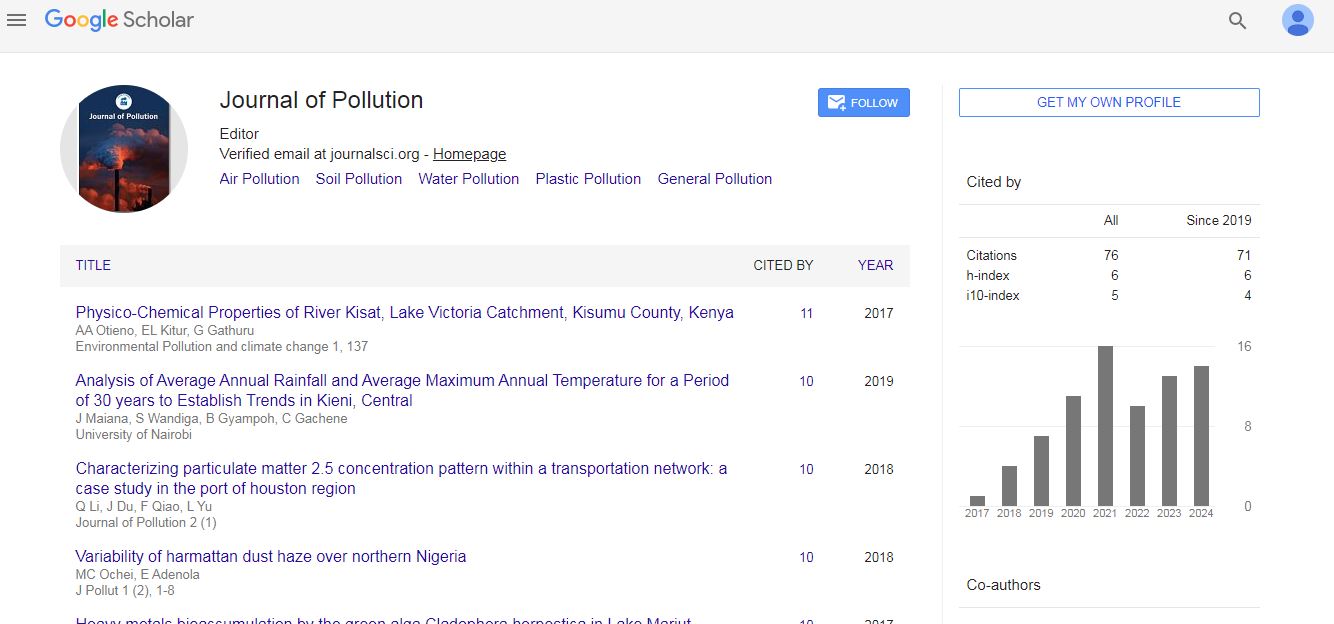
Journal of Pollution received 64 citations as per Google Scholar report