Commentary - (2025) Volume 13, Issue 4
Received: 04-Aug-2025, Manuscript No. jcdd-25-176813;
Editor assigned: 06-Aug-2025, Pre QC No. P-176813;
Reviewed: 20-Aug-2025, QC No. Q-176813;
Revised: 25-Aug-2025, Manuscript No. R-176813;
Published:
01-Sep-2025
, DOI: 10.37421/2329-9517.2025.13.682
Citation: Keller, Johanna. ”Stent Technologies: Advancements,
Applications, Patient Outcomes.” J Cardiovasc Dis Diagn 13 (2025):682.
Copyright: © 2025 Keller J. This is an open-access article distributed under the terms of the Creative Commons Attribution License, which permits unrestricted use, distribution
and reproduction in any medium, provided the original author and source are credited.
Medical science often relies on specialized devices to manage various conditions, with stents playing a pivotal role in restoring function and alleviating symptoms across numerous bodily systems. The evolution of these devices continues to enhance patient outcomes, offering solutions for complex vascular, gastrointestinal, and respiratory issues. For instance, advancements in second-generation Drug-Eluting Stents (DES) have dramatically improved outcomes for coronary artery disease (CAD) patients, significantly reducing issues like restenosis and stent thrombosis compared to older designs, signaling ongoing innovation in percutaneous coronary intervention (PCI) [1].
These developments include biodegradable polymers and novel drug coatings, consistently aiming to optimize results. Similarly, contemporary strategies for peripheral artery disease (PAD) frequently involve endovascular interventions, such as stent placement, crucial for revascularization, symptom relief, and preventing limb loss, especially in critical limb ischemia cases. Research into advanced stent designs for PAD continues, focused on improving long-term vessel patency and clinical success [2].
Beyond cardiovascular applications, stents are essential in managing obstructions and complications in other anatomical sites. Endoscopic biliary stent placement, a common procedure for biliary obstructions, carries risks of complications like post-ERCP pancreatitis, cholangitis, stent migration, and occlusion. Identifying risk factors and implementing preventive measures are vital for safer clinical outcomes [3].
Patients with ureteral stents often experience discomfort, prompting research into pharmacological and non-pharmacological strategies to alleviate pain, urgency, and frequency. Future advancements in stent materials and designs, including drug-eluting and bioresorbable options, look to minimize patient morbidity and enhance life quality post-insertion [4].
Esophageal stent placement addresses conditions like strictures, leaks, and fistulas, with technology evolving through self-expanding metal stents (SEMS) and plastic stents to optimize therapeutic results. Patient selection and procedural techniques are key considerations for success [5].
Cerebral Venous Sinus Stenting (CVSS) has emerged as a therapeutic option for carefully selected patients with idiopathic intracranial hypertension (IIH) linked to venous sinus stenosis. This procedure aims to lower intracranial pressure and ease IIH symptoms, though associated risks are always part of the discussion [6].
In cardiovascular intervention, Transcatheter Aortic Valve Implantation (TAVI) involves both self-expanding and balloon-expandable stents. A comprehensive review of current evidence evaluates their performance, highlighting the importance of tailoring device selection to individual patient factors for optimal procedural success and long-term durability [7].
Another critical area is carotid artery stenosis, where Carotid Artery Stenting (CAS) is compared against endarterectomy. A systematic review and meta-analysis assess the relative risks and benefits, including periprocedural stroke and myocardial infarction, emphasizing individualized treatment decisions based on patient risks and operator expertise [8].
Airway stents are crucial for managing malignant and benign tracheobronchial obstructions, using various metallic and silicone designs. The techniques and potential complications, along with their management, are significant for improving symptoms and quality of life for patients with severe respiratory compromise [9].
The broader landscape of Drug-Eluting Stents (DES) continues its rapid evolution, with discussions in 2023 highlighting continuous innovation from early generations to current bioresorbable scaffolds and next-generation designs. Ongoing advancements in polymer-free, ultrathin-strut, and drug-coated balloon technologies aim to further optimize outcomes in percutaneous coronary intervention [10].
This extensive use and ongoing development underscore the critical role of stents in modern medicine.
Stent technologies represent a cornerstone in contemporary medical interventions, addressing a wide array of conditions across various organ systems. For cardiovascular diseases, Drug-Eluting Stents (DES) have revolutionized the treatment of coronary artery disease (CAD), particularly second-generation designs. These stents, featuring advanced materials like biodegradable polymers and innovative drug coatings, have demonstrably reduced rates of restenosis and stent thrombosis, leading to improved long-term patient outcomes compared to their predecessors [1]. The ongoing evolution of DES technology, including polymer-free designs and ultrathin-strut stents, continues to push the boundaries of percutaneous coronary intervention (PCI), aiming for superior biocompatibility and minimized adverse events [10]. Beyond coronary applications, endovascular interventions, specifically stent placement, are critical in managing peripheral artery disease (PAD). These procedures are vital for restoring blood flow, alleviating debilitating symptoms, and preventing severe complications such as limb loss, particularly in cases of critical limb ischemia. Research consistently seeks to refine stent designs to enhance long-term vessel patency and clinical efficacy in PAD [2]. Furthermore, Transcatheter Aortic Valve Implantation (TAVI) utilizes both self-expanding and balloon-expandable stents, each with distinct advantages depending on patient anatomy and clinical presentation. A careful, individualized approach to device selection is paramount for maximizing procedural success and durability [7]. Carotid artery stenosis also benefits from stent intervention. Carotid Artery Stenting (CAS) is a debated alternative to endarterectomy, with systematic reviews comparing their respective risks of periprocedural complications like stroke and myocardial infarction, emphasizing the need for patient-specific treatment plans and high operator expertise [8].
Stent applications extend significantly into gastrointestinal and genitourinary systems, where they manage obstructions and related complications. Endoscopic biliary stent placement, for instance, is a routine procedure for biliary obstructions but can lead to issues such as post-ERCP pancreatitis, cholangitis, stent migration, and occlusion. Effective management hinges on recognizing risk factors and employing preventive strategies to ensure safer patient outcomes [3]. Similarly, esophageal stents are indispensable for treating benign and malignant conditions, including strictures, leaks, and fistulas. The choice between self-expanding metal stents (SEMS) and plastic stents, alongside meticulous procedural techniques, is crucial for optimal therapeutic results [5]. In the genitourinary tract, ureteral stent placement frequently causes patient discomfort. Researchers are actively exploring pharmacological and non-pharmacological methods to alleviate symptoms like pain and urinary urgency. Advances in stent materials, such as drug-eluting and bioresorbable designs, aim to significantly reduce patient morbidity and improve their overall quality of life after stent insertion [4].
The utility of stents also spans neurological and respiratory contexts. Cerebral Venous Sinus Stenting (CVSS) serves as a specialized therapeutic option for select patients suffering from idiopathic intracranial hypertension (IIH) associated with venous sinus stenosis. This intervention effectively lowers intracranial pressure and mitigates IIH-related symptoms, with patient selection and an understanding of potential risks being key to successful treatment [6]. For the respiratory system, airway stent placement is vital for managing both malignant and benign tracheobronchial obstructions. A variety of stent types, including metallic and silicone designs, are deployed based on specific indications, with attention paid to placement techniques and the prevention or management of complications. This approach significantly enhances symptom relief and improves the quality of life for individuals experiencing severe respiratory compromise [9].
Overall, the broad application of stent technologies underscores their versatility and essential role in modern interventional medicine. Continuous innovation in materials, designs, and deployment techniques aims to address ongoing challenges, minimize patient discomfort, and expand therapeutic possibilities, reinforcing stents as a dynamic and evolving field within healthcare. From complex cardiovascular interventions to delicate neurological procedures, and from managing gastrointestinal obstructions to alleviating respiratory distress, stents offer targeted solutions that profoundly impact patient care and prognosis. These continuous advancements reflect a commitment to optimizing therapeutic outcomes and improving patient experiences globally.
This dataset provides a comprehensive overview of stent technologies and their diverse applications across various medical specialties. It highlights significant advancements in second-generation Drug-Eluting Stents (DES) for coronary artery disease, which have improved patient outcomes by reducing restenosis and thrombosis. The data also covers endovascular interventions for peripheral artery disease, emphasizing the role of stents in restoring blood flow and preventing limb loss. Stent placements in non-vascular systems are thoroughly discussed, including endoscopic biliary stents, with a focus on managing complications like pancreatitis and migration, and esophageal stents for strictures and fistulas, detailing technical considerations and complications. The collection further explores strategies for managing symptoms associated with ureteral stents, including future innovations in drug-eluting and bioresorbable designs to enhance patient comfort. Cerebral Venous Sinus Stenting (CVSS) is presented as a treatment for idiopathic intracranial hypertension, outlining patient selection and efficacy. Comparative analyses feature Transcatheter Aortic Valve Implantation (TAVI) stents (self-expanding vs. balloon-expandable) and Carotid Artery Stenting (CAS) versus endarterectomy, underscoring individualized treatment decisions. Finally, airway stent placement for tracheobronchial obstructions is detailed, addressing various stent types and complication management. The overall narrative emphasizes continuous innovation in stent materials, designs, and procedural techniques aimed at optimizing clinical outcomes and improving patient quality of life across diverse medical conditions.
Indexed at, Google Scholar, Crossref
Indexed at, Google Scholar, Crossref
Indexed at, Google Scholar, Crossref
Indexed at, Google Scholar, Crossref
Indexed at, Google Scholar, Crossref
Indexed at, Google Scholar, Crossref
Indexed at, Google Scholar, Crossref
Indexed at, Google Scholar, Crossref
Indexed at, Google Scholar, Crossref
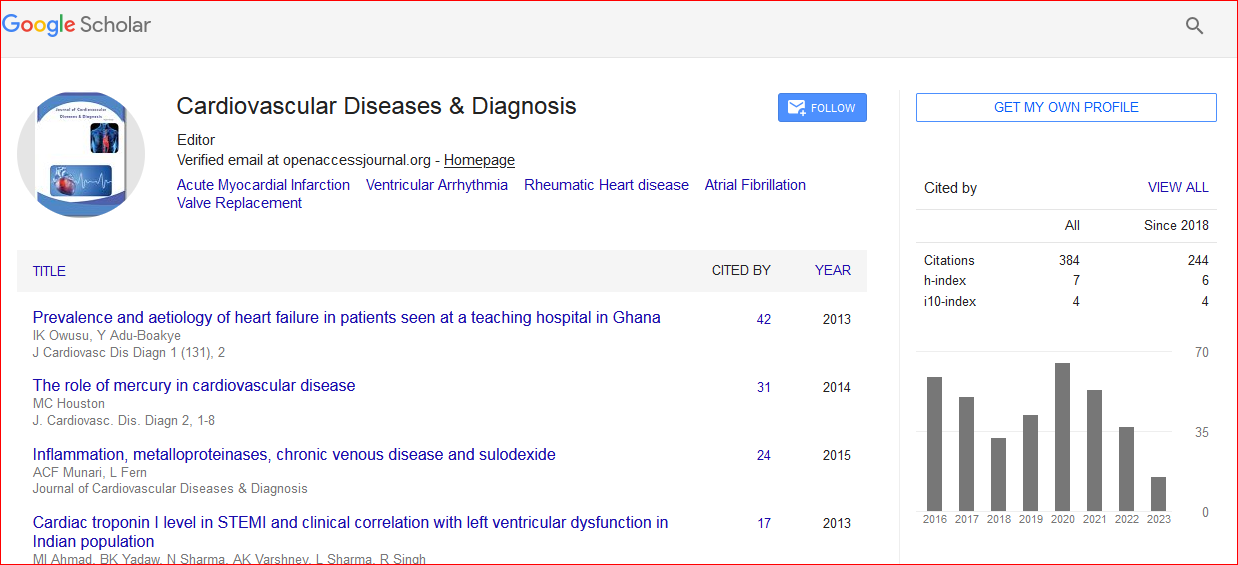
Cardiovascular Diseases & Diagnosis received 427 citations as per Google Scholar report