Commentary - (2025) Volume 11, Issue 5
Received: 01-Oct-2025, Manuscript No. jssc-26-188311;
Editor assigned: 03-Oct-2025, Pre QC No. P-188311;
Reviewed: 17-Oct-2025, QC No. Q-188311;
Revised: 22-Oct-2025, Manuscript No. R-188311;
Published:
29-Oct-2025
, DOI: 10.37421/2472-0437.2025.11.321
Citation: Pereira, Joao. ”Steel Structures Behavior Under Fire:
Research Insights.” J Steel Struct Constr 11 (2025):321.
Copyright: © 2025 Pereira J. This is an open-access article distributed under the terms of the Creative Commons Attribution License, which permits unrestricted use,
distribution and reproduction in any medium, provided the original author and source are credited.
The thermal behavior of steel structures under elevated temperatures, particularly in fire scenarios, is a critical area of research for ensuring structural safety and performance. This field delves into the complex thermomechanical response of steel members, exploring how heat affects their mechanical properties and load-bearing capacities. Understanding these effects is paramount for accurate structural analysis and robust design, necessitating the consideration of transient thermal gradients and material degradation during fire events. Advanced modeling techniques are being developed to predict fire-induced deformations and potential collapse mechanisms, aiming to enhance the resilience of steel structures [1].
The buckling behavior of steel columns is significantly influenced by high temperatures. Studies investigate this phenomenon through numerical simulations and experimental validation, demonstrating how reduced stiffness and strength at elevated temperatures impact critical buckling loads. These insights are crucial for performance-based fire design of steel column systems, ensuring their stability under fire conditions [2].
Steel beams are also susceptible to thermal loads in fire scenarios. Research focuses on analyzing the impact of temperature on bending stiffness and moment capacity. This has led to the development of advanced composite sections designed to improve fire performance and prevent premature failure through enhanced heat dissipation and structural integrity [3].
The effectiveness of passive fire protection systems for steel structures is a vital aspect of fire safety engineering. Experimental results on the thermal insulation provided by intumescent coatings and fire-resistant boards showcase their ability to extend the critical fire exposure time, thereby maintaining structural stability under extreme thermal conditions [4].
Progressive collapse behavior of steel-framed structures under fire loading is another significant area of concern. Advanced finite element analysis is employed to simulate sequential element failure, identify critical failure modes, and understand load redistribution mechanisms. The findings from such studies provide valuable data for designing robust steel structures capable of resisting progressive collapse during fire events [5].
The high-temperature mechanical properties of various steel grades used in construction are essential for accurate structural analysis. Experimental data on yield strength, tensile strength, and elastic modulus at elevated temperatures are crucial material parameters for reliable thermal and structural analysis of steel elements exposed to fire [6].
Assessing the fire resistance of steel connections requires specialized approaches. A combination of analytical modeling and experimental tests is used to evaluate thermal-induced forces and deformations in bolted and welded connections. This research offers guidelines for designing fire-safe connections within steel structures [7].
The behavior of steel-composite beams under transient thermal loads, such as those in a fire, is also under investigation. Studies examine the interaction between steel and concrete components at elevated temperatures and its effect on overall load-carrying capacity, providing insights for the design of efficient and safe composite structures [8].
A parametric study on the fire resistance of steel-framed multi-story buildings analyzes the influence of various design parameters, including structural system type, member dimensions, and fire protection levels. This helps in understanding the building's overall fire performance and its ability to maintain structural integrity over time [9].
Advanced computational tools are increasingly utilized for simulating the behavior of steel structures under thermal loads. The application of non-linear finite element analysis and advanced material models allows for the capture of complex thermomechanical responses, forming a basis for more reliable fire safety engineering [10].
The thermal behavior of steel structures under fire conditions is a complex phenomenon involving significant changes in material properties and structural response. Research, such as that focusing on the thermal analysis and structural response of steel members under fire conditions, investigates how elevated temperatures affect mechanical properties and load-bearing capacity. This work highlights the importance of transient thermal gradients and material degradation in structural analysis and design, proposing advanced modeling techniques to predict fire-induced deformations and potential collapse mechanisms [1].
In parallel, the buckling behavior of steel columns under high temperatures is examined through experimental and numerical investigations. These studies demonstrate how reduced stiffness and strength at elevated temperatures critically influence buckling loads, offering valuable insights for performance-based fire design of steel column systems [2].
Similarly, the behavior of steel beams subjected to thermal loads during fires is a key research area. Analysis of temperature's impact on bending stiffness and moment capacity has driven the development of advanced composite sections aimed at enhancing fire performance and preventing premature failure through improved heat dissipation and structural integrity [3].
The effectiveness of passive fire protection systems for steel structures is evaluated through experimental results. Studies on intumescent coatings and fire-resistant boards show their ability to extend the critical fire exposure time, thus maintaining structural stability under extreme thermal conditions [4].
Furthermore, the progressive collapse behavior of steel-framed structures under fire loading is analyzed using advanced finite element analysis. This approach simulates sequential element failure, identifies critical failure modes, and clarifies load redistribution mechanisms, providing data for designing robust structures resistant to progressive collapse [5].
The high-temperature mechanical properties of structural steels are a fundamental aspect of fire design. Experimental data on yield strength, tensile strength, and elastic modulus at elevated temperatures offer essential material parameters for accurate thermal and structural analysis of steel elements under fire exposure [6].
Assessing the fire resistance of steel connections involves both numerical and experimental studies. This research evaluates thermal-induced forces and deformations in bolted and welded connections, providing guidelines for designing fire-safe connections in steel structures [7].
The behavior of steel-composite beams under transient thermal loads, like those in fires, is explored by examining the interaction between steel and concrete components at elevated temperatures. This analysis influences the overall load-carrying capacity and provides insights for designing safe composite structures [8].
Parametric studies on the fire resistance of steel-framed multi-story buildings analyze the impact of various design parameters, such as structural system type, member dimensions, and fire protection levels. These studies assess the overall fire performance and the ability to maintain structural integrity over time [9].
Finally, the application of advanced computational tools for simulating steel structures under thermal loads is reviewed. The use of non-linear finite element analysis and sophisticated material models captures complex thermomechanical responses, forming a foundation for more reliable fire safety engineering [10].
This collection of research focuses on the behavior of steel structures under fire conditions. It covers the thermal analysis of steel members, the buckling of steel columns, and the performance of steel beams at elevated temperatures. The effectiveness of fire protection systems, the risk of progressive collapse, and the high-temperature mechanical properties of steel are also investigated. Furthermore, the studies address the fire resistance of steel connections and composite beams, as well as the fire performance of multi-story steel buildings. Advanced computational modeling techniques are highlighted as crucial tools for simulating these complex thermomechanical responses and improving fire safety engineering for steel structures.
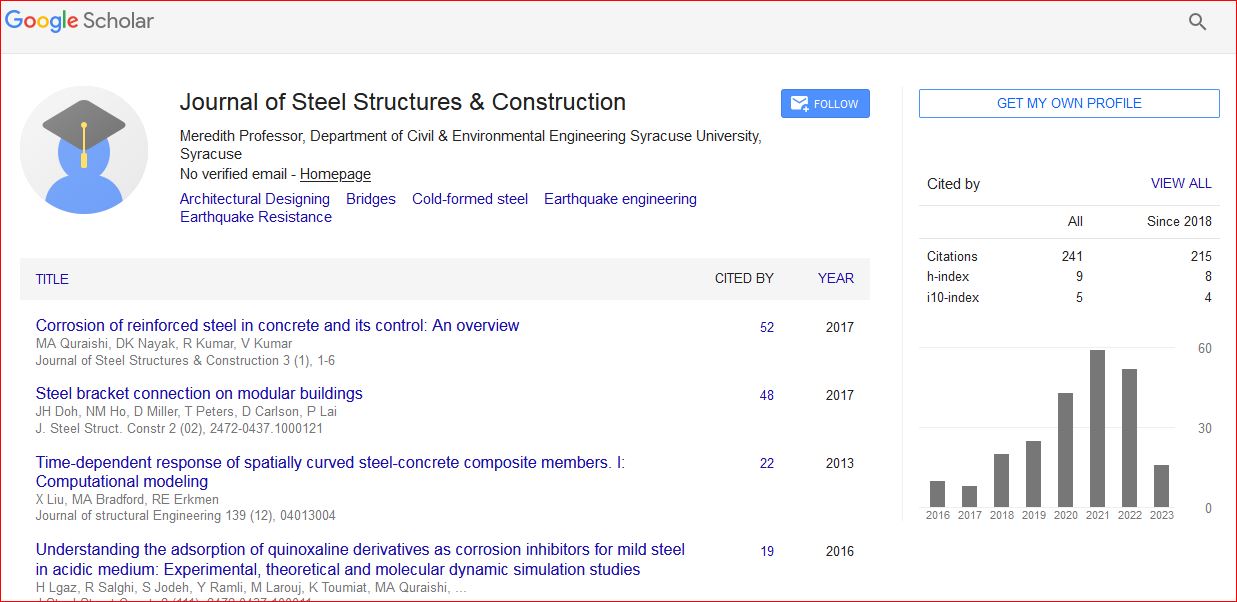
Journal of Steel Structures & Construction received 583 citations as per Google Scholar report