Commentary - (2025) Volume 11, Issue 6
Received: 01-Dec-2025, Manuscript No. jssc-26-188335;
Editor assigned: 03-Dec-2025, Pre QC No. P-188335;
Reviewed: 17-Dec-2025, QC No. Q-188335;
Revised: 22-Dec-2025, Manuscript No. R-188335;
Published:
29-Dec-2025
, DOI: 10.37421/2472-0437.2025.11.333
Citation: Rahman, Noor. ”Steel Frame Seismic Resilience: Performance,
Design, and Durability.” J Steel Struct Constr 11 (2025):333.
Copyright: © 2025 Rahman N. This is an open-access article distributed under the terms of the Creative Commons Attribution License, which permits unrestricted use,
distribution and reproduction in any medium, provided the original author and source are credited.
The seismic performance of steel frames is a critical area of structural engineering, with numerous studies focusing on various aspects of their behavior under dynamic loads. One significant aspect is the configuration of bracing systems, where different arrangements and types of bracing have been investigated for their impact on lateral stiffness, strength, and ductility, ultimately influencing the structure's resilience to earthquake-induced forces. Optimizing bracing design is therefore essential for enhancing seismic resilience in steel buildings [1].
In parallel, the incorporation of damping devices, such as viscous dampers, has emerged as an effective strategy for improving the seismic response of multi-story steel frames. These devices can substantially reduce inter-story drifts and peak accelerations, thereby enhancing structural safety and minimizing damage during seismic events. Research in this area provides insights into the optimal placement and properties of viscous dampers for practical applications [2].
Beyond seismic considerations, steel frames also face challenges from wind loads, particularly aerodynamic effects. Understanding and quantifying the forces and moments induced by wind on different frame geometries is crucial, and design considerations must be implemented to mitigate potential instabilities and excessive deformations. It is important to consider wind effects beyond simple static pressure when designing tall steel structures [3].
The behavior of steel frames with semi-rigid connections under seismic excitations presents another complex area of study. The inherent flexibility of these connections can significantly alter the frame's dynamic response, potentially leading to larger displacements and different failure mechanisms compared to frames with rigid connections. This research provides valuable data for the design of steel frames with semi-rigid connections to ensure adequate seismic performance [4].
A more advanced approach to seismic design is performance-based seismic design, which focuses on achieving specific performance objectives under various earthquake hazard levels. This methodology involves evaluating and enhancing structural behavior to ensure both safety and serviceability, contributing to a more rational and efficient design process for seismic-resistant steel structures [5].
The stability of individual structural elements, such as columns, also plays a crucial role in the overall lateral behavior of steel frames. The influence of column buckling, which arises from the interaction between axial load and bending moments, can lead to reduced stiffness and strength, significantly affecting the frame's response to lateral loads. Careful consideration of second-order effects is therefore essential in the design of tall steel structures [6].
Furthermore, the presence of infill walls in steel frames can substantially alter their seismic vulnerability. The interaction between the steel frame and concrete infills influences load distribution and deformation patterns, potentially leading to brittle failure modes if not properly accounted for. These findings are vital for assessing and retrofitting existing steel structures with infill walls [7].
Base isolation systems offer another promising avenue for enhancing seismic resilience by decoupling the superstructure from ground motion. This significantly reduces seismic demands, lowering accelerations and displacements and thereby improving the overall seismic performance of steel frame structures. Guidance is provided on the application of base isolation for different types of steel frames [8].
The long-term durability of steel frames in seismic zones is also a concern, particularly regarding fatigue behavior under repeated cyclic lateral loads. Investigating cumulative damage effects and identifying critical locations susceptible to fatigue crack initiation and propagation is essential for ensuring the long-term safety and integrity of these structures [9].
Finally, the influence of shear yielding on the lateral response of steel frames is a critical factor, especially in shorter, stiffer frames. Shear deformation in beams and columns can become a significant contributor to premature failure if not adequately considered in structural analysis, highlighting the importance of accounting for shear effects in the design process [10].
The seismic performance of steel frames is extensively analyzed, with a particular focus on the impact of different bracing configurations. Studies reveal that the arrangement and type of bracing significantly influence a steel frame's lateral stiffness, strength, and ductility, directly affecting its capacity to withstand earthquake forces. Consequently, optimizing bracing design is paramount for enhancing the seismic resilience of steel buildings [1].
In parallel, the integration of viscous dampers has been explored as an effective means to improve the seismic response of multi-story steel frames. Research demonstrates that these devices can substantially reduce inter-story drifts and peak accelerations, leading to enhanced structural safety and diminished damage under seismic events. This work provides valuable insights into the optimal placement and characteristics of viscous dampers for practical implementation [2].
Beyond seismic threats, steel frames are also susceptible to wind loads, with aerodynamic effects posing a significant challenge. Computational analyses are employed to quantify the forces and moments generated by wind on various frame geometries, and design considerations are outlined to mitigate potential instabilities and excessive deformations. The importance of considering wind effects beyond static pressure is emphasized for tall steel structures [3].
The dynamic behavior of steel frames with semi-rigid connections subjected to seismic excitations is another area of significant investigation. The flexibility inherent in semi-rigid connections can notably alter the frame's response, potentially resulting in larger displacements and different failure patterns compared to frames with rigid connections. This research offers crucial data for designing steel frames with semi-rigid connections to achieve adequate seismic performance [4].
Performance-based seismic design offers a more sophisticated approach, concentrating on meeting specific performance objectives under diverse earthquake hazard levels. This methodology involves evaluating and enhancing the structural behavior to ensure safety and serviceability, thereby promoting a more rational and efficient design framework for seismically resistant steel structures [5].
The lateral behavior of steel frames is also influenced by the stability of individual columns, specifically the phenomenon of column buckling. The interplay between axial load and bending moments within columns can diminish stiffness and strength, thereby impacting the frame's reaction to lateral forces. Consequently, the careful consideration of second-order effects is indispensable in the design of tall steel structures [6].
The seismic vulnerability of steel frames can be significantly altered by the presence of concrete infills. The interaction between the steel frame and infill walls affects load distribution and deformation patterns, potentially leading to brittle failure modes if not adequately addressed. These findings are of paramount importance for the assessment and retrofitting of existing steel structures incorporating infill walls [7].
Base isolation systems represent a key strategy for mitigating seismic demands on steel frame structures. By decoupling the superstructure from ground motion, these systems significantly reduce accelerations and displacements, thereby bolstering seismic resilience. The research offers guidance for the application of base isolation across various types of steel frames [8].
Long-term structural integrity is addressed through the examination of fatigue behavior in steel frames subjected to repeated cyclic lateral loads, such as those experienced during earthquakes. This investigation focuses on cumulative damage effects and the identification of critical zones prone to fatigue crack initiation and propagation, which is essential for ensuring the longevity and safety of steel structures in seismically active regions [9].
Lastly, the influence of shear yielding on the lateral response of steel frames is analyzed. It is highlighted that shear deformation in beams and columns can become a critical factor, particularly in shorter, stiffer frames, potentially leading to premature failure if not properly accounted for in structural analysis. This research underscores the necessity of incorporating shear effects into the design process for steel frame structures [10].
This collection of research delves into the seismic resilience and overall structural performance of steel frames. Investigations cover a range of critical factors including the optimization of bracing configurations for enhanced stiffness and ductility, the effectiveness of viscous dampers in reducing seismic response, and the impact of aerodynamic forces from wind loads. The studies also explore the complexities introduced by semi-rigid connections, the application of performance-based seismic design, and the influence of column buckling and shear yielding on frame behavior. Furthermore, the role of concrete infills and the benefits of base isolation systems in mitigating seismic demands are examined. Finally, the long-term durability of steel frames is addressed through fatigue assessments under cyclic loading. Collectively, these efforts aim to provide comprehensive insights for designing safer, more resilient, and durable steel structures.
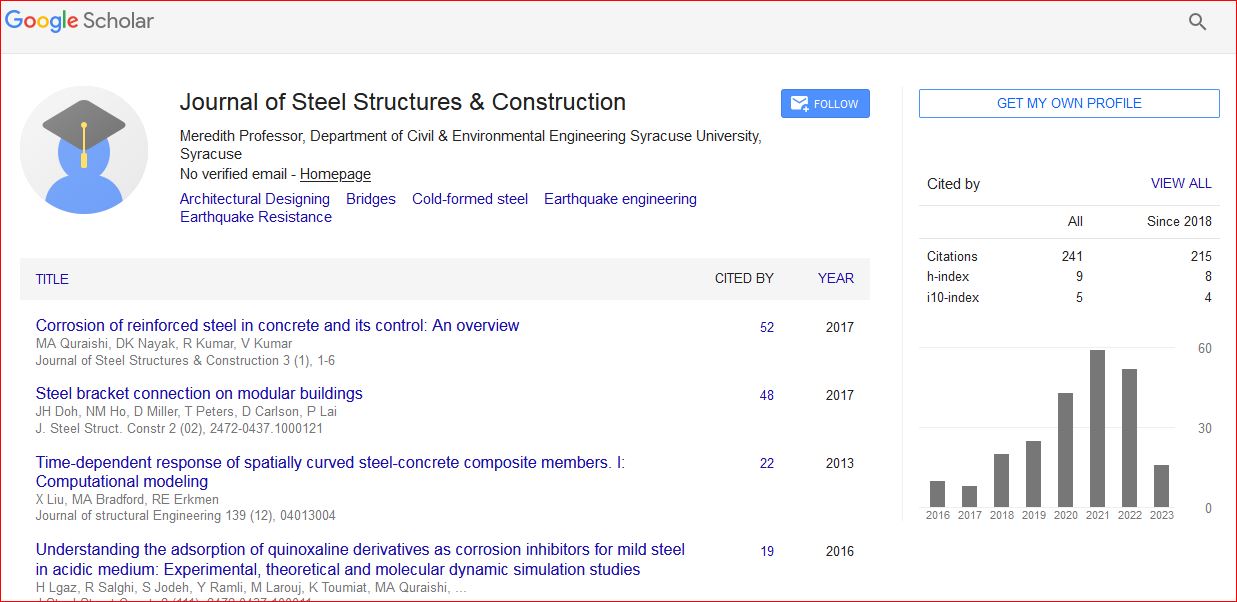
Journal of Steel Structures & Construction received 583 citations as per Google Scholar report